Square Tube Laser Cutting: Sizes, Wall Thickness, Corner Radius, V-Notches and Machine Choice
By Casper Geng, Sales Manager, PCL Group · Updated 2026-10-29
Short answer
- Square and rectangular tube fit the square chuck by their larger side: up to 240, 360 or 520 mm on the LT240, LT360 and LT520.
- Wall thickness sets the laser power: 1.5 kW to 3 mm walls, 3 kW to 6 mm, 6 kW to 10 mm and 12 kW above for production speed.
- The corner radius is about two to three times the wall on cold-formed tube, so holes and notches near a corner must allow for it.
- V-notches let one tube fold into a closed frame with a single weld; tab-and-slot joints locate parts without jigs.
On this page
- What square tube laser cutting covers
- Square tube sizes, chuck fit and laser power
- Laser power by wall thickness
- Corner radius and weld seam
- V-notches and folded frames
- Tab-and-slot joints, mitres and holes
- Laser, saw or punch for square tube?
- Which machine for square tube
- Checks on the first part
- Machines mentioned in this article
- FAQ
What square tube laser cutting covers
Square tube laser cutting is the processing of square and rectangular hollow sections on a CNC fiber laser tube cutter. The tube, also called square pipe, box section or SHS and RHS, is clamped in square chucks and turned face by face under the laser head, which cuts it to length and adds holes, slots, notches, mitres and joints on all four sides in one clamping. It is the most common job on a tube laser: furniture and fitness frames, racking, machine guards, trailers, handrails and steel structures are mostly built from square and rectangular tube.
In a fabrication shop the square tube laser cutting machine takes the place of the saw, the drill, the notching press and the marking table. Parts come off ready to bend, fit and weld, and a program written once cuts the same part next year without jigs.
Square tube sizes, chuck fit and laser power
The tables list common sizes with weight per metre, outer corner radius and the smallest LT model and laser power for each. Weights and radii are calculated from the EN 10219 corner profile for cold-formed tube; mill figures vary slightly. Power is the size for production speed, not the maximum it can cut.
Square hollow sections (SHS)
| Size, mm | kg/m (approx.) | Outer corner radius, mm | Smallest LT model | Laser power |
|---|---|---|---|---|
| 20 × 20 × 2 | 1.05 | 4 | LT240 | 1.5 kW |
| 25 × 25 × 2 | 1.36 | 4 | LT240 | 1.5 kW |
| 30 × 30 × 2 | 1.68 | 4 | LT240 | 1.5 kW |
| 40 × 40 × 3 | 3.30 | 6 | LT240 | 1.5 kW |
| 50 × 50 × 3 | 4.25 | 6 | LT240 | 1.5 kW |
| 60 × 60 × 4 | 6.71 | 8 | LT240 | 3 kW |
| 80 × 80 × 5 | 11.27 | 10 | LT240 | 3 kW |
| 100 × 100 × 5 | 14.41 | 10 | LT240 | 3 kW |
| 120 × 120 × 6 | 20.75 | 12 | LT240 | 3 kW |
| 150 × 150 × 8 | 33.95 | 20 | LT240 | 6 kW |
| 200 × 200 × 10 | 56.96 | 25 | LT240 | 6 kW |
| 250 × 250 × 10 | 72.66 | 25 | LT360 | 6 kW |
| 300 × 300 × 12 | 103.67 | 36 | LT360 | 12 kW |
| 400 × 400 × 16 | 184.30 | 48 | LT520 | 12 kW |
Rectangular hollow sections (RHS)
| Size, mm | kg/m (approx.) | Outer corner radius, mm | Smallest LT model | Laser power |
|---|---|---|---|---|
| 40 × 20 × 2 | 1.68 | 4 | LT240 | 1.5 kW |
| 50 × 30 × 3 | 3.30 | 6 | LT240 | 1.5 kW |
| 60 × 40 × 3 | 4.25 | 6 | LT240 | 1.5 kW |
| 80 × 40 × 4 | 6.71 | 8 | LT240 | 3 kW |
| 100 × 50 × 4 | 8.59 | 8 | LT240 | 3 kW |
| 120 × 60 × 5 | 12.84 | 10 | LT240 | 3 kW |
| 150 × 100 × 6 | 21.69 | 12 | LT240 | 3 kW |
| 200 × 100 × 8 | 33.95 | 20 | LT240 | 6 kW |
| 250 × 150 × 10 | 56.96 | 25 | LT360 | 6 kW |
| 300 × 200 × 10 | 72.66 | 25 | LT360 | 6 kW |
| 400 × 200 × 12 | 103.67 | 36 | LT520 | 12 kW |
| 500 × 300 × 16 | 184.30 | 48 | LT520 | 12 kW |
Imperial tube follows the same rules: 2 × 2 in (51 mm) and 4 × 4 in (102 mm) tube fit the LT240; 10 × 10 in (254 mm) needs the LT360. Sections larger than 520 mm go on the H-beam laser cutting machine or the HFT laser.
Laser power by wall thickness
| Laser power | Max carbon steel | Max stainless | Typical square tube work |
|---|---|---|---|
| 1.5 kW | 12 mm | 5 mm | Furniture, fitness, shelving: walls 1-3 mm |
| 3 kW | 20 mm | 8 mm | Machine frames, trailers: walls 3-6 mm |
| 6 kW | 22 mm | 14 mm | Structural box section: walls 6-10 mm |
| 12 kW | 35 mm | 25 mm | Heavy RHS and fast production on thick walls |
Figures from the fiber laser cutting speed chart. On thin galvanized and stainless tube, nitrogen gives a bright, oxide-free edge ready for welding; on carbon steel above about 4 mm, oxygen is faster and cheaper.
Corner radius and weld seam
Two features of square tube change how parts are programmed:
- Corner radius. Under EN 10219-2 the outer corner of cold-formed tube is about 1.6-2.4 times the wall for walls up to 6 mm, 2.0-3.0 times up to 10 mm and 2.4-3.6 times above. A hole or slot that runs into the radius is cut on a curved surface and comes out distorted. Keep holes at least the corner radius plus the hole radius from the edge, or let the software wrap the contour around the corner.
- Weld seam. Welded tube has an internal seam bead on one face. A hole or notch that crosses it, or a part that must slide over another tube, needs the seam on a known face. The software can be told which face carries the seam, and parts are loaded the same way round.
- Twist and bow. EN 10219 and ASTM A500 allow tube to twist and bow along its length. Self-centring chucks and supports near the cut hold the section square to the head; on long bars the three-chuck LT3 adds a middle chuck.
V-notches and folded frames
A V-notch cut through three faces of the tube leaves the fourth face as a hinge. Bend the tube at the notch and the cut faces close into a mitred corner. Four notches turn one length of tube into a closed rectangular frame with a single weld, instead of four separate mitred pieces and four welds.
- 90° corner: notch angle 90°, cut through three faces, leaving the inner wall to bend.
- Other angles: the notch angle equals 180° minus the frame angle; a 120° corner needs a 60° notch.
- Bend allowance: the hinge face stretches slightly; the software adds the allowance so the frame closes to size. How this is set up in the program is covered in CNC tube cutting software.
Tab-and-slot joints, mitres and holes
| Feature | Use | Programming note |
|---|---|---|
| Tab and slot | One tube locates in another without jigs | Slot = tab width plus 0.1-0.2 mm clearance |
| 45° mitre | Picture-frame corners | Common-line cut saves material between parts |
| Fish-mouth on square tube | Square tube meeting round tube | Cut from the 3D model |
| Bolt and pin holes | Assembly, hinges, adjustment | Hole diameter not below wall thickness |
| Slot rows | Racking uprights, adjustable supports | Pitch changed in the program, not with a die |
| Marks and part numbers | Assembly order | Laser marking at low power |
Laser, saw or punch for square tube?
| Tube laser | Saw plus drill | Notching press and punch | |
|---|---|---|---|
| Holes and slots on all faces | One clamping | Turn and re-clamp for each face | Tooling per shape |
| V-notches and mitres | Any angle | Mitre only | Fixed angles |
| New part | New program | New stops and marking | New dies |
| Thin stainless tube | Clean, no burr | Burr, deburring needed | Possible deformation |
| Best for | Varied parts, frames, small to large batches | Plain cut-to-length | Very high volume of one shape |
Which machine for square tube
| Your tube | Machine |
|---|---|
| Square and rectangular tube up to 240 mm, walls to 6 mm | LT240, 1.5-6 kW |
| Box section up to 360 or 520 mm | LT360 or LT520, up to 12 kW (20 kW on request) |
| Thousands of identical frame tubes | Automatic loading tube laser |
| Long or heavy RHS, zero tail, weld bevels | LT3 three-chuck series, 6-30 kW |
| Square tube plus channel and angle | Any LT model; see channel laser cutting |
Checks on the first part
- Length on two opposite faces, to catch a squareness error at the end cut.
- Hole and slot positions from the end and from the reference face.
- Holes near corners: shape, and distance from the corner radius.
- V-notches: fold one frame and check that it closes square and to size.
- Tab-and-slot fit with the mating part.
- Edge: dross inside the tube, especially on thick walls.
Have a cutting job in mind? Send the section size, wall thickness and a drawing, and an engineer will tell you which method or machine fits.
Ask on WhatsAppMachines mentioned in this article
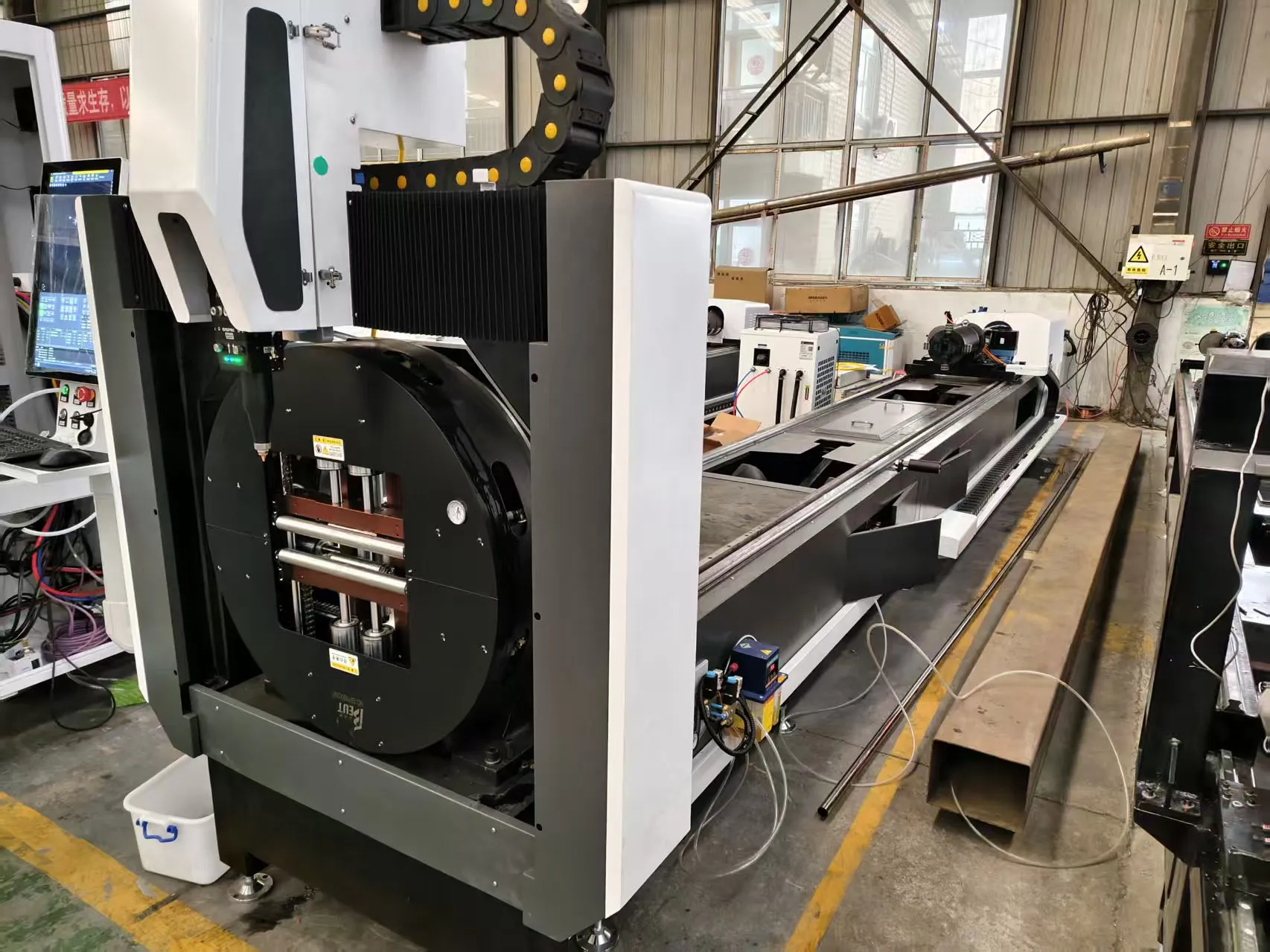
LT Series Tube Laser
Square tube up to 520 mm.
Compare all models →
Automatic Loading Tube Laser
For long runs of frame tube.
View machine →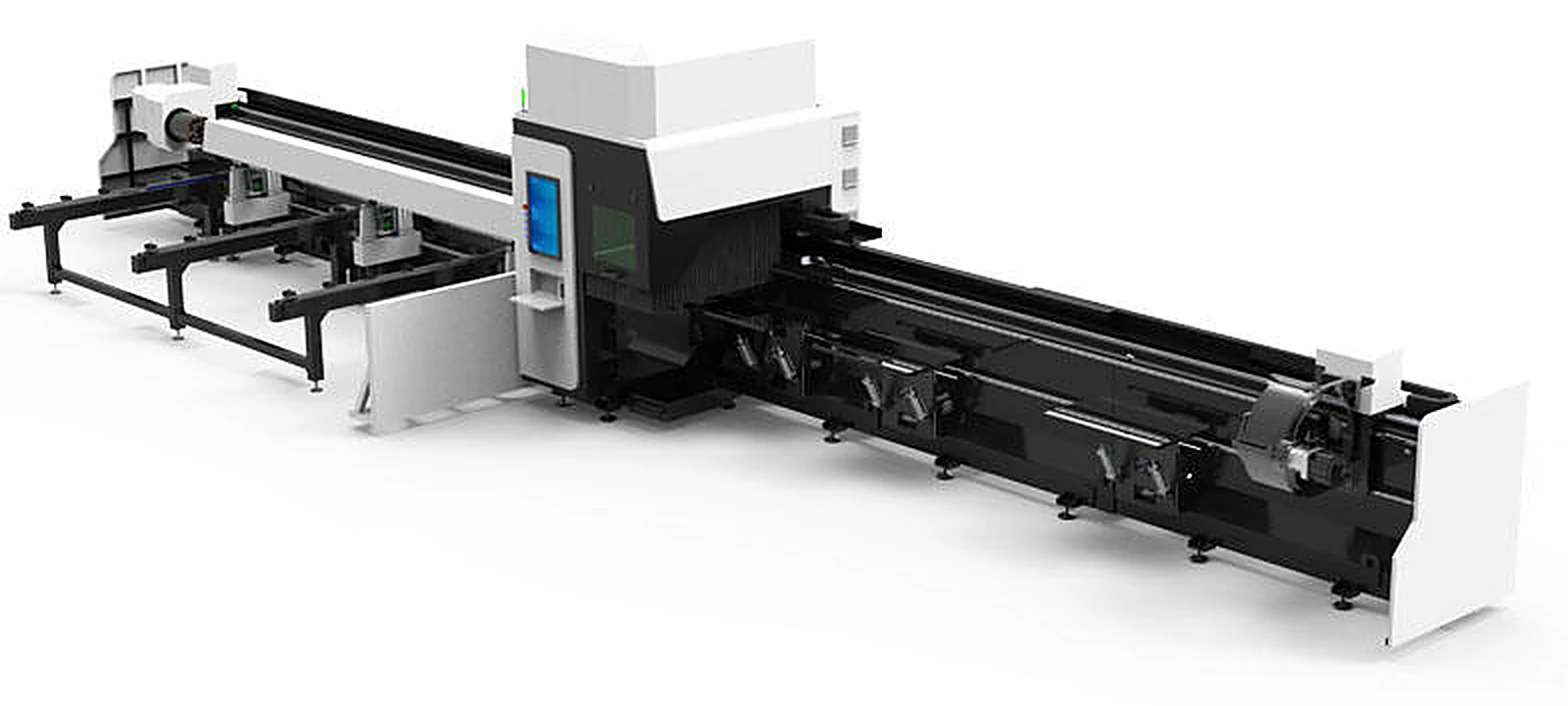
LT3 Three-Chuck Heavy Tube Laser
Zero tail, 6-30 kW.
View machine →Steel Channel Laser Cutting
Channel sizes, power and machine choice.
View machine →FAQ
What size square tube can a tube laser cut?
Up to the square chuck size: 240 × 240 mm on the LT240, 360 × 360 mm on the LT360 and 520 × 520 mm on the LT520. Rectangular tube fits by its larger side.
What laser power do I need for square tube?
About 1.5 kW for walls up to 3 mm, 3 kW up to 6 mm, 6 kW up to 10 mm and 12 kW for thicker walls at production speed.
Can you laser cut rectangular tube?
Yes. Rectangular tube is clamped in the same square chucks and cut on all four faces; the larger side must fit the chuck.
How close to the corner can a hole be?
Keep the hole edge clear of the corner radius, which is about two to three times the wall on cold-formed tube. Closer holes are possible but cut on a curved surface.
How do you bend square tube into a frame?
Laser cut V-notches through three faces, leaving the fourth as a hinge, then bend at each notch. Four notches make a closed frame with one weld.
What notch angle for a 90 degree corner?
A 90° V-notch. In general the notch angle is 180° minus the frame angle.
Does the weld seam matter?
Yes, for holes or notches that cross it and for tubes that slide into each other. Load tubes with the seam on a known face and tell the software.
Is a square tube laser cutting machine better than a saw?
For tube with holes, slots, notches or mitres, yes: one clamping and no marking. For plain cut-to-length, a saw is cheaper.
Can it cut galvanized and stainless square tube?
Yes. Nitrogen gives a clean, oxide-free edge on stainless and thin galvanized tube.
What is square pipe?
Another name for square hollow section, used in much of Asia and the Middle East. It is cut the same way as square tube.