High-Power Fiber Laser Cutting Machine: 20 kW, 30 kW, 40 kW and 60 kW
PCL Group application engineering, Jinan · Updated 20 October 2026
High-power fiber lasers from 20 kW to 60 kW have moved laser cutting into plate thicknesses that used to belong to plasma and oxy-fuel. A 20 kW source cuts through 70 mm carbon steel; 60 kW reaches 200 mm. Just as important for most shops, high power makes medium plate much faster by cutting with compressed air instead of oxygen. This page sets out what each power level can cut and how to choose.
On this page
Thickness and speed by power
| Laser power | Carbon steel | Stainless steel | Aluminium | Brass and copper | Top speed |
|---|---|---|---|---|---|
| 20 kW | up to 70 mm | up to 80 mm | up to 80 mm | up to 70 mm | over 100 m/min |
| 30 kW | up to 80 mm | up to 100 mm | up to 80 mm | up to 80 mm | over 110 m/min |
| 40 kW | 120 mm and more | 120 mm and more | 120 mm and more | 120 mm and more | up to 120 m/min |
| 60 kW | 16 to 200 mm | 16 to 200 mm | — | — | 0.05 to 15 m/min on 16–200 mm |
Thickness figures are the maximum the source can cut through. Top speeds apply to thin sheet. For continuous production and a clean edge, plan on less than the maximum; we confirm the right power with a test cut on your material.
Maximum thickness is not production thickness
Every laser can cut through more than it can cut well all day. The cutting data of Maxphotonics, the laser source fitted as standard on PCL machines, show the gap clearly for the sources up to 15 kW:
| Source | Carbon steel, production | Carbon steel, cuts through | Stainless, production | Stainless, cuts through |
|---|---|---|---|---|
| 10 kW | 30 mm | 40 mm | 20 mm | 40 mm |
| 12 kW | 35 mm | 45 mm | 25 mm | 50 mm |
| 15 kW | 35 mm | 50 mm | 25 mm | 70 mm |
For carbon steel, the production limit sits at about 70 to 80 percent of the cut-through thickness; for stainless steel it is closer to half. Expect the same pattern at 20 kW and above, and choose power for the thickness you cut every week, not the thickest plate you might cut once. The full data are in the fiber laser cutting speed chart.
Where high power really pays: air cutting
With oxygen, carbon steel cutting speed is set mostly by the oxygen reaction, so extra laser power adds little. With compressed air, speed keeps rising with power. Speeds in m/min for carbon steel (Maxphotonics data):
| Source | 10 mm oxygen | 10 mm air | 20 mm oxygen | 20 mm air |
|---|---|---|---|---|
| 10 kW | 2.2–2.3 | 6 | 1.3 | 1.4 |
| 12 kW | 2.2–2.3 | 9 | 1.5 | 1.8 |
| 15 kW | 2.2–2.3 | 11 | 1.5 | 2.5 |
At 10 mm, a 15 kW source cuts about five times faster with air than with oxygen. At 20 kW and above the gap grows further, which is why most high-power machines cut medium plate with air and keep oxygen for the thickest work. Air cutting needs a large, dry, oil-free compressor sized for the gas flow.
Which power for which work
| Power | Typical use |
|---|---|
| 20 kW | Shops cutting mostly 10–30 mm carbon steel, fast air cutting of medium plate, occasional thick plate |
| 30 kW | High throughput on medium plate, thick stainless and aluminium |
| 40 kW | Heavy plate for machinery, mining, shipbuilding and steel structures |
| 60 kW | Very thick plate up to 200 mm, replacing plasma and oxy-fuel on parts that need laser accuracy |
What a high-power machine needs
- A cutting head rated for the power, with automatic focus and good cooling of the optics.
- Gas supply: a high-flow air compressor with dryer and filters, and oxygen and nitrogen supply for the processes you run.
- Cooling and power: a chiller and electrical supply sized for the source.
- A bed built for heavy plate, with slag handling and zoned fume extraction.
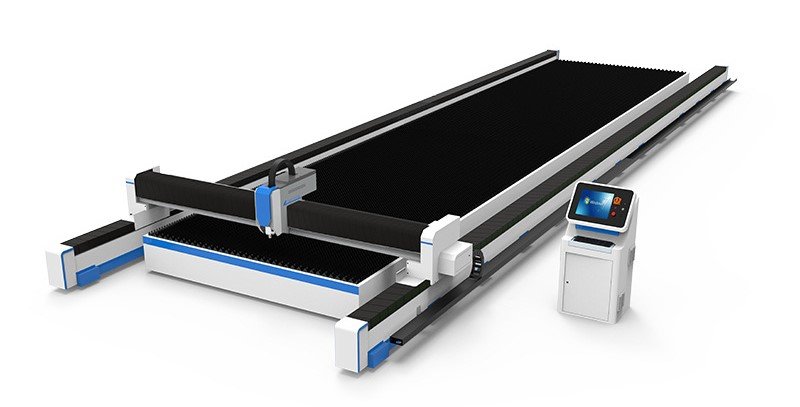
- The right machine format: a plate laser, a gantry laser up to 12 m for long plates, or the H-beam laser for sections.
Get a configuration
Bed size, source brand and options depend on your plates and parts. Send us your plate sizes, the thickness mix you cut, materials and a few typical drawings. We reply with a machine proposal and cut a sample on the power you are considering.

Video: a laser line cutting heavy plate and H-beams in a structural steel plant.
Common questions
How thick can a 20 kW fiber laser cut?
A 20 kW source cuts through up to 70 mm carbon steel, 80 mm stainless steel and aluminium, and 70 mm brass and copper. For continuous production, plan on less than these maximum values.
Is 30 kW much better than 20 kW?
30 kW cuts thicker stainless steel (up to 100 mm) and is faster on medium plate with air. If most of your work is 10–30 mm carbon steel, 20 kW is often enough; a test cut shows the difference on your parts.
Why choose high power if oxygen speed hardly changes?
Because high power makes compressed-air cutting fast. At 10 mm carbon steel, a 15 kW source cuts about five times faster with air than with oxygen, and the gap grows above 20 kW.