Air Duct Laser Cutting Machine for HVAC Ductwork
An air duct laser cutting machine cuts the flat patterns for HVAC ductwork from thin galvanised or stainless sheet: straight duct panels, elbows, reducers, transitions and the holes and notches for flanges. PCL duct lasers use a 1 to 3 kW fiber source on a 1.5 × 3 m or 1.5 × 4 m bed, fed from coil through a leveller.

Specifications
| Item | Specification |
|---|---|
| Working area | 1,500 × 3,000 mm or 1,500 × 4,000 mm |
| Laser source | 1,000 to 3,000 W fiber, Maxphotonics or Raycus |
| Sheet thickness | 0.5 to 4.0 mm |
| Positioning accuracy | ±0.03 mm |
| Feeding | From coil; leveller with 2 to 6 rollers depending on coil thickness |
| Control | CNC with duct CAM software |
| Cooling | Dual-circuit water chiller |
From coil to duct parts
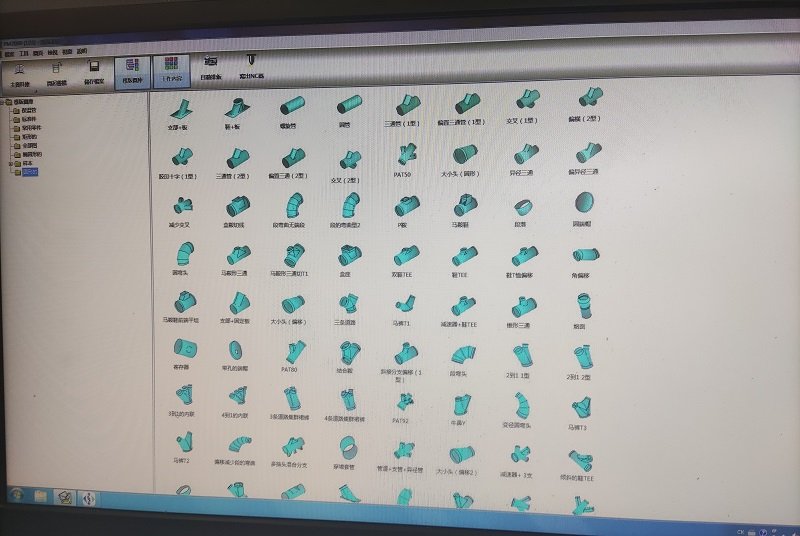
- Design the fitting. The duct software generates the flat pattern of elbows, reducers, transitions and straight sections from their dimensions.
- Nest. Parts are nested on the sheet to reduce scrap.
- Level. The coil runs through the leveller so the sheet lies flat under the laser.
- Cut. The fiber laser cuts contours, holes and notches with clean, burr-free edges, ready for seaming or welding.
Why laser for ductwork
- Any fitting shape without dies: elbows and transitions are just another program.
- Clean edges on galvanised and stainless sheet, so parts go straight to forming and assembly.
- Light gantry, high acceleration, which matters more than raw power on thin sheet with many short cuts.
- Low maintenance: a solid-state fiber source with no laser gas or mirrors to align.
Cutting speeds on thin sheet
Reference speeds in m/min from Maxphotonics cutting data for the source powers used on duct lasers. Galvanised sheet is normally cut with nitrogen or compressed air like thin carbon steel.
| Material | 1 kW | 1.5 kW | 3 kW |
|---|---|---|---|
| Carbon steel (nitrogen), 1 mm | 24–26 | 32–35 | 38–40 |
| Carbon steel (nitrogen), 2 mm | 8–9 | 9–10 | 15 |
| Stainless steel (nitrogen), 1 mm | 21–23 | 32–35 | 35–37 |
| Stainless steel (nitrogen), 2 mm | 6.5–7 | 9–10 | 13–15 |
More materials and thicknesses: fiber laser cutting speed chart.
Related machines
- Gantry laser for large plates
- Tube laser for round and rectangular tube
- Laser welding machine for seams on stainless ductwork
FAQ
What thickness can an air duct laser cut?
PCL duct lasers cut 0.5 to 4.0 mm sheet, the range used for galvanised and stainless HVAC ductwork.
Which laser power is right for duct work?
1 to 3 kW. On thin sheet, acceleration and nesting matter more than power; 3 kW adds speed on 2 mm and thicker sheet.
Can it cut directly from coil?
Yes. The sheet is fed from coil through a leveller with 2 to 6 rollers, then cut on a 1.5 by 3 m or 1.5 by 4 m bed.