Steel Beam Cutting Machine, 8-Axis CNC Plasma
For H-beam, I-beam, channel, angle, box section and pipe
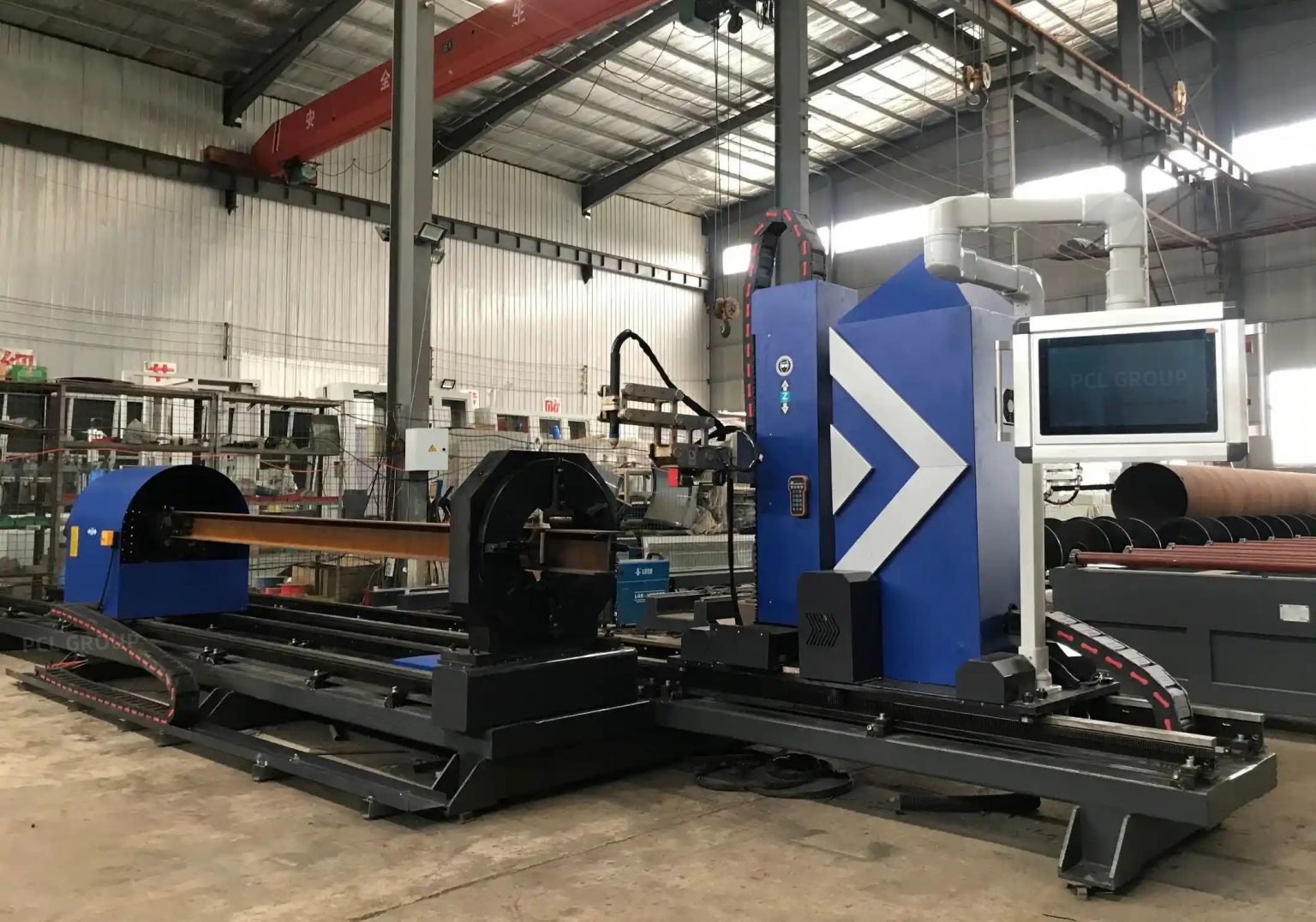
A CNC beam cutting machine with a robotic plasma torch that reaches every face of the section. It cuts beam ends, copes, notches, bolt holes, weld access holes and bevels in one set-up, programmed straight from the 3D model. Five models cover sections up to 565 mm wide and pipe up to Ø800 mm.
- Free test cut on your pipe
- 3-year machine warranty
- Installed in 80+ countries
- Factory direct since 2005
- Axes
- 8, robotic
- Section width
- up to 565 mm
- Pipe
- up to Ø800 mm
- Sections
- H, I, U, L, box, pipe
- Models
- 5
What is a steel beam cutting machine?
A steel beam cutting machine, also called a CNC beam cutter, beam cutter machine, steel beam cutting equipment or steel beam processing machine, cuts structural sections to the shape the connection needs, not just to length. A saw only cuts the beam off; a beam processing line adds holes. On this 8-axis machine a robotic arm moves the plasma torch around the section with full 360° access, so the web and both flanges of an H-beam or I-beam, the legs of a channel or angle, every face of a box section and the wall of a round pipe are cut from one program. The operator loads the section, the software reads the 3D model and the machine cuts the part ready for fit-up.
In Europe steel sections are often called profiles, so the same machine is also known as a 3D plasma cutting machine or CNC profile cutting machine for profiles and pipes. Either way, it does the structural beam CNC machining that used to need a layout table, a torch and a grinder.
Beam processing operations
The cuts a structural fabricator usually makes by layout, torch and grinder, done by the CNC beam cutting machine instead:
| Operation | What it is | Used for |
|---|---|---|
| End cope | Flange and web cut back so a beam fits against another beam | Beam-to-beam connections |
| Notch | Rectangular or shaped cut-out at the end or along the beam | Clearance for crossing members |
| Bolt holes | Round or slotted holes in the web and flanges | Bolted end plates, splices, cleats |
| Weld access hole | Rounded hole at the web-flange junction (rat hole) | Full-penetration flange welds |
| Bevel | Angled edge on a flange or web end | Welded moment connections |
| Mitre and angled end | Beam end cut at an angle | Frames, rafters, bracing |
| Web opening | Round or rectangular hole through the web | Services through beams, lightening holes |
| Slot | Slot for a gusset or fin plate | Plate-to-section connections |
Sections it cuts
One machine works as an I-beam cutting machine, H-beam cutting machine and U-beam cutting machine, and also cuts angle, box section and pipe:
| Section | Typical cuts |
|---|---|
| H-beam, I-beam, wide flange | Copes, notches, bolt holes in web and flanges, weld access holes, bevels |
| Channel (U-beam) | Ends, notches, holes in web and legs |
| Angle | Angled ends, notches, bolt holes in both legs |
| Box section, square and rectangular tube | Mitres, holes and slots on all four faces |
| Round pipe | Saddles, branch holes and bevelled ends |
Pipe joints in more detail, including saddles and branch bevels, are explained in pipe profile cutting: types of cuts.
Models and capacities
| Model | Max section width (beam, box, channel) | Max pipe diameter |
|---|---|---|
| 8axis300 | 212 mm | 300 mm |
| 8axis400 | 282 mm | 400 mm |
| 8axis500 | 353 mm | 500 mm |
| 8axis600 | 425 mm | 600 mm |
| 8axis800 | 565 mm | 800 mm |
A robotic plasma cutting machine for structural steel
The cutting head is carried by an industrial robot rather than a gantry, which is why the machine is also known as a robotic plasma cutting machine or plasma cutting robot. A gantry torch can only tilt within a limited range above the part; a robot arm reaches round the section, under a flange and into the corners of a channel, so the whole member is cut in one set-up. For structural work this robotic cutting system replaces the layout table, the hand torch and much of the grinding.
| Robotic plasma cutter (this machine) | Gantry plasma cutter | |
|---|---|---|
| Access | 360° round beams, channels, angles, box and pipe | Top surface, limited tilt |
| Best for | Structural sections with copes, holes and bevels on several faces | Flat plate, or round pipe on a dedicated pipe machine |
| Programming | From the 3D model of the member | From 2D drawings or pipe parameters |
Get the price and a free test cut
The price depends on the largest section, the longest member and the plasma source. Send those, or a drawing of a typical part, and we reply with a configuration and quotation. We can also cut a sample and send the video.
8-axis beam cutter specifications
- Axes
- 8-axis CNC, robotic arm with 360° access to the section
- Sections
- H-beam, I-beam, channel, angle, box section, round pipe
- Max section width
- 212-565 mm by model
- Max pipe diameter
- 300-800 mm by model
- Process
- CNC plasma cutting and beveling
- Programming
- From 3D models; SolidWorks and common CAD formats
- Control
- Windows-based CNC control
- Section length
- configured to order
Section length, plasma source and loading are configured to your parts. Send your largest section and longest member and we confirm the model and configuration in the quotation.
How a beam is cut
- Load: the section is placed on the machine and clamped.
- Program: the software reads the 3D model of the part and calculates the torch path for every face.
- Cut: the robotic arm moves the torch around the section, cutting the web, flanges and ends, tilting for bevels.
- Unload: the finished member comes off with copes, holes and bevels done, ready for assembly and welding.
Plasma beam cutting vs drill line vs laser
| Method | Strong at | Weak at |
|---|---|---|
| 8-axis plasma (this machine) | Copes, notches, shaped holes, bevels and mixed sections in one station | Very fine detail on thin sections |
| CNC beam line (drill and saw) | High volume straight cuts and round holes | Copes, notches and shaped cuts need extra machines |
| Fiber laser H-beam machine | Fine detail and speed on thinner sections | Higher machine cost; slower on thick flanges |
| Manual layout and torch | Low investment | Slow, operator-dependent, grinding needed |
Where it is used
Steel structures
Beams, columns and bracing for factories, warehouses and high-rise frames.
Bridges
Cross girders, bracing and connection members.
Shipbuilding
Profiles and stiffeners with notches and scallops.
Architectural steel
Exposed frames where clean copes and joints matter.
Industrial plant
Pipe racks and platforms mixing beams, channels and pipe.
Cranes and machinery
Frames and booms from box section and beams.
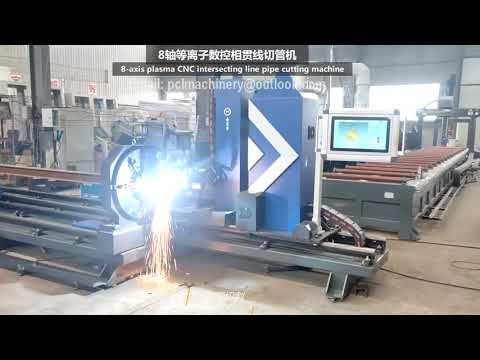
8-axis beam cutting video
Is this the right machine for your parts?
| Your parts | Recommended machine |
|---|---|
| Beams, channels, angles and pipe in the same shop | This 8-axis steel beam cutting machine |
| Mainly H-beams and channels, high throughput, no pipe | H-Series robotic beam coping machine |
| Mainly pipe and tube up to Ø600 mm | 5-axis tube plasma cutting machine |
| Pipe Ø600-2000 mm | Large diameter pipe cutting machine |
| Thin-wall tube and stainless steel | Fiber laser tube cutting machine |
Before you order: what to check
| Check | Why it matters |
|---|---|
| Largest section | Sets the model (212-565 mm section width) |
| Longest and heaviest member | Sets the bed length, supports and loading |
| Thickest flange or wall | Sets the plasma source |
| Operations | Copes and holes only, or bevels for welded connections as well |
| CAD workflow | The 3D model format your detailers use |
Why buy from PCL
Since 2005
Factory in Jinan, China, building cutting machines.
80+ countries
Machines installed worldwide.
3-year warranty
On the machine; consumables excluded.
Free test cut
On your own part before you order.
On-site installation
With operator training.
Remote support
By WhatsApp and video.
Some dealers copy our photos and videos to sell look-alike machines. Buy direct from the manufacturer.
Related machines
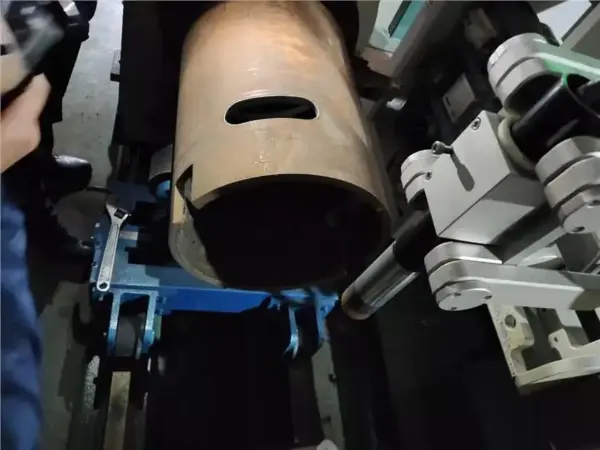
CNC Pipe Cutting and Beveling Machine
All pipe cutting and beveling models compared.
Compare all models →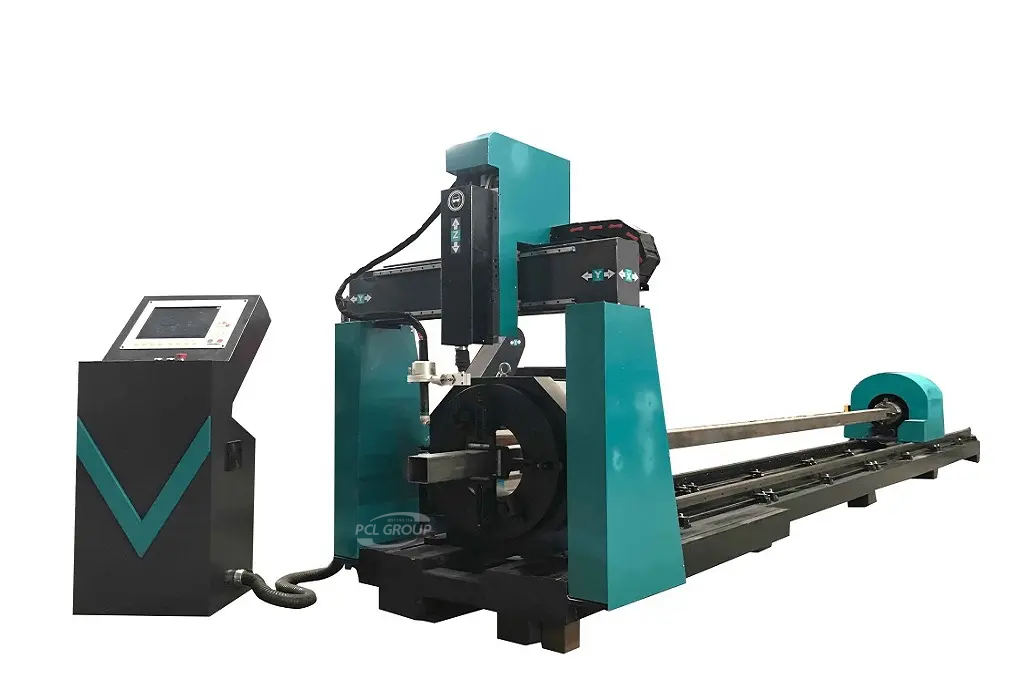
5-Axis CNC Tube Plasma Cutting Machine
Pipe Ø40-600 mm, tube, channel and angle.
View machine →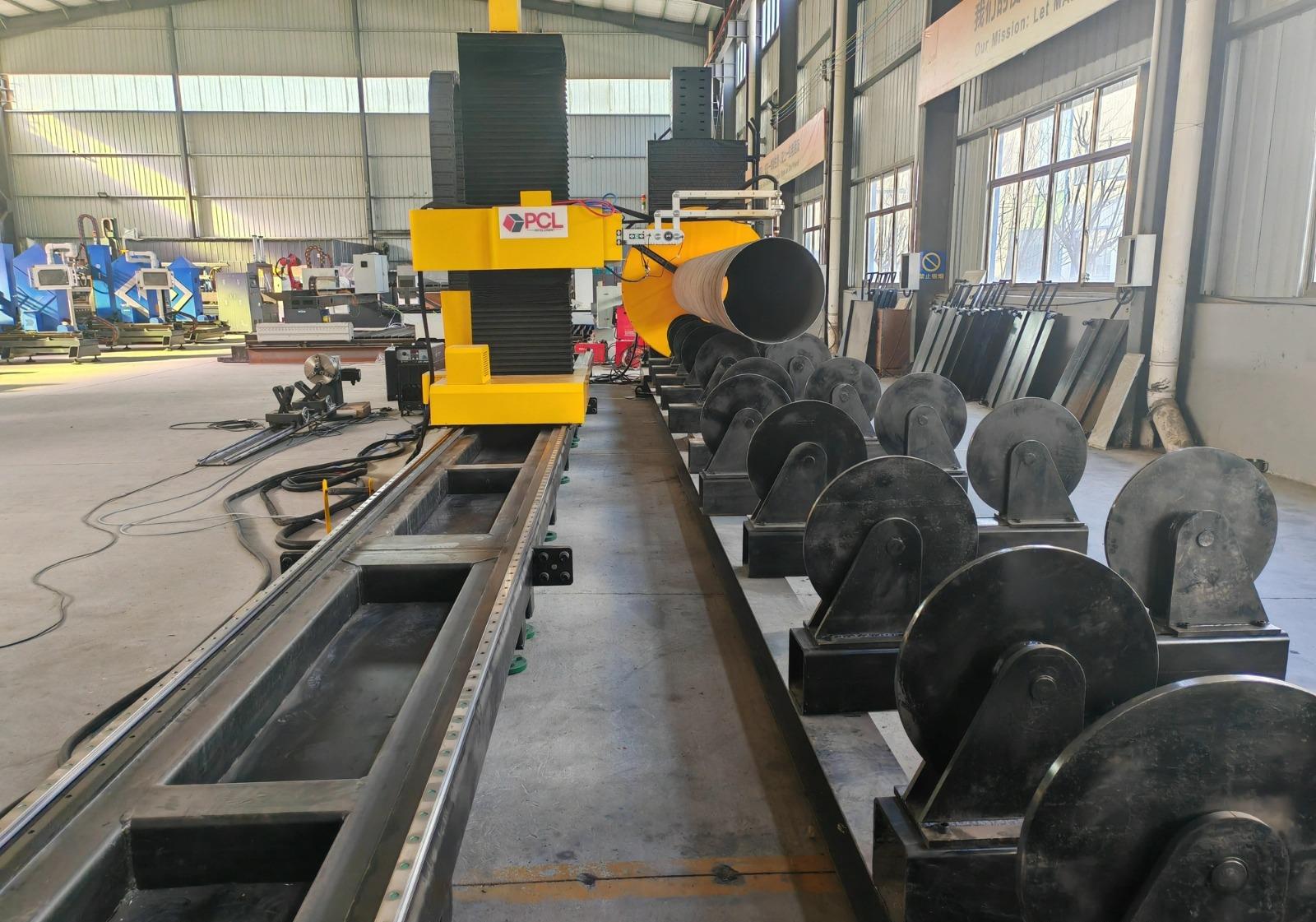
Large Diameter Pipe Cutting Machine
Pipe Ø600-2000 mm, up to 10 t.
View machine →
Tube Laser Cutting Machine
Fiber laser for thin-wall round and square tube.
View machine →Frequently asked questions
What is a steel beam cutting machine?
A CNC machine that cuts structural sections to their finished shape: beam ends, copes, notches, bolt holes, weld access holes and bevels. On the PCL 8-axis machine a robotic arm carries the plasma torch around the section, so all faces of an H-beam, I-beam, channel, angle, box section or pipe are cut in one set-up.
Can it cut I-beams as well as H-beams?
Yes. I-beams, H-beams and wide flange beams are the same kind of section for the machine; it cuts the web and both flanges from one program. Channel (U-beam), angle, box section and round pipe are cut on the same machine.
What size of beam can it cut?
It depends on the model. The section width goes from 212 mm on the 8axis300 to 565 mm on the 8axis800, and round pipe from 300 mm to 800 mm diameter. Send your largest section and we recommend the model.
What is a robotic plasma cutting machine?
A plasma cutter whose torch is carried by an industrial robot arm. On the PCL 8-axis machine the robot works with the part handling axes to reach every face of beams, channels, angles, box sections and pipe, cutting copes, holes and bevels in one set-up.
Why 8 axes?
A beam has a web and two flanges facing different directions. Eight coordinated axes let the robotic torch reach every face, tilt for bevels and follow 3D contours such as copes, so a part that would need several set-ups on a drill line or a saw is finished in one.
Can it cut bolt holes?
Yes, in the web and the flanges, in the positions given by the 3D model. Plasma-cut holes are suitable for most structural bolted connections; if your specification requires drilled or reamed holes for fitted bolts, tell us and we will advise.
Can it cut copes and weld access holes?
Yes. End copes for beam-to-beam connections, notches, weld access holes (rat holes) and flange bevels are cut from the same program, with no layout marking or grinding.
How is the machine programmed?
From the 3D model of the part. The software reads models from common CAD platforms such as SolidWorks, calculates the torch path for every face and generates the CNC code, so the operator does not write programs by hand.
How does it compare with a beam drilling and sawing line?
A drill and saw line is fast for straight cuts and round holes, but copes, notches and slotted or shaped holes need extra machines or manual work. The 8-axis plasma machine cuts all of these in one station, which suits shops with mixed sections and complex connections.
Plasma or laser for H-beams?
Plasma cuts thicker flanges at a lower machine cost and is the usual choice for heavy structural steel. A fiber laser H-beam machine gives finer detail and faster cutting on thinner sections. Tell us your section sizes and we compare both.
Is it a beam cutter or a complete beam line?
It is a cutting station: it replaces the layout, torch cutting and grinding of copes, holes, notches and bevels. Shops that already run a saw or drill line often add it for the complex members; smaller shops use it as their main steel beam cutting equipment.
Which industries use it?
Steel structure fabrication, bridges, shipbuilding, architectural steelwork and industrial buildings: anywhere beams, channels, angles and pipe are connected by welding or bolting.
Can I get a test cut?
Yes. Send a drawing or 3D model of a typical part and we cut it at our factory in Jinan and send you the video.
What is the warranty?
3 years on the machine, consumables excluded, with on-site installation, operator training and remote support by WhatsApp and video.
Get a quote and a test cut
Send your sections and a typical part. We recommend the model, quote it and can cut a sample.
What happens next
- An engineer checks your sizes and parts.
- You receive the recommended configuration and a quotation.
- If you want, we cut a sample and send you the video.