Field Report: Integration of 6000W Universal Profile Laser Systems in Large-Scale Infrastructure
1. Executive Summary
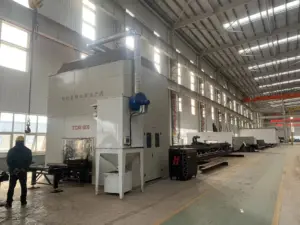
The following technical report details the operational deployment and performance metrics of the 6000W Universal Profile Steel Laser System, specifically equipped with automated unloading technology, within the context of the Istanbul Airport (IST) expansion and auxiliary steel structure fabrication. As infrastructure projects in the Marmara region scale in both complexity and seismic requirements, the transition from traditional mechanical processing (sawing, drilling, and manual coping) to automated fiber laser oscillation has become a prerequisite for structural compliance and throughput optimization. This report focuses on the synergy between high-wattage fiber sources and automated discharge kinematics in processing heavy structural sections (I, H, U, and L profiles).
2. Project Context: Istanbul Airport Structural Requirements
The Istanbul Airport project represents one of the most demanding environments for structural steel engineering. Due to the massive spans required for terminal roofs and the high wind loads originating from the Black Sea, the structural specifications necessitate S355J2+N and S460 grade steels with significant wall thicknesses.
Traditional fabrication methods for these profiles involve multi-stage handling: mechanical sawing for length, CNC drilling for bolt holes, and manual plasma torching for complex copes or web openings. This creates three critical failure points:
1. Cumulative Tolerance Errors: Multiple setups lead to dimensional drift.
2. Thermal Deformation: Manual plasma lacks the localized heat control required for S460 high-strength steel.
3. Logistical Stagnation: The bottleneck is rarely the “cut” itself, but the loading and unloading of 12-meter profiles weighing several tons.
3. Technical Analysis of the 6000W Fiber Laser Source
The selection of a 6000W fiber laser source is engineered for the “sweet spot” of structural profile thickness. While 10kW+ sources exist, the 6000W density provides the most stable beam parameter product (BPP) for materials ranging from 6mm to 25mm—the standard thickness for most Istanbul Airport secondary and tertiary support structures.
3.1. Photon Density and Kerf Quality
At 6000W, the system achieves a power density capable of maintaining a narrow kerf width even in heavy-walled H-beams. This is vital for the “A-frame” junctions used in the terminal’s architectural canopy. The fiber laser’s 1.07-micron wavelength ensures high absorption rates in structural carbon steel, resulting in a Heat Affected Zone (HAZ) that is 70% smaller than that of oxygen-fuel or conventional plasma cutting. This preservation of material integrity is essential for meeting the Turkish Seismic Code requirements, as it prevents the embrittlement of connection points.
3.2. Gas Dynamics and Beveling
The system utilizes high-pressure nitrogen or oxygen-assisted cutting. In the Istanbul project, the ability to perform 45-degree beveling on the fly for weld preparation has eliminated the need for secondary grinding. The 6000W output maintains the feed rate necessary to prevent “dross” accumulation on the underside of the lower flange, a common issue in lower-powered systems processing heavy profiles.
4. The Mechanics of Universal Profile Processing
The “Universal” designation refers to the system’s ability to process non-linear geometries through a multi-chuck rotation system.
4.1. Four-Chuck Kinematics
To handle the 12-meter profiles standard in the IST project, the system utilizes a four-chuck pneumatic arrangement. This configuration allows for “zero-tailing” cutting. In heavy steel processing, material waste (remnants) can account for 10-15% of total costs. By passing the profile through a series of synchronized chucks, the laser head can maintain access to the material even at the very ends of the beam, maximizing nesting efficiency.
4.2. Geometric Compensation
Profiles like H-beams often suffer from “mill twist” or “web camber.” The 6000W system integrates tactile and laser-based sensing to map the actual geometry of the profile before the first cut. The software then adjusts the cutting path in real-time to ensure that bolt holes are perfectly centered on the web, regardless of the beam’s physical irregularities.
5. Solving the Efficiency Bottleneck: Automatic Unloading Technology
In heavy steel fabrication, the “processing time” is often dwarfed by the “handling time.” A 600W laser can cut a bolt hole pattern in seconds, but if the machine must wait 10 minutes for an overhead crane to clear the finished part, the efficiency gains are lost.
5.1. Synchronized Discharge Mechanism
The Automatic Unloading system integrated into the Istanbul deployment utilizes a heavy-duty chain-driven conveyor combined with hydraulic lifting forks. As the laser completes the final cut, the unloading unit supports the finished part along its entire length. This prevents the “sagging” or “clashing” that occurs when heavy parts drop via gravity, which can damage the laser bed or the part’s precision edges.
5.2. Buffer Management and Continuous Flow
The unloading module functions as a buffer zone. In the IST terminal fabrication, this allowed for a “lights-out” capability during night shifts. Finished profiles are automatically moved to a lateral discharge rack, clearing the main cutting axis for the next raw profile. This reduced the total cycle time per H-beam by approximately 45% compared to systems requiring manual intervention for part removal.
5.3. Precision Preservation
Large structural members are susceptible to surface scarring if dragged across support slats. The automatic unloader uses polyurethane-coated rollers and synchronized lifting movements to transition the part from the cutting zone to the logistics zone. For the Istanbul Airport’s aesthetic “exposed” steelwork, this prevents surface defects that would otherwise require expensive sandblasting or filling before painting.
6. Synergy Between 6000W Power and Automation
The true technical advantage observed in the field is the synergy between the power of the source and the speed of the unloading. High-power laser cutting generates a significant amount of “small parts” (slugs, gussets, and connection plates) alongside the large profiles.
The 6000W system’s high dynamic response allows it to toggle between heavy profile coping and high-speed plate cutting. The automatic unloading system is designed to differentiate between these. Small parts are diverted to a scrap/part collector via a conveyor belt underneath the slats, while the primary structural profile is moved forward. This dual-path discharge is critical for maintaining a clean workspace and preventing mechanical interference during high-speed laser oscillation.
7. Impact on Istanbul Airport Construction Timelines
The deployment of the 6000W Universal Profile Laser System with Automatic Unloading has resulted in several measurable improvements:
- Reduction in Labor Hours: The automation of the unloading phase reduced the required floor crew by two technicians per shift.
- Assembly Precision: The precision of laser-cut notches and holes resulted in a 30% faster “fit-up” time during the on-site erection of the terminal’s support columns.
- Waste Reduction: Advanced nesting software paired with the four-chuck system reduced scrap rates from 12% to less than 4%, a significant cost saving given current global steel prices.
8. Conclusion
For the Istanbul Airport expansion, the transition to 6000W fiber laser technology for profile processing is not merely an upgrade in cutting speed; it is a fundamental shift in structural steel workflow. The integration of Automatic Unloading technology addresses the physical reality of handling heavy-duty profiles, ensuring that the high-speed capabilities of the fiber laser are not undermined by manual logistical constraints. As we move toward more complex architectural geometries and stricter seismic codes, the precision and efficiency provided by this system represent the current gold standard in industrial steel fabrication.
Field Report Prepared by:
Senior Engineering Lead, Laser Systems Division
Structural Steel Technical Consultant – Istanbul Project Group