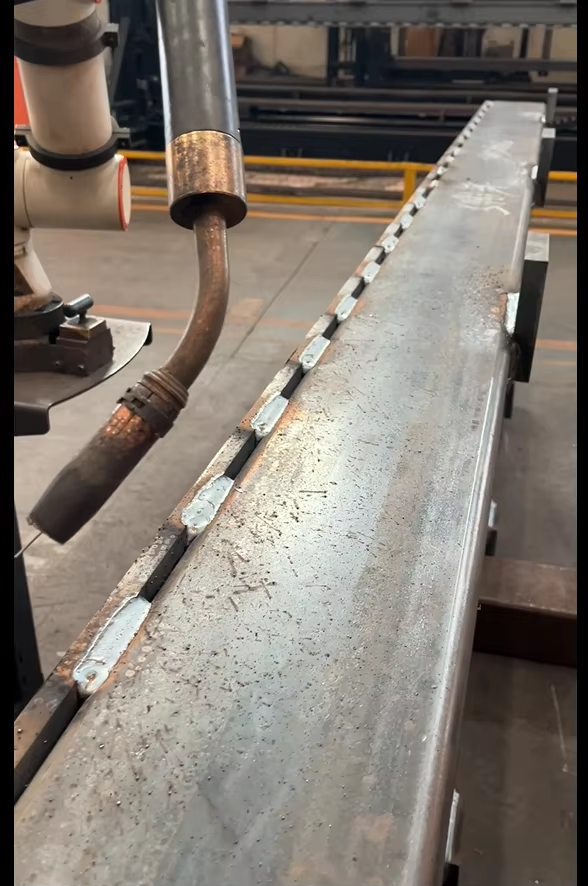
Technical Field Report: Implementation of 6000W 5-Axis Profile Laser Systems in Monterrey’s Offshore Fabrication Sector
1. Executive Summary and Scope of Deployment
This report evaluates the technical integration and operational performance of the 6000W Universal Profile Steel Laser System, equipped with a ±45° 5-axis beveling head, within the heavy industrial corridor of Monterrey, Nuevo León. While Monterrey is geographically inland, it serves as the primary metallurgical and fabrication hub for offshore platform components destined for the Gulf of Mexico. The transition from traditional plasma arc cutting and mechanical drilling to high-power fiber laser processing represents a critical shift in how H-beams, I-beams, C-channels, and hollow structural sections (HSS) are prepared for high-fatigue marine environments.
The primary objective of this deployment is to address the rigorous tolerances required by international offshore standards (such as AWS D1.1 and API RP 2A-WSD), focusing on weld preparation accuracy, Heat Affected Zone (HAZ) minimization, and automated throughput of secondary and tertiary structural members.
2. The Synergy of 6000W Fiber Laser Power in Heavy Profile Processing
The selection of a 6000W fiber laser source is strategic for the specific gauge of steel utilized in offshore topside modules and jacket secondary structures. Unlike 3000W systems, which struggle with the thick-walled flanges of heavy H-beams (often exceeding 12-20mm), the 6000W output provides the necessary power density to maintain high feed rates while ensuring a clean vaporizing cut.
In Monterrey’s fabrication facilities, the 6000W source allows for:
- Superior Kerf Control: The beam quality (BPP) of a 6000W fiber source ensures a narrow kerf, which is vital when performing complex intersections on circular hollow sections (CHS) used in platform trusses.
- Gas Dynamic Optimization: At 6kW, the balance between oxygen-assisted cutting for carbon steel and nitrogen-assisted high-pressure cutting for stainless components is optimized to prevent dross accumulation on the lower edge of the profile—a common failure point in offshore corrosion resistance.
- Material Versatility: The system handles the heavy carbon steels (ASTM A36, A572 Grade 50) typical of offshore structures with minimal thermal distortion, preserving the metallurgical integrity of the profile.
3. Advanced ±45° Bevel Cutting: Solving the Fit-Up Challenge
The cornerstone of this system is the 5-axis “Universal” head capability. In offshore platform construction, the “Fit-Up” phase is historically the most labor-intensive. Traditional straight-cut profiles require manual grinding to create the V, Y, or K-groove weld preparations necessary for full-penetration welds.
Kinematics and Precision:
The ±45° beveling capability allows the laser to perform complex contouring on the flanges and webs of profiles simultaneously. By interpolating the A and B axes with the X, Y, and Z travel, the system produces ready-to-weld edges in a single pass.
Technical Advantages in Monterrey Operations:
1. Zero-Gap Fit-Up: The accuracy of the laser bevel (±0.5mm) ensures that when a brace is fitted to a chord, the root gap is consistent across the entire geometry. This reduces the volume of filler metal required and significantly lowers the probability of weld defects such as lack of fusion or inclusions.
2. Complex Intersection Beveling: For offshore jackets, pipes often meet at compound angles. The 6000W system’s software calculates the varying bevel angle required along the “saddle and bird-mouth” cuts, ensuring a constant weld prep angle relative to the mating surface.
3. Elimination of Secondary Processing: By integrating the bevel into the primary cutting cycle, the Monterrey facility eliminated the need for handheld plasma gouging and mechanical beveling machines, reducing the “part-to-part” cycle time by approximately 65%.
4. Application in Monterrey’s Offshore Supply Chain
Monterrey’s role as a “Dry Port” for the energy sector involves the pre-fabrication of modular units that are later transported to coastal yards in Tampico or Altamira. The logistics of offshore construction demand that components be fabricated with extreme precision to ensure that assembly at the coast—where labor costs and environmental variables are higher—proceeds without rework.
Structural Integrity in High-Salinity Environments:
The 6000W laser produces a significantly smaller Heat Affected Zone (HAZ) compared to plasma cutting. In the context of offshore platforms, a large HAZ can lead to local hardening and increased susceptibility to stress corrosion cracking (SCC). By utilizing the precision of the fiber laser, the Monterrey-produced profiles maintain their grain structure closer to the cut edge, facilitating higher quality welds that meet the stringent Charpy V-Notch (CVN) impact testing required for sub-zero or high-impact marine applications.
5. Automation and Integration with Structural Software
The “Universal” aspect of the system refers to its ability to ingest complex 3D data. The Monterrey deployment utilizes a direct interface between TEKLA Structures and the laser’s NC (Numerical Control) generator.
Digital Workflow:
1. BIM to Laser: Engineering teams in Monterrey upload 3D IFC or STEP files directly to the system.
2. Automatic Nesting: The software optimizes the layout on standard 12-meter profile lengths, minimizing scrap—a critical factor given the high cost of offshore-grade certified steel.
3. Automated Handling: The 6000W system is paired with automated loading and unloading racks. As the laser processes an I-beam with ±45° bevels on both ends and internal bolt-hole patterns, the next profile is staged, ensuring a “spindle-on” time exceeding 85%.
6. Overcoming Heavy Steel Processing Bottlenecks
Heavy steel processing has historically been hindered by the “Three-Machine Problem”: one machine for sawing to length, one for drilling bolt holes, and manual labor for weld prepping. The 6000W Universal Profile Laser collapses these into a single workstation.
Specific Case Study Observations:
During the fabrication of a secondary deck module for a Gulf of Mexico platform, the system was tasked with processing 250mm x 250mm H-columns. The requirements included:
– Precision bolt holes for temporary seafastening.
– ±35° bevels on the flanges for primary structural welding.
– Complex cope cuts to allow for utility piping pass-throughs.
The 6000W system completed each column in 8 minutes. Comparative data from the previous mechanical/plasma workflow showed a total processing time of 42 minutes per column, including transit between stations and manual grinding. The precision of the laser-cut holes (H11 tolerance) eliminated the need for reaming during trial assembly.
7. Thermal Management and Material Stability
A critical technical concern in Monterrey’s high-ambient-temperature environment is the thermal expansion of long profiles during cutting. The system employs a sophisticated “Floating Support” and “Part Tracking” sensor array. As the 6000W laser delivers energy, the system’s real-time compensation software adjusts the cutting path to account for any longitudinal expansion of the beam, ensuring that the distance between bolt holes at opposite ends of a 12-meter profile remains within ±0.2mm.
Furthermore, the use of high-pressure oxygen as a cutting gas for heavy carbon steel is regulated by proportional valves that adjust pressure based on the thickness of the flange versus the web. This prevents “over-burning” at the transition points (the fillet of the beam), which is a common area of structural failure if notched or overheated.
8. Conclusion and Future Outlook
The deployment of the 6000W Universal Profile Steel Laser System with ±45° beveling in Monterrey has redefined the benchmarks for offshore structural fabrication. By merging high-power fiber laser technology with 5-axis kinematics, fabricators have achieved a level of “First-Time-Right” manufacturing previously impossible with thermal arc processes.
The reduction in manual labor for weld preparation and the elimination of fit-up errors directly translate to higher structural integrity for offshore platforms, where the cost of failure is catastrophic. As the energy sector moves toward deeper water and more extreme environments, the precision afforded by 6000W laser processing will become the baseline requirement for all structural steel fabrication in the region.
Technical Log End.
Senior Consultant: [Laser & steel structure Division]
Location: Monterrey, NL, MX













