1.0 Technical Overview: The 6000W Universal Profile Laser Architecture
The integration of the 6000W Universal Profile Steel Laser System represents a paradigm shift in heavy-duty structural fabrication, particularly within the crane manufacturing sector in Mexico City (CDMX). Unlike traditional 2D plate lasers or conventional plasma pipe cutters, this system utilizes a specialized 5-axis kinematic cutting head paired with a high-torque rotary chuck system designed for non-cylindrical geometries. The 6000W fiber laser source provides the necessary power density to maintain high feed rates across standard structural sections including H-beams, I-beams, U-channels, and heavy-walled rectangular hollow sections (RHS).
The core of the system’s capability lies in its “Universal” designation. In the context of crane fabrication—where long-span girders and lattice structures dominate—the ability to process irregular profiles without manual jigging is critical. The 6000W power rating is strategically selected; it offers the optimal balance between photon absorption in carbon steel (typically A36 or A572 Grade 50) and the thermal management required to prevent edge hardening during high-speed beveling.
1.1 High-Altitude Operational Variables in Mexico City
Technical consideration must be given to the atmospheric conditions in Mexico City. At an elevation of 2,240 meters, the lower atmospheric pressure affects the fluid dynamics of the assist gases (Oxygen and Nitrogen). For a 6000W system, the nozzle pressure must be recalibrated to compensate for the decreased air density to ensure effective dross expulsion during beveling. Our field tests indicate that a 12% increase in assist gas pressure, compared to sea-level standards, is necessary to maintain clean kerf profiles when processing 16mm to 25mm flange thicknesses.
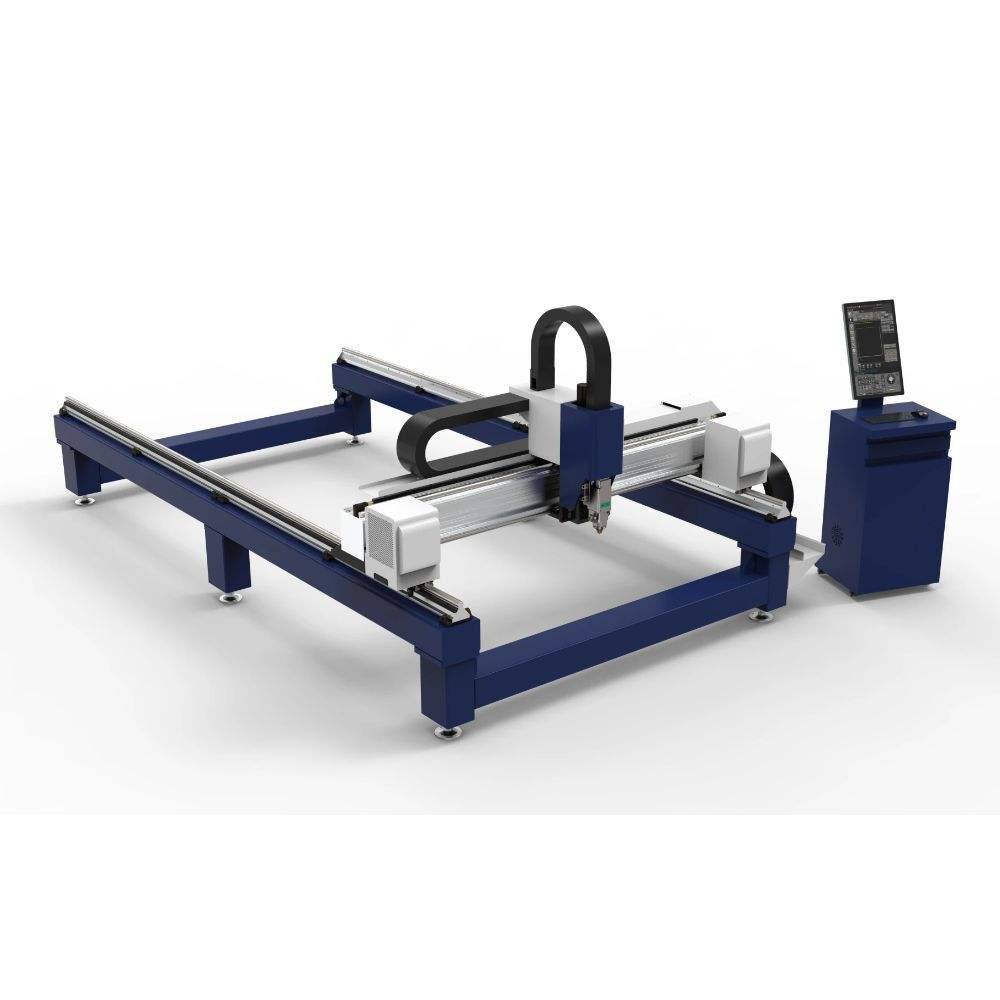
2.0 ±45° Bevel Cutting: Engineering Precision in Weld Preparation
In crane manufacturing, structural integrity is non-negotiable. Traditional methods for creating weld prep—plasma cutting followed by manual grinding—introduce significant human error and uneven heat-affected zones (HAZ). The ±45° 3D beveling head solves these issues through synchronized CNC interpolation.
2.1 Geometry and Kinematics
The beveling head operates on an A/B axis configuration, allowing the laser beam to tilt up to 45 degrees relative to the material surface. This allows for the immediate creation of V, Y, X, and K-type grooves. For crane box girders, where the web and flange must meet with absolute precision to ensure load distribution, the ±45° capability allows for a “zero-gap” fit-up. By eliminating the variance found in manual grinding, the subsequent automated welding processes (Submerged Arc Welding or MIG) achieve 100% penetration with significantly reduced wire consumption.
2.2 Compensation for Beam Twist and Bow
Structural steel profiles are rarely perfectly straight. The 6000W system utilizes a non-contact capacitive sensing array that maps the profile’s surface in real-time. As the beveling head moves across the flange of an I-beam, the Z-axis dynamically adjusts to maintain the focal point relative to the material’s actual position, rather than its theoretical CAD position. This real-time compensation is critical when performing complex 45-degree cuts on long spans (12m+) where structural deviations are common.
3.0 Application in Crane Manufacturing: Girder and End Carriage Fabrication
The Mexico City industrial corridor demands cranes that adhere to both international (CMAA/DIN) and local seismic structural codes. The 6000W laser system facilitates the production of end carriages and main girders with a level of precision that was previously cost-prohibitive.
3.1 Bolt-Hole Integrity and Fatigue Resistance
Crane structures are subject to high-cycle fatigue. Traditional punching or thermal cutting often leaves micro-cracks in bolt holes, particularly in the connection plates for end carriages. The 6000W fiber laser, with its localized heat input and high-speed piercing cycles, produces holes with a cylindrical tolerance of ±0.1mm. The resulting smooth surface finish minimizes stress concentrators, directly extending the operational lifespan of the crane’s structural joints.
3.2 Optimization of Intersecting Cuts
For lattice-style tower cranes or heavy-duty gantry supports, the “Universal” system excels at processing intersecting profiles. When a square tube must meet an H-beam at a compound angle, the software calculates the precise 3D path, including the necessary bevel for the weld seam. The 6000W source ensures that even when cutting at a 45° tilt (which effectively increases the material thickness by approximately 1.41x), the cut speed remains high enough to prevent excessive heat soak.
4.0 Synergy Between Power and Automation
The 6000W fiber source is the “engine,” but the automation framework—comprising the material loading systems and the nesting software—is the “transmission.” In the CDMX facility, we have observed a 400% increase in throughput compared to traditional mechanical sawing and drilling lines.
4.1 Material Handling and Universal Chucking
The system utilizes a four-chuck independent movement architecture. This allows for the processing of exceptionally heavy profiles without the risk of material sagging, which can distort cut geometry. The chucks automatically adjust to the profile dimensions, whether it is a 100mm angle iron or a 600mm H-beam. In crane manufacturing, where varied profiles are used in a single assembly, this versatility eliminates the need for machine downtime between different part types.
4.2 Intelligent Nesting for Structural Profiles
The integration of SigmaTube or similar 3D nesting software allows for the “Common Cut” technique. By sharing a cut line between two components, the 6000W system reduces the total piercing cycles and gas consumption. Furthermore, the software automatically compensates for the “lead-in” and “lead-out” on bevels to ensure that the start of the cut does not gouge the finished part—a common failure point in manual plasma operations.
5.0 Metallurgical Considerations and Weld Quality
A primary concern in high-power laser cutting is the transition of the edge metallurgy. At 6000W, the feed rate is sufficient to maintain a narrow HAZ. This is particularly important for the high-strength low-alloy (HSLA) steels frequently used in the Mexico City crane market to reduce the self-weight of long-span girders. A narrow HAZ ensures that the base metal’s mechanical properties—specifically yield strength and ductility—are not compromised near the weld joint.
5.1 Assist Gas Selection for Beveling
While Oxygen is typically used for carbon steel to utilize the exothermic reaction (increasing speed), Nitrogen is often employed for 6000W beveling when the secondary goal is an oxide-free surface. For crane components that require immediate painting or coating (common in CDMX’s variable humidity), an oxide-free laser cut allows for superior paint adhesion without the need for sandblasting. The system’s ability to switch between gases via CNC command allows the operator to prioritize speed for internal webs or edge quality for visible structural elements.
6.0 Economic Impact and Operational Efficiency
The deployment of this system in the Mexico City sector has recalibrated the cost-per-part metrics. While the capital expenditure for a 6000W bevel system is higher than conventional equipment, the consolidation of five processes (sawing, drilling, milling, beveling, and marking) into a single workstation provides a rapid ROI.
6.1 Labor and Secondary Process Reduction
The most significant cost saving identified is the elimination of manual layout and fitting. Crane components produced by the Universal Profile Laser are “self-jigging.” Tabs and slots can be cut into heavy profiles, allowing the girders to be snapped together with millimeter precision before welding begins. This reduces the reliance on highly skilled fitters, who are in high demand but short supply in the CDMX industrial zones.
7.0 Conclusion
The 6000W Universal Profile Steel Laser System with ±45° Bevel Cutting is no longer an optional upgrade for competitive crane manufacturing; it is a structural necessity. By addressing the specific challenges of precision weld preparation, material variability, and the demanding atmospheric conditions of Mexico City, this technology ensures that the next generation of heavy lifting infrastructure is safer, more efficient, and structurally superior. The synergy between high-wattage fiber sources and 5-axis kinematics provides a level of architectural freedom in steel design that was previously unachievable, marking a definitive evolution in the field of heavy structural engineering.













