Technical Field Report: Implementation of 6000W Fiber Laser Profiling in Jakarta Railway Infrastructure
1. Project Scope and Environmental Parameters
This report details the operational deployment and performance metrics of a 6000W Heavy-Duty I-Beam Laser Profiler within the context of Jakarta’s ongoing railway expansion projects, including the LRT and MRT Phase 2 developments. The structural requirements for these projects demand high-tensile steel components (predominantly SS400 and ASTM A36) capable of withstanding seismic activity and high-frequency vibrational loads inherent to urban rail corridors.
Jakarta’s specific environmental conditions—namely average humidity levels exceeding 80% and ambient temperatures reaching 34°C—present unique challenges for fiber laser optics and machine thermal stability. The deployment focuses on replacing traditional plasma cutting and manual oxy-fuel drilling with a fully automated, 6-axis laser profiling system to ensure geometric precision and structural integrity.
2. 6000W Fiber Laser Source Dynamics and Beam Delivery
The 6000W power rating was selected as the optimal equilibrium between cutting speed and edge quality for heavy-wall structural sections. In railway infrastructure, I-beams and H-beams typically feature web thicknesses ranging from 10mm to 16mm and flange thicknesses up to 22mm. A 6KW source provides sufficient power density to achieve a narrow Heat Affected Zone (HAZ), which is critical for maintaining the metallurgical properties of the steel.
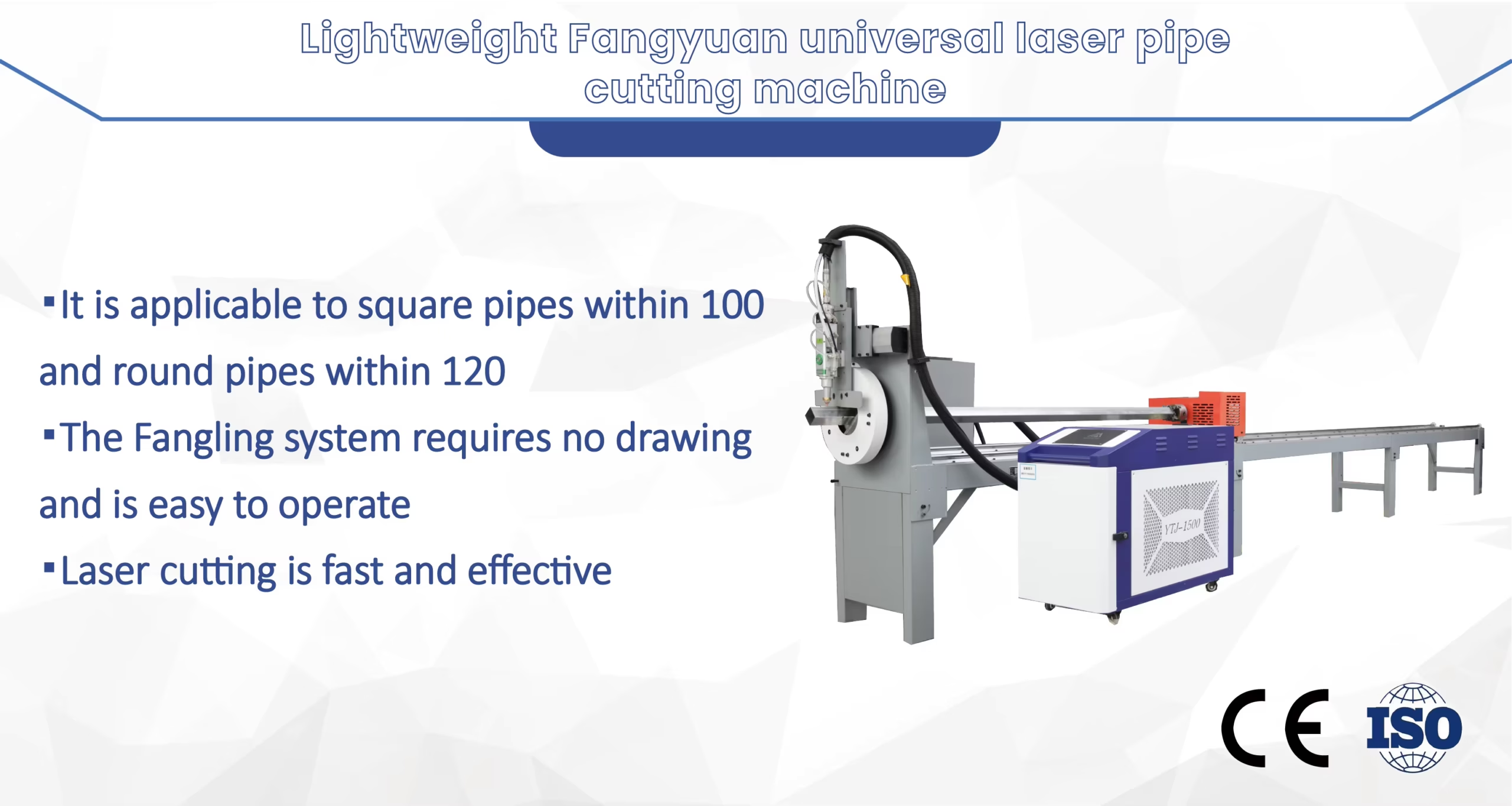
The beam delivery system utilizes a high-precision 3D cutting head capable of ±45° beveling. This is essential for creating weld-ready preparations (V, Y, and K-type joints) in a single pass. Unlike CO2 lasers, the 1.06μm wavelength of the fiber laser ensures higher absorption rates in structural steel, significantly reducing the energy input required per millimeter of cut, thereby minimizing thermal distortion across the length of a 12-meter I-beam.
3. Zero-Waste Nesting Algorithmic Logic
One of the primary bottlenecks in heavy steel processing is the high cost of raw material and the subsequent waste generated from “tailings” or end-of-bar scrap. The “Zero-Waste Nesting” technology integrated into the profiler utilizes a dynamic lead-in/lead-out optimization and common-line cutting algorithm specifically tailored for structural profiles.
In traditional processing, a minimum of 200mm to 300mm of material is often required for chuck clamping, leading to significant cumulative waste. The Zero-Waste system utilizes a dual-chuck or triple-chuck synchronization mechanism that allows the laser to process the material within the clamping zone. By utilizing “over-travel” capabilities and specialized gripper geometries, the software calculates nesting patterns that utilize the entire length of the beam. In the Jakarta project, this has resulted in a measurable reduction in raw material procurement by approximately 15-18% across the fabrication of bridge girders and station support columns.
4. Precision Engineering in I-Beam Profiling
Processing I-beams for railway applications requires more than simple cut-off operations. It involves complex bolt-hole arrays, coping cuts for interlocking joints, and drainage apertures. The 6000W profiler employs a non-contact capacitive sensing system to maintain a constant focal distance, even when transitioning between the flange and the web of the beam, where surface irregularities are common.
The CNC trajectory must account for the radius of the inner flange (the fillet). Traditional mechanical methods often fail to achieve clean cuts in these transition zones. The laser profiler’s 5-axis movement allows the nozzle to remain perpendicular to the material surface throughout the fillet transition, ensuring that bolt holes are perfectly cylindrical with no taper. This precision is vital for the Jakarta Rail project, where friction-grip bolts require a tolerance of +0.5mm/-0.0mm to ensure load distribution across the girder assembly.
5. Synergy Between Automation and Structural Integrity
The integration of the 6000W laser source with an automatic loading and unloading system eliminates human error and mechanical damage during material handling. In the Jakarta facility, the profiler is synchronized with a hydraulic storage rack. Once a profile is scanned for dimensional accuracy (compensating for any mill-induced camber or sweep), the Zero-Waste software adjusts the cutting path in real-time.
This “closed-loop” manufacturing approach ensures that every I-beam processed meets the stringent Bureau of Statistics and Standardization (BPS) requirements for Indonesian infrastructure. The speed of the 6000W laser—cutting 12mm web sections at approximately 2.5m/min—represents a 400% increase in throughput compared to manual plasma cutting, while simultaneously improving the surface finish (Ra) to levels that require no post-process grinding before welding or galvanization.
6. Mitigation of Thermal Stress and Metallurgical Considerations
A critical concern in railway engineering is the potential for brittle fracture caused by rapid cooling of the cut edge. The 6000W fiber laser, when used with oxygen as an assist gas, produces a clean, oxidized edge that is easily manageable. However, for high-cycle fatigue components in Jakarta’s rail bridges, nitrogen-assisted cutting is often preferred to prevent oxidation entirely.
The Zero-Waste Nesting software further assists in thermal management by distributing the “heat load” across the beam. Instead of cutting all features in a linear sequence, the algorithm jumps between sections of the beam to prevent localized overheating. This prevents “bowing” of the I-beam, ensuring that 12-meter sections remain straight within a 2mm tolerance over their entire length, which is a prerequisite for high-speed rail alignment.
7. Operational Field Observations from Jakarta
During the initial three months of deployment, several field-specific adjustments were made. The high humidity in Jakarta necessitated the installation of secondary air desiccant dryers and high-precision chillers to prevent condensation on the laser’s protective windows. Furthermore, due to the intermittent power fluctuations common in industrial zones, a dedicated UPS and voltage stabilizer were integrated to protect the 6000W resonator.
The transition to Zero-Waste Nesting has simplified the inventory management for the project. By maximizing the yield of each 12-meter stock beam, the fabrication site has reduced the number of “remnant” pieces that require cataloging and storage. The reduction in scrap has also decreased the carbon footprint of the project, aligning with Jakarta’s “Green Infrastructure” initiatives.
8. Conclusion
The implementation of the 6000W Heavy-Duty I-Beam Laser Profiler marks a significant technological leap for railway infrastructure fabrication in Indonesia. The convergence of high-power fiber laser technology with intelligent Zero-Waste Nesting algorithms addresses the twin challenges of precision and cost-efficiency. As Jakarta continues to expand its rail network, the ability to produce high-tolerance, structurally sound steel components with minimal waste will be the benchmark for all future heavy-duty manufacturing. The system has proven that it can maintain aerospace-level precision at a scale required for massive civil engineering projects, ensuring the safety and longevity of the city’s transport backbone.













