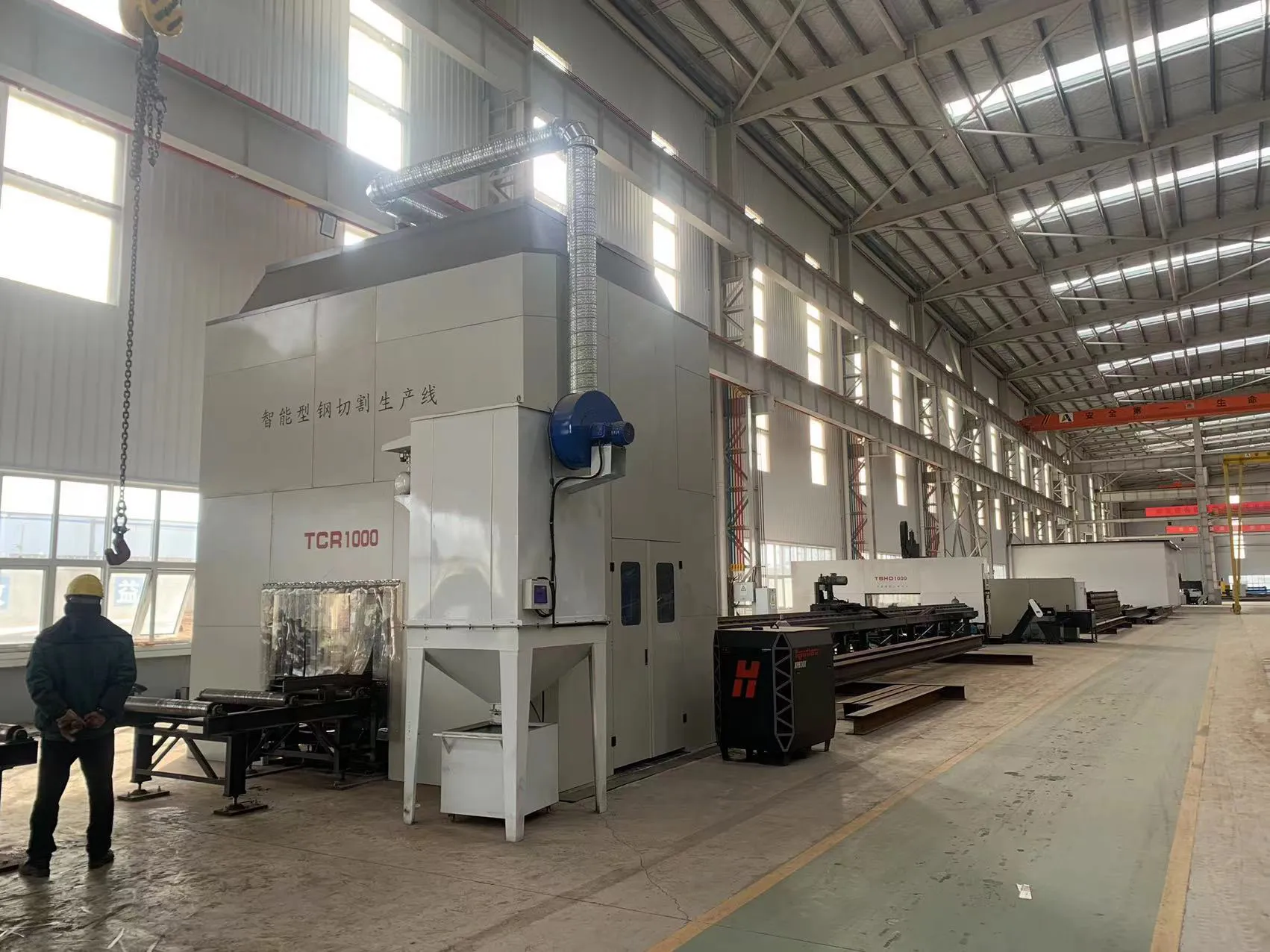
Technical Field Report: Implementation of 6000W Heavy-Duty I-Beam Laser Profiling in Dubai Power Infrastructure
1.0 Executive Summary
This report details the technical deployment and operational performance of a 6000W Heavy-Duty I-Beam Laser Profiler equipped with ±45° beveling capabilities within the power tower fabrication sector in Dubai, UAE. As the region expands its high-voltage transmission networks, the demand for high-tensile structural steel components—specifically I-beams and H-channels—has necessitated a shift from conventional plasma cutting and mechanical drilling to high-precision fiber laser processing. This transition addresses the critical tolerances required for lattice tower assembly and the stringent metallurgical standards of the UAE energy sector.
2.0 Regional Challenges and Material Specifications
Dubai’s environmental conditions and structural requirements present unique challenges for steel fabrication. Power towers must withstand high wind loads, extreme thermal expansion, and corrosive saline environments.
- Material Composition: Most structural members utilize high-strength low-alloy (HSLA) steels, such as ASTM A572 Grade 50. These materials require precise thermal management during cutting to avoid excessive Heat Affected Zones (HAZ) that could compromise structural integrity.
- Geometric Complexity: Lattice towers rely on complex intersections of I-beams where load distribution is paramount. Traditional methods often result in “fit-up” gaps, requiring extensive corrective welding.
3.0 6000W Fiber Laser Source: Power Density and Kerf Dynamics
The integration of a 6000W fiber laser source provides the necessary power density to penetrate heavy-wall I-beams (up to 25mm thickness) with high feed rates.
3.1 Thermal Management
At 6000W, the energy density allows for a stabilized melt pool. Unlike plasma arc cutting, which introduces significant lateral heat transfer, the fiber laser maintains a narrow kerf width. This is critical for power tower fabrication where bolt-hole precision is non-negotiable. The 6000W threshold is the “sweet spot” for balancing throughput with edge quality, ensuring that the dross formation is minimized, thus eliminating post-process grinding.
3.2 Gas Dynamics
In the Dubai field application, high-pressure Oxygen (O2) is utilized for carbon steel processing to leverage the exothermic reaction, while Nitrogen (N2) is reserved for thinner sections or when a weld-ready oxide-free surface is required immediately. The 6000W system’s CNC-controlled gas pressure regulation ensures consistent penetration even during the varying thicknesses encountered in I-beam flanges and webs.
4.0 ±45° Bevel Cutting: Engineering Precision in Joinery
The core technical advantage of this system is the 5-axis 3D cutting head capable of ±45° beveling. In power tower fabrication, beams rarely meet at 90° angles.
4.1 Weld Preparation Optimization
Traditional fabrication requires a secondary process—manual bevelling or milling—to create V, Y, or K-type weld preparations. The ±45° bevel profiler executes these geometries in a single pass. By programmatically adjusting the focal point and nozzle standoff in real-time, the system produces a “weld-ready” edge. This precision reduces the volume of filler metal required during the welding phase and ensures deeper penetration, which is vital for the dynamic loads of high-tension towers.
4.2 Compensating for Structural Irregularities
Heavy-duty I-beams often possess inherent “mill-tolerance” deviations (warping or twisting). The profiler utilizes advanced laser sensors to map the beam’s actual topography before cutting. The 5-axis head then adjusts its toolpath to maintain a constant focal distance, ensuring the ±45° angle is accurate relative to the beam’s actual surface, rather than a theoretical CAD model.
5.0 System Kinematics and Heavy-Duty Handling
The “Heavy-Duty” designation refers to the machine’s ability to manipulate I-beams weighing upwards of 200kg/m.
5.1 Multi-Chuck Synchronous Rotation
The system utilizes a four-chuck architecture to provide maximum rigidity. In Dubai’s large-scale fabrication facilities, beams can reach lengths of 12 meters. The synchronous rotation of the chucks prevents “torsional lag” during 3D movements. This is particularly important when executing complex bevel cuts on the web of the beam while the flanges are being supported.
5.2 Vibration Damping and Frame Stability
Given the 6000W output and the rapid acceleration of the cutting head, the machine bed is constructed from high-tensile manganese steel, stress-relieved via annealing. This prevents harmonic vibrations from affecting the cut quality—a common failure point in lighter-duty machines attempting to process heavy structural sections.
6.0 Automation and CAD/CAM Integration
The synergy between the hardware and the software stack (typically utilizing TEKLA or specialized 3D nesting software) allows for “End-to-End” processing.
- Nesting Efficiency: Automated nesting algorithms for I-beams reduce scrap rates by optimizing the sequence of cuts across multiple workpieces. In the context of Dubai’s high material costs, a 5-8% increase in material utilization significantly impacts project margins.
- Bolt Hole Precision: Power towers require thousands of bolt holes. The 6000W laser achieves a circularity tolerance of ±0.1mm, far exceeding the capabilities of mechanical punching or plasma drilling. This ensures that during field assembly in the desert, beams align perfectly without the need for reaming.
7.0 Comparative Analysis: Laser vs. Traditional Methods
A field analysis conducted during the deployment showed a marked improvement in operational metrics:
| Metric | Traditional (Plasma/Drill) | 6000W Laser Profiler |
|---|---|---|
| Processing Time (per beam) | 120 Minutes | 18 Minutes |
| Post-Process Grinding | Required (High) | Negligible |
| Hole Accuracy | ±0.5mm – 1.0mm | ±0.05mm |
| Labor Requirement | 3 Technicians | 1 Operator |
8.0 Impact on Galvanization and Coating
Dubai’s power towers are invariably hot-dip galvanized. The high-quality edge produced by the 6000W laser, characterized by its low roughness (Rz), ensures superior adhesion of the zinc coating. Unlike plasma-cut edges, which can exhibit “edge hardening” or micro-cracking that traps pickling acids, the laser-cut edge provides a stable substrate for long-term corrosion protection.
9.0 Conclusion
The deployment of the 6000W Heavy-Duty I-Beam Laser Profiler with ±45° bevel technology represents a critical evolution in Dubai’s structural steel sector. By consolidating cutting, hole-making, and weld preparation into a single automated process, fabricators can meet the aggressive timelines of the UAE’s infrastructure roadmap while upholding the highest safety and precision standards. The synergy of high-power fiber optics with 5-axis kinematics effectively eliminates the bottlenecks associated with traditional heavy steel processing, providing a scalable solution for the next generation of power transmission architecture.
10.0 Technical Recommendations
1. Focal Lens Maintenance: Given the ambient dust levels in Dubai, a pressurized, triple-filtered clean room environment for the laser source is mandatory to prevent lens contamination.
2. Assist Gas Purity: A minimum of 99.999% purity for Nitrogen assist gas is recommended to maintain the oxide-free edge required for immediate galvanization.
3. Software Calibration: Weekly calibration of the 3D sensing probe is necessary to compensate for the thermal expansion of the machine’s own 12-meter gantry in non-climate-controlled environments.













