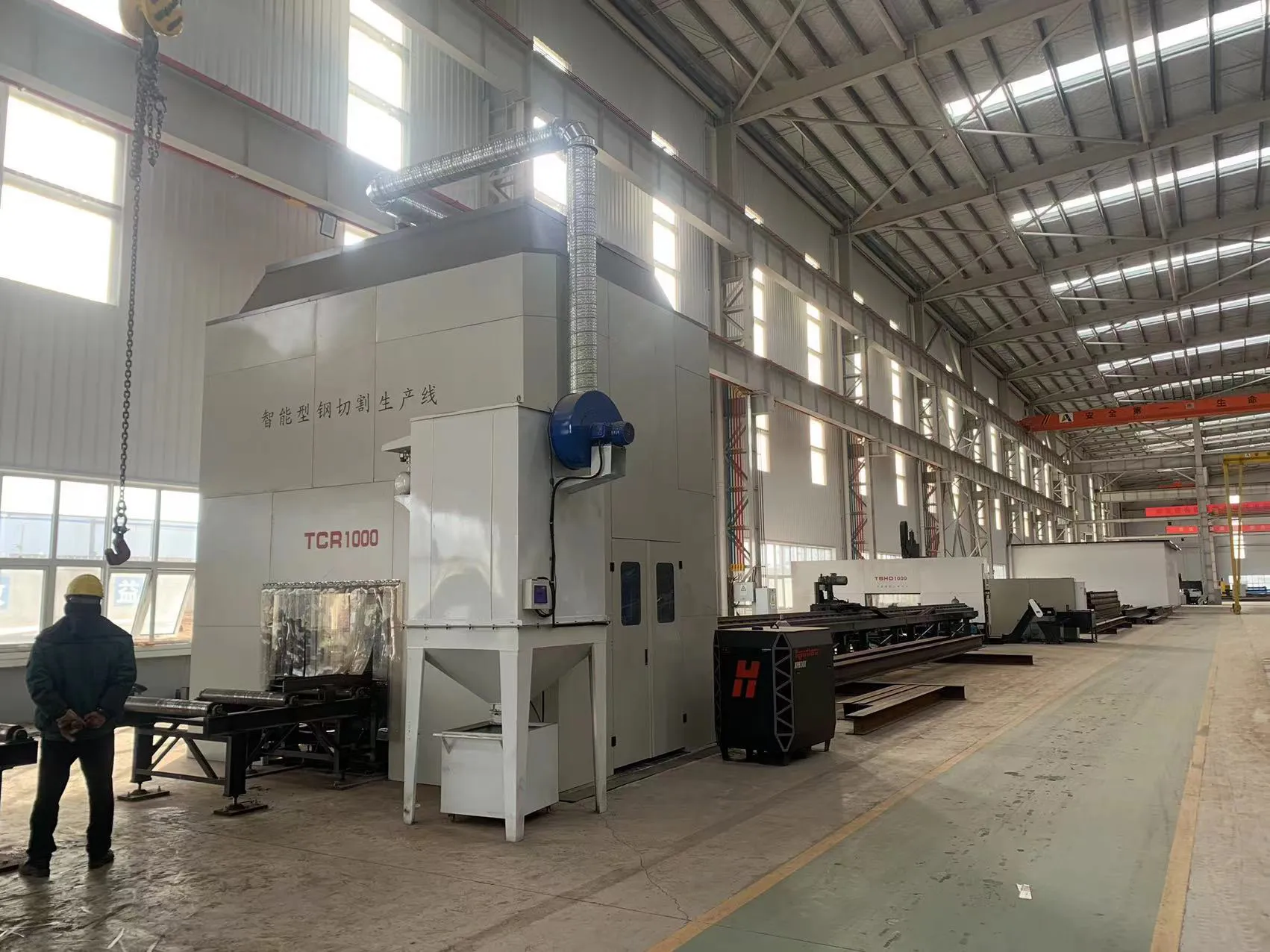
Technical Field Report: Integration of 6000W Heavy-Duty Structural Laser Profiling in Monterrey Offshore Fabrication
1.0 Introduction and Site Context
This report evaluates the deployment and operational performance of a 6000W Heavy-Duty I-Beam Laser Profiler equipped with a 5-axis ±45° beveling head within the industrial corridor of Monterrey, Mexico. Monterrey has solidified its position as a critical fabrication hub for offshore platform components destined for the Gulf of Mexico. The transition from traditional mechanical and plasma-based profiling to high-wattage fiber laser technology represents a fundamental shift in structural steel processing.
The offshore sector demands extreme structural integrity, where I-beams and H-sections form the primary skeletal structures of topsides and jackets. These components must withstand corrosive environments and cyclic loading. The technical objective of this deployment was to eliminate secondary machining processes and manual weld preparation through high-precision laser geometry.
2.0 6000W Fiber Laser Source Dynamics in Structural Steel
The selection of a 6000W power rating is calculated based on the material thickness common in offshore engineering (typically 12mm to 25mm for primary beam webs and flanges). At this power density, the fiber laser achieves a balance between cutting speed and kerf quality.
The 6000W source provides sufficient photon density to maintain a stable plasma cap during the fusion cutting process. In the context of Monterrey’s heavy-duty fabrication shops, the energy efficiency of the 6000W fiber source over traditional CO2 or high-definition plasma systems results in a significantly reduced Heat Affected Zone (HAZ). Minimizing the HAZ is critical for offshore platforms to prevent hydrogen embrittlement and fatigue cracking at the joinery. The beam quality (BPP) of the 6000W source ensures that even at the extremities of a 12-meter I-beam, the focal point remains consistent, preventing taper errors that exceed the ±0.5mm tolerance required by structural codes like AWS D1.1.
3.0 ±45° Bevel Cutting: Technical Implementation
The cornerstone of this profiler is the 5-axis kinematic head capable of ±45° beveling. In traditional structural steel processing, I-beams are cut to length, then moved to a separate station for manual grinding or oxy-fuel beveling to create weld preparations (V, Y, and K-type joints).
3.1 Geometric Accuracy and Kinematics
The laser profiler utilizes a specialized 3D cutting head that compensates for the flange-to-web thickness variations inherent in hot-rolled I-beams. The ±45° capability allows for the simultaneous cutting of the profile and the weld prep. For offshore platform jackets, where beams intersect at complex compound angles, the ability to laser-cut a 45-degree bevel with a constant root face is transformative.
The control system employs real-time height sensing. Because structural steel is rarely perfectly straight—often possessing “mill sweep” or “camber”—the laser head must dynamically adjust its Z-axis and tilt angle to maintain the stand-off distance relative to the material surface. In Monterrey’s high-throughput environments, this automation reduces the margin of human error associated with manual layout and beveling.
3.2 Weld Preparation Optimization
The precision of a laser-cut bevel (within ±0.3° angular tolerance) significantly reduces the volume of filler metal required during the welding phase. By achieving a precise ±45° bevel, the “gap-up” during fit-up is minimized. This leads to a reduction in the number of weld passes required for full-penetration joints, which are ubiquitous in offshore topside modules.
4.0 Application in Monterrey’s Offshore Platform Sector
Monterrey’s fabrication facilities serve as the backbone for PEMEX and international offshore contractors. The requirements for deep-water platforms necessitate the use of high-strength low-alloy (HSLA) steels.
4.1 Structural Integrity and Fatigue Resistance
Offshore structures are subject to constant wave action. A laser-cut I-beam edge is superior to a plasma-cut edge because it lacks the micro-cracking and dross adhesion typical of high-heat input processes. The 6000W laser produces a surface finish that often meets the Rz 20-40 micron range, eliminating the need for post-cut grinding before coating. In Monterrey’s arid but dusty climate, the enclosed nature of the laser profiler also protects the optical path and the material surface from environmental contaminants that could lead to weld porosity.
4.2 Complex Intersection Profiling
Offshore platforms involve complex “node” intersections where multiple I-beams converge. The profiler’s software handles the unfolding of these 3D intersections, allowing the ±45° head to cut the “fish-mouth” or complex saddle cuts required for seamless fit-up. This level of geometric complexity, when handled by the 6000W profiler, reduces the assembly time of a platform deck section by an estimated 40% compared to traditional methods.
5.0 Automatic Structural Processing and Synchronization
The “Heavy-Duty” designation of the profiler refers not just to the laser power, but to the material handling system. The Monterrey site report confirms that the synchronization between the CNC controller and the automated chucking system is vital for maintaining the structural integrity of the beam.
5.1 Large-Scale Material Handling
A standard offshore I-beam can weigh several tons. The profiler utilizes a synchronized dual-chuck or multi-point support system that prevents “bowing” during the rotation of the beam. As the beam rotates to allow the ±45° head to access the lower flange, any deflection would result in a ruined cut. The heavy-duty pneumatic chucks provide the necessary clamping force to ensure the beam’s center of rotation remains coaxial with the machine’s A-axis.
5.2 Software Integration (BIM to G-Code)
The integration of Tekla Structures and other BIM (Building Information Modeling) software directly with the laser’s NC path generation is a prerequisite for Monterrey’s modern engineering workflows. The software accounts for the ±45° tilt and automatically calculates the necessary lead-ins and lead-outs to ensure the laser doesn’t gouge the opposing flange or the web during the transition between surfaces.
6.0 Metallurgical Considerations and Gas Dynamics
In the 6000W range, the choice of assist gas—Oxygen (O2) versus Nitrogen (N2)—is dictated by the specific offshore application.
– **Oxygen Cutting:** Used for thick section carbon steel (A36, A572). The exothermic reaction assists the 6000W laser, allowing for faster speeds on 20mm+ flanges, though it leaves a thin oxide layer that must be removed before painting.
– **Nitrogen/Air Cutting:** While requiring higher pressures, nitrogen cutting at 6000W produces a clean, oxide-free edge. For Monterrey shops focusing on stainless steel components for offshore desalination or chemical modules, this is the preferred method to maintain corrosion resistance.
The report observes that the laminar flow nozzles on the bevel head are critical. During a 45-degree tilt, the gas flow tends to become turbulent as it hits the material at an angle. The advanced nozzle design of this profiler maintains a coherent gas column, ensuring the molten metal is ejected cleanly from the kerf, even at maximum tilt.
7.0 Efficiency Gains and ROI Analysis
Data from the Monterrey field site indicates a significant reduction in Total Cost of Ownership (TCO) per processed ton. While the CAPEX for a 6000W heavy-duty laser is higher than a plasma system, the operational savings are found in:
1. **Elimination of Secondary Operations:** Manual beveling and grinding costs are reduced by 85%.
2. **Consumable Longevity:** Fiber laser nozzles and protective windows have a significantly longer lifespan than plasma electrodes and nozzles.
3. **Fit-up Speed:** The accuracy of the laser-cut profiles allows for “snap-together” assembly on the shop floor, reducing the man-hours required for fitters and tack-welders.
8.0 Conclusion
The deployment of the 6000W Heavy-Duty I-Beam Laser Profiler with ±45° Bevel Cutting technology in Monterrey represents the pinnacle of current structural steel fabrication. For the offshore platform sector, where precision is synonymous with safety and longevity, the ability to automate the profiling and beveling of heavy sections is no longer a luxury but a technical necessity. The synergy between high-wattage fiber sources and 5-axis motion control solves the long-standing industry bottleneck of manual weld preparation, ensuring that Monterrey remains a competitive leader in global offshore engineering.













