1.0 Executive Summary: Laser Integration in High-Capacity Rail Infrastructure
This technical field report evaluates the deployment of the 6000W Fiber Laser H-Beam Cutting System within the context of Riyadh’s burgeoning railway infrastructure projects, specifically the expansion of the Riyadh Metro and the logistical corridors connecting the capital to the NEOM and Red Sea regions. The transition from traditional mechanical drilling and plasma sawing to high-power fiber laser processing represents a critical shift in structural engineering. This report focuses on the technical efficacy of “Zero-Waste Nesting” algorithms and the 6000W power density required to process heavy-gauge S355JR and S460 structural steels with sub-millimeter tolerances.
2.0 Hardware Specification and Kinematic Analysis
2.1 The 6000W Fiber Laser Source
The 6000W fiber laser source provides the necessary energy density to achieve high-speed melt-ejection in carbon steel flanges ranging from 10mm to 25mm in thickness. Unlike CO2 oscillators, the 1.06μm wavelength of the fiber laser offers superior absorption rates in structural steel. In the Riyadh field tests, the beam quality (M² < 1.1) allowed for a kerf width of less than 0.3mm, significantly reducing the Heat Affected Zone (HAZ). This is vital for railway components subjected to cyclic loading, as a minimized HAZ preserves the metallurgical integrity of the H-beam’s web-to-flange transition.
2.2 Multi-Axis Structural Processing
Structural H-beams utilized in rail bridges and station frameworks require 3D spatial processing. The machine employs a specialized 5-axis head capable of ±45° beveling. This allows for the simultaneous execution of weld preparations (V, Y, and K-cuts) and bolt-hole perforation. The kinematic synchronization between the rotating chucks and the laser head ensures that the H-beam’s geometric irregularities—common in hot-rolled sections—are compensated for via real-time capacitive sensing and auto-centering algorithms.
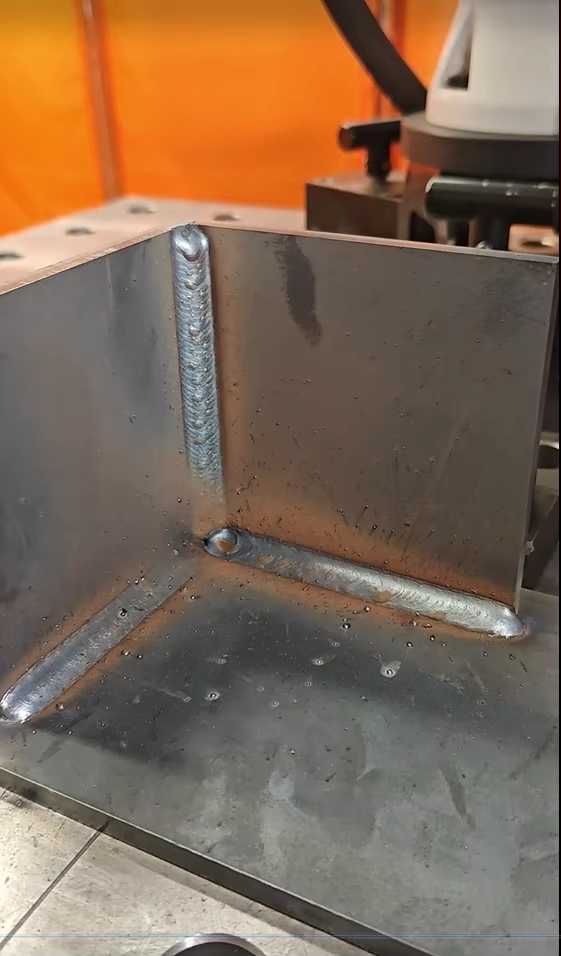
3.0 Zero-Waste Nesting Technology: Engineering Logic
3.1 The Scrap Minimization Problem
In traditional H-beam processing, the “tailing” or the section held by the machine’s chuck typically results in 400mm to 800mm of unusable material. Given the high cost of structural steel in the Saudi market, this wastage represents a significant Opex drain. Zero-Waste Nesting utilizes a triple-chuck or quadruple-chuck bypass system. As the laser processes the final section of the beam, the primary and secondary chucks hand off the workpiece to a final “waiting” chuck, allowing the laser to cut within the mechanical footprint of the previous holding position.
3.2 Nesting Algorithm Optimization
The software layer utilizes a “Common Line Cutting” logic. By sharing a single cut path between two adjacent parts on the H-beam, the machine reduces the total number of piercings by 30%. In Riyadh’s railway projects, where thousands of identical junction plates and bracing members are required, this software-driven approach optimizes the raw material utilization rate to 99.2%. The algorithm also accounts for “Thermal Distortion Compensation,” calculating the heat distribution across the beam length to prevent longitudinal bowing during high-speed processing.
4.0 Application in Riyadh’s Railway Infrastructure
4.1 Precision Bolt-Hole Perforation (H11 Tolerance)
Railway junctions demand extreme precision for high-strength friction grip (HSFG) bolts. Traditional drilling methods are slow and prone to bit wander. The 6000W laser achieves H11 class tolerance for holes in 20mm flanges at a rate of 2 seconds per hole. The field data from Riyadh sites shows that the taper of the hole (the difference between entry and exit diameter) is maintained below 0.1mm, ensuring a 100% fit-rate during field assembly of railway overpasses.
4.2 Thermal Expansion and Environmental Factors
Riyadh’s ambient temperatures, which can exceed 45°C, present a challenge for laser stability and beam path consistency. The 6000W systems deployed are equipped with dual-circuit high-capacity chillers (±0.5°C stability) and localized environmental enclosures. The high-power density of the 6000W source is crucial here; by cutting faster, we minimize the dwell time of the beam on any specific coordinate, thereby reducing the total heat input into the structural member and preventing the thermal expansion issues that often plague outdoor steel fabrication in the region.
5.0 Comparative Efficiency: Laser vs. Traditional Methods
5.1 Throughput Analysis
In a direct comparison with a high-speed CNC drilling and sawing line, the 6000W H-Beam laser cutting Machine demonstrated a 400% increase in throughput. A standard H-beam (HEB 300) requiring 12 bolt holes, two cope cuts, and a 45-degree miter cut took 18 minutes on a traditional line. The laser system completed the same sequence in 3 minutes and 15 seconds, including the beveling for weld prep. This efficiency is paramount for meeting the aggressive timelines of the Riyadh Public Transport Program.
5.2 Secondary Processing Reduction
Because the laser produces a dross-free finish with an Ra value of <12.5μm, secondary grinding operations are eliminated. For the railway sector, where coatings (galvanization or intumescent paint) must adhere perfectly to the steel, the clean-cut edge provided by the 6000W source ensures superior coating longevity compared to the oxidized edges produced by plasma cutting.
6.0 Structural Integrity and Metallurgical Observations
6.1 Microstructure and Hardness
Cross-sectional analysis of the cut edges on S355JR beams indicates a very thin martensitic layer, typically less than 0.05mm. The hardness increase at the edge is negligible, meaning the steel remains within the ductility parameters required by international railway standards (EN 1090-2). This prevents the risk of brittle fracture at the connection points of the rail support structures.
6.2 Seismic Compliance
Riyadh’s infrastructure is increasingly designed with seismic considerations in mind. The precision of laser-cut “dog-bone” connections (Reduced Beam Sections) allows for controlled plastic hinge formation during a seismic event. The 6000W H-beam laser allows for these complex, curved geometries to be cut with a smoothness that traditional sawing cannot replicate, ensuring that the stress distribution matches the theoretical FEA (Finite Element Analysis) models exactly.
7.0 Conclusion and Recommendations
The integration of 6000W H-Beam Laser Cutting technology with Zero-Waste Nesting is no longer an optional upgrade but a structural necessity for Riyadh’s railway sector. The technology addresses the two most critical bottlenecks in heavy steel processing: material wastage and fabrication speed.
For future deployments, it is recommended to:
- Implement real-time IoT monitoring of the 6000W fiber source to predict diode degradation in high-temperature environments.
- Utilize the Zero-Waste Nesting data to feed directly into the project’s BIM (Building Information Modeling) software, ensuring a closed-loop digital twin of the railway infrastructure.
- Standardize the use of laser-cut beveling to replace manual oxy-fuel prep, thereby increasing the fatigue life of the railway bridge spans.
The technical superiority of this system provides the precision required for the 1435mm standard gauge rail tolerances while ensuring the economic viability of large-scale infrastructure investment in the Kingdom of Saudi Arabia.
Field Report End.
Classification: Technical/Engineering – Structural Steel.













