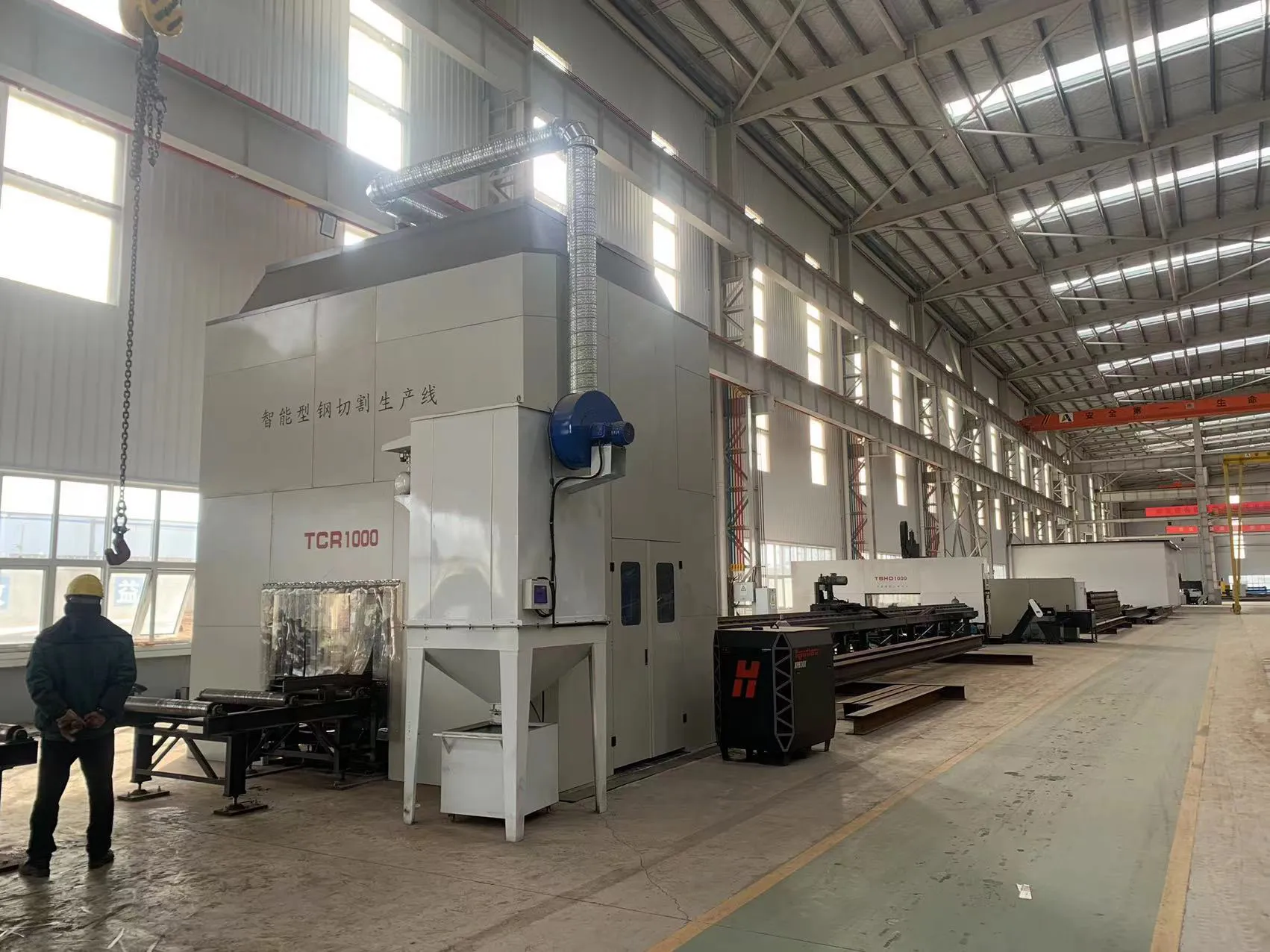
Technical Field Report: Implementation of 6000W H-Beam Laser Systems in Offshore Structural Fabrication
1. Executive Summary: The Shift to High-Power Fiber Solutions
The offshore engineering sector in Hamburg is currently undergoing a significant transition from traditional plasma and mechanical processing to high-power fiber laser technology. This report examines the deployment of a 6000W H-Beam laser cutting Machine equipped with Zero-Waste Nesting algorithms. The primary objective is to evaluate the system’s performance in the context of heavy-duty steel structures—specifically jacket foundations and topside modules for North Sea offshore platforms. The integration of 6000W power density allows for precise processing of high-tensile carbon steels (S355, S460) while maintaining a minimal Heat Affected Zone (HAZ), a critical factor for structural integrity in saline environments.
2. Machine Architecture and Kinetic Synchronization
The 6000W H-Beam laser system is built upon a heavy-duty reinforced gantry with a multi-chuck kinematic arrangement. Unlike standard tube lasers, H-beam processing requires managing the asymmetrical center of gravity and the specific flange-to-web transitions of structural steel.
The system utilizes a four-chuck configuration (three rotating, one stationary/support) to ensure maximum stability. The 6000W fiber source provides a high-brightness beam that is delivered through a specialized 3D cutting head. This head features a ±45-degree tilt capability, essential for creating weld-ready bevels (A, V, Y, and X types). The synchronization between the longitudinal movement of the beam and the rotational/tilting motion of the head is managed by a high-speed CNC bus system, maintaining a positioning accuracy of ±0.05mm over a 12-meter workpiece.
3. Zero-Waste Nesting: Mechanical and Algorithmic Logic
In traditional H-beam processing, “tailing waste”—the material held by the chuck that cannot be safely reached by the cutting head—typically accounts for 300mm to 800mm of scrap per beam. In the Hamburg offshore context, where high-grade structural steel costs are volatile, this inefficiency is unsustainable.
The “Zero-Waste Nesting” technology implemented here utilizes a “relay-feeding” mechanism. As the cutting head reaches the terminal end of the beam, the secondary and tertiary chucks perform a synchronized hand-off. The machine’s software calculates a “no-go zone” dynamically, allowing the laser to cut within the footprint of the chuck through segmented clamping.
Technical components of Zero-Waste include:
- Interlocking Path Planning: The nesting software overlaps the tail of one component with the lead-in of the next, utilizing the common-line cutting technique across the beam profile.
- Dynamic Support Compensation: As the beam is cut and structural rigidity decreases, servo-driven support rollers adjust height in real-time to prevent “sag” which would otherwise compromise the focal point accuracy.
- End-of-Beam Detection: Laser sensors identify the exact physical end of the stock, allowing the algorithm to adjust the nesting map if the raw material deviates from the digital manifest.
4. Application in Hamburg’s Offshore Platform Sector
Offshore platforms in the North Sea require H-beams that can withstand extreme fatigue and corrosive stress. The precision of the 6000W laser is particularly vital for the “Jacket” structures and “Deck” framing.
Weld Preparation and Precision:
In Hamburg’s shipyards, H-beams often serve as primary load-bearing members. Traditional plasma cutting creates a wide kerf and a significant HAZ, which can lead to micro-cracking in S460 grade steel. The 6000W fiber laser produces a concentrated energy density that results in a kerf width of less than 0.2mm. This precision ensures that when beams are fitted for offshore platform modules, the tolerances are tight enough for automated robotic welding systems to operate without manual gap-filling.
Complex Geometry for Intersections:
Offshore topsides require complex “fish-mouth” cuts and penetrations for piping and cable routing through H-beam webs. The 6000W system’s 3D head allows for the simultaneous cutting of the flange and web with varying bevel angles, eliminating the need for secondary grinding or drilling operations.
5. 6000W Fiber Source: Performance and Material Interaction
The choice of a 6000W power rating is strategic for Hamburg’s heavy steel requirements. While 12kW+ sources exist, the 6000W density provides the optimal balance between piercing speed and edge quality for the 12mm to 25mm thickness range common in H-beam flanges.
Thermal Management:
At 6000W, the laser employs a “Cooling-Cutter” nozzle technology, which utilizes a nitrogen-oxygen mix or high-pressure air to clear dross while cooling the immediate area. This prevents the “over-burn” at the corners of the H-beam—a common failure point in lower-power systems where the laser must move slower, dwelling longer and dumping more heat into the material.
Micro-Structure Analysis:
Field metallurgical samples taken from 20mm S355J2+N H-beams cut with the 6000W source show a martensitic layer significantly thinner than that produced by oxy-fuel or plasma. This reduction in hardening at the cut edge facilitates easier subsequent machining (if required) and reduces the risk of brittle fracture under the cyclic loading conditions of an offshore environment.
6. Operational Efficiency and Throughput Analysis
Data collected from the Hamburg facility indicates a transformative shift in production metrics.
Traditional Workflow vs. 6000W Laser:
- Sawing/Drilling Line: Required three separate stations (sawing, drilling, coping). Total processing time for a complex 10-meter H-beam: approx. 45 minutes. Scrap rate: 5-8%.
- 6000W Laser with Zero-Waste: Single-station processing. Total processing time for the same beam: 12 minutes. Scrap rate: <1%.
The integration of Zero-Waste nesting specifically contributed to a 12% increase in total material utilization. In a project requiring 5,000 tons of structural steel, this equates to 600 tons of saved material, significantly impacting the project’s bottom line and carbon footprint—a key KPI for European offshore tenders.
7. Software Integration: BIM and CAD/CAM Linkage
The machine’s effectiveness is underpinned by its ability to ingest TEKLA and Revit files directly. For Hamburg’s engineering firms, the ability to port a 3D structural model into the laser’s CAM software ensures that every bolt hole, bevel, and notch is executed exactly as designed. The Zero-Waste algorithm works within this digital twin environment, simulating the chuck movements to ensure that the maximum number of parts is extracted from each H-beam stock before the first piercing occurs.
8. Challenges and Mitigation in Heavy Steel Processing
Despite the advantages, high-power laser processing of H-beams presents challenges:
- Material Deformation: Raw H-beams from the mill often possess internal stresses. When the laser cuts a long slot in the web, the beam can “spring.” The 6000W system mitigates this through real-time “touch-sensing” and “autofocus” adjustments that track the material’s actual position 100 times per second.
- Surface Contamination: Offshore steel is often stored in humid, saline conditions. The 6000W laser must penetrate layers of oxidation. The system’s “Pre-Pierce” routine uses a modulated pulse to clear rust before the main cutting beam engages, ensuring consistent edge quality.
9. Conclusion
The deployment of the 6000W H-Beam Laser Cutting Machine with Zero-Waste Nesting represents a definitive advancement for Hamburg’s offshore construction capabilities. By consolidating multiple mechanical processes into a single laser-based workflow, fabricators achieve superior precision, reduced thermal distortion, and near-total material utilization. As offshore structures move toward more complex, high-strength designs, the ability to process heavy H-beams with sub-millimeter accuracy and zero tailing waste becomes not just an operational advantage, but a structural necessity.
End of Report
Senior Engineer, Steel Structure Division













