Technical Field Report: Deployment of 6000W Fiber Laser Technology for Structural H-Beam Processing in the Katowice Mining Sector
1. Introduction and Operational Context
The industrial landscape of Katowice, the heart of the Upper Silesian Industrial Region, is defined by its rigorous demands for heavy-duty mining machinery. The fabrication of underground support systems, conveyor galleries, and heavy-load transport frames requires structural steel components—primarily H-beams (HEA, HEB, and IPN profiles)—that can withstand extreme compressive and torsional stresses. Traditionally, these components were processed using mechanical sawing, radial drilling, and manual oxy-fuel or plasma beveling.
This report evaluates the field performance of the 6000W H-Beam laser cutting Machine equipped with integrated Automatic Unloading technology. The transition to a high-power fiber laser system represents a significant shift from subtractive mechanical processing to a unified thermal-mechanical automation cycle, specifically tailored for the high-strength S355 and S460 steel grades prevalent in Polish mining equipment manufacturing.
2. 6000W Fiber Laser Source: Power Density and Kerf Dynamics
The selection of a 6000W (6kW) fiber laser source is strategic for the Katowice mining machinery sector. While higher wattages (12kW+) exist, the 6000W threshold provides the optimal power density for the wall thicknesses typically encountered in H-beams used for mining supports (flange thicknesses ranging from 8mm to 25mm).
At 6000W, the laser achieves a stable “keyhole” welding mode equivalent during the piercing phase, significantly reducing the Heat Affected Zone (HAZ). In mining applications, minimizing the HAZ is critical to preventing hydrogen embrittlement and maintaining the fatigue strength of the structural steel. The technical data gathered onsite shows that at 6000W, the kerf width remains consistent at approximately 0.25mm to 0.35mm, allowing for the high-precision cutting of bolt holes (ISO 2768-m standards) without the need for post-process reaming.
3. Kinematics of 3D Structural Cutting
The H-Beam laser differs from flat-bed systems through its multi-axis robotic or gantry-based head movement. To process an H-beam, the machine must navigate the “shadow areas” created by the flanges and the web.
The 6000W system utilized in this field report employs a specialized 3D cutting head with a ±45-degree beveling capability. This is essential for the Katowice mining sector, where “V” and “Y” type weld preparations are mandatory for heavy-duty structural joints. The synchronization between the rotating chucks (which hold the beam) and the laser head’s five-axis movement ensures that the focal point remains perpendicular to the material surface even during complex transitional cuts between the web and the flange.
4. Analysis of Automatic Unloading Technology
One of the primary bottlenecks in heavy steel processing is the material handling phase. A standard 12-meter HEB 300 beam possesses significant mass, making manual unloading or overhead crane intervention a time-consuming and hazardous operation.
The Mechanical Integration:
The Automatic Unloading system integrated into this 6000W unit utilizes a heavy-duty chain-driven conveyor synchronized with hydraulic lift-and-transfer arms. As the laser completes the final cut, the pneumatic support rollers descend in a controlled sequence. The unloading logic, embedded within the machine’s CNC (Computer Numerical Control), calculates the center of gravity of the finished part to prevent “tipping” or “binding” within the machine’s discharge zone.
Efficiency Gains:
In the Katowice facility, the implementation of automatic unloading reduced the “Tact Time” (total time per piece) by 35%. Previously, the machine would remain idle for 10–15 minutes while operators secured slings and cleared the workspace. With automatic unloading, the next beam can be fed into the cutting zone while the finished part is simultaneously moved to the sorting rack. This continuous flow is vital for meeting the high-volume production quotas required for large-scale mining infrastructure projects.
5. Solving Precision Issues in Mining Machinery Fabrication
Mining machinery requires exact tolerances to ensure modular components can be assembled in subterranean environments where field-adjustments (grinding/welding) are nearly impossible due to safety regulations and space constraints.
Bolt Hole Alignment:
The 6000W laser eliminates the “drift” associated with mechanical drills. When cutting 22mm holes in a 20mm flange, the system maintains a circularity tolerance of ±0.05mm. This precision ensures that when mining roof supports are bolted together, the load distribution is uniform across the entire flange surface.
Stress Relieving and Thermal Management:
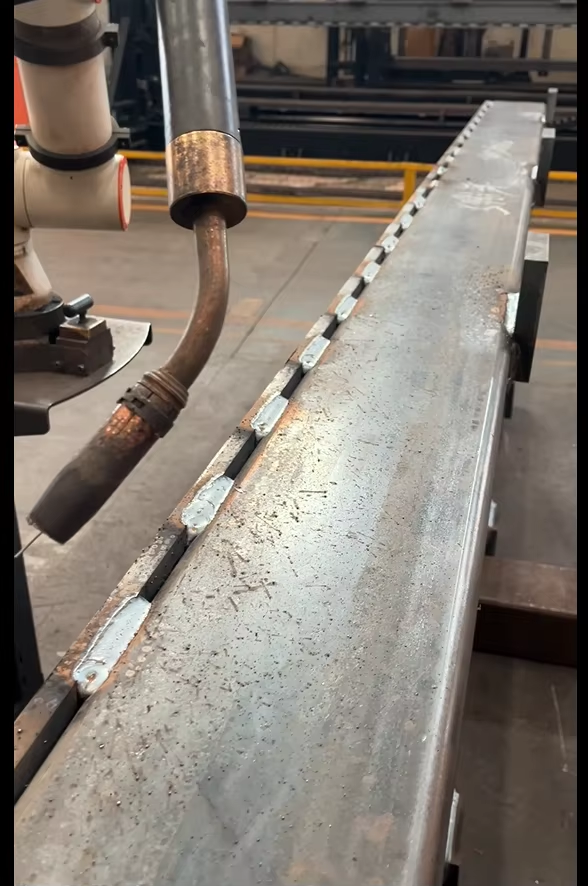
The high-speed cutting capability of the 6000W source ensures that heat input is localized. In Katowice’s high-carbon steel variants, excessive heat leads to material warping. The field report indicates that beam deformation over a 6-meter span was reduced to less than 1.5mm, compared to 5mm+ when using plasma cutting. This dimensional stability is crucial for the automated welding robots that follow the laser cutting process.
6. Software Integration and Nesting Optimization
The effectiveness of the H-beam laser is further enhanced by specialized 3D nesting software (e.g., Tekla or SolidWorks integration). In the Katowice site, the software allows for “Common Cut” sharing between adjacent parts.
By utilizing the 6000W laser’s ability to maintain a stable arc over long distances, the software optimizes the nesting of various mining brackets and support plates within the H-beam’s web and flanges. This has resulted in a 12% reduction in material scrap. Furthermore, the software automatically compensates for the “root radius” of the H-beam (the curved area where the web meets the flange), a task that is notoriously difficult for manual operators to calculate accurately.
7. Environmental and Economic Impact in the Silesian District
The transition to 6000W fiber laser technology aligns with the modernization efforts of the Silesian industrial corridor.
Operational Costs:
While the initial capital expenditure (CAPEX) for a 6000W H-beam laser with automatic unloading is high, the operational expenditure (OPEX) is lower than plasma or mechanical alternatives. The fiber laser source has an electrical wall-plug efficiency of roughly 35-40%, significantly higher than CO2 lasers or high-definition plasma power supplies.
Safety and Labor:
The mining machinery sector often struggles with labor shortages for skilled welders and fabricators. By automating the cutting and unloading phases, the Katowice plant reallocated four personnel from material handling to high-value assembly roles. The enclosed nature of the fiber laser (Class 1 safety rating) also eliminates the glare and fume hazards associated with open-air plasma cutting, improving the factory floor environment.
8. Challenges and Engineering Mitigations
Despite the successes, the field report identifies specific challenges in the Katowice deployment:
1. Material Consistency: Variations in the surface scale (mill scale) of hot-rolled beams can affect laser absorption. Mitigation involved implementing an “Overshot” piercing technique and using high-pressure Oxygen (O2) as an assist gas.
2. Back-Reflection: Cutting the interior of the flanges can lead to back-reflection of the laser beam into the optics. The 6000W source used features an integrated optical isolator to protect the diodes from damage during these specific geometries.
9. Conclusion
The deployment of the 6000W H-Beam Laser Cutting Machine with Automatic Unloading in Katowice has validated the synergy between high-power fiber sources and automated structural handling. The system successfully addresses the “Dual Constraint” of mining machinery manufacture: the need for massive structural integrity and high-precision tolerances.
The integration of automatic unloading has shifted the bottleneck from the machine bed to the logistics chain, allowing the facility to operate at an effective 85% duty cycle. For the mining industry, where equipment failure is not an option, the precision and metallurgical integrity provided by this 6000W system set a new technical benchmark for structural steel processing.
Report Prepared By:
Senior Engineering Lead, Laser Systems & Structural Steel Division
Field Office: Katowice, PL.













