1.0 Technical Overview: The 6000W Fiber Laser in Structural Frameworks
The integration of 6000W fiber laser sources into CNC beam and channel processing represents a critical shift from traditional mechanical sawing and plasma thermal cutting. In the context of Dubai’s high-velocity construction environment, the 6000W threshold is not merely a power metric but a necessity for maintaining feed rates across heavy-wall structural sections. At this power density, the laser maintains a stable kerf width while processing S355JR and S355J2+N carbon steel—the primary alloys utilized in modular frames.
The 6000W source provides the requisite photon density to achieve high-speed sublimation and melt-ejection cycles. When processing I-beams (IPE) and Channels (UPN), the laser maintains a narrow Heat Affected Zone (HAZ), which is vital for preserving the metallurgical integrity of the steel. In modular construction, where structural members are often subjected to repetitive stress and high-load transfers, minimizing the HAZ ensures that the base material’s yield strength is not compromised during the fabrication phase.
1.1 Beam-Material Interaction and Gas Dynamics
The synergy between the 6000W source and the CNC controller allows for real-time frequency modulation. This is particularly relevant when navigating the varying thicknesses of a structural beam (e.g., the transition from the web to the flange). The system utilizes high-pressure Nitrogen for thin-walled sections to ensure oxide-free edges, while Oxygen-assisted cutting is deployed for thicker flanges to leverage the exothermic reaction, thereby maintaining cutting speeds exceeding 1.2 m/min on 15mm sections. This level of efficiency is unattainable via traditional CNC plasma systems, which suffer from angularity errors and excessive dross accumulation.
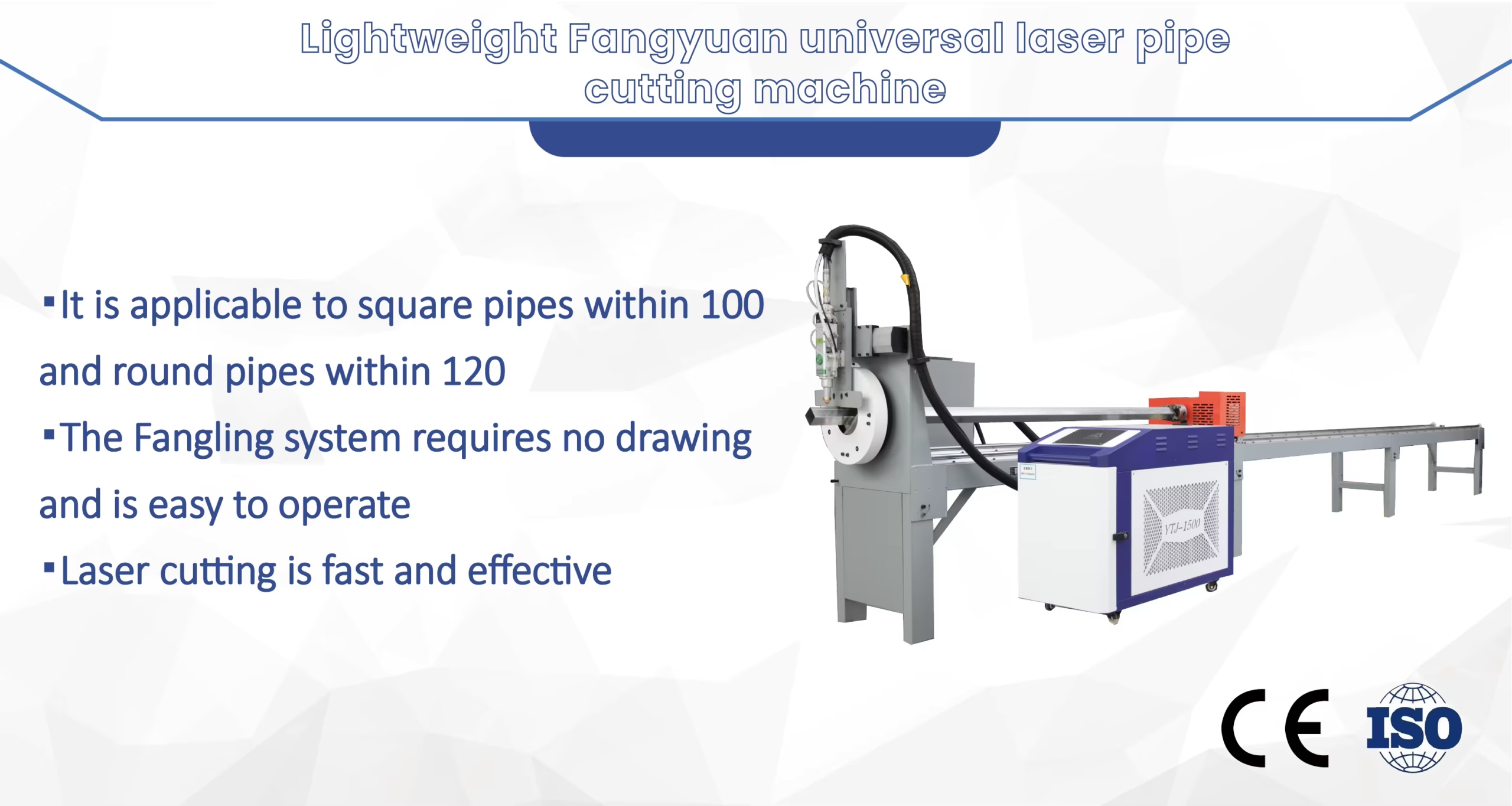
2.0 Infinite Rotation 3D Head: Kinematics and Geometric Fidelity
The “Infinite Rotation” 3D head is the core technological differentiator in this field report. Unlike standard 5-axis heads that are limited by cable winding and require “unwinding” cycles, the infinite rotation capability utilizes advanced slip-ring technology or high-flex internal cabling to allow the cutting head to rotate 360 degrees (and beyond) without interruption. This is critical when executing complex 3D geometries such as “bird-mouth” joints, miter cuts, and multi-planar weld preparations.
2.1 Weld Preparation and Beveling Capabilities
In modular construction, the efficiency of the assembly line depends on the “fit-up” quality. The 3D head allows for precision beveling (V, X, Y, and K-shaped cuts) directly on the laser cutter. By achieving ±45-degree tilt angles with infinite rotation, the system can prep a structural channel for welding in a single pass. This eliminates the need for secondary manual grinding—a process that is historically prone to human error and high labor costs in the UAE’s industrial zones.
The infinite rotation ensures that when the laser tracks around the radius of an H-beam flange, the nozzle orientation remains perfectly perpendicular or at the programmed bevel angle relative to the surface tangent. This constant orientation control prevents the “gouging” effect often seen in 4-axis systems, ensuring a uniform root gap for automated welding robots downstream.
3.0 Application in Dubai’s Modular Construction Sector
Dubai’s construction landscape is increasingly pivoting toward modularization to meet the demands of the “Dubai 2040 Urban Master Plan.” Modular construction involves the off-site fabrication of steel volumetric units which are then transported and stacked on-site. This requires tolerances that are an order of magnitude tighter than traditional site-built steelwork.
3.1 High-Rise Modular Tolerances
When stacking modular units 20 to 40 stories high, a cumulative error of even 2mm per module can lead to catastrophic structural misalignment. The 6000W CNC Beam Laser ensures a dimensional accuracy of ±0.05mm. The system’s ability to laser-cut bolt holes, utility pass-throughs, and interlocking notches into channels and beams ensures that every module is a “digital twin” of the CAD model. In Dubai’s climate, where thermal expansion must be calculated into every joint, such precision is the only way to ensure that prefabricated components fit during the narrow windows of night-time installation.
3.2 Structural Channels and MEP Integration
Modular units require complex penetrations for Mechanical, Electrical, and Plumbing (MEP) systems. Traditional methods involve manual oxy-fuel cutting after the frame is welded. The CNC 3D laser cutter allows for these penetrations to be pre-cut into the C-channels and I-beams prior to assembly. Because the 3D head can rotate infinitely, it can cut complex apertures across the web and both flanges of a channel in a single continuous program, significantly reducing the structural assembly timeline.
4.0 Automatic Structural Processing and Workflow Integration
The “Automatic” component of this technology refers to the integration of four-chuck material handling and automated loading/unloading systems. In a high-throughput Dubai fabrication facility, manual handling of 12-meter structural beams is a bottleneck. The CNC system utilizes a series of pneumatic or hydraulic chucks that provide synchronized rotation and feeding of the beam through the cutting zone.
4.1 Four-Chuck Support and Zero-Tailings Technology
Structural steel is expensive; minimizing waste (tailings) is a priority for operational ROI. Advanced 6000W systems utilize a four-chuck arrangement where the middle chucks provide stability while the leading and trailing chucks maneuver the beam through the 3D head’s workspace. This allows for “zero-tailing” cutting, where the laser can process the very end of the beam, reducing scrap rates by up to 15% compared to two-chuck systems. This is particularly vital when processing expensive, heavy-gauge channels imported into the UAE market.
4.2 Software Synergy: From BIM to Cut
The technical efficacy of the hardware is unlocked by its integration with Building Information Modeling (BIM) software. Tekla or Revit structures are exported as DSTV or STEP files directly to the laser’s CAM software. The software automatically compensates for the “spring-back” of the steel and the kerf width of the 6000W laser. It then generates the toolpath for the infinite rotation head, ensuring that complex intersections between beams—such as notched flange-to-web connections—are executed with zero manual intervention.
5.0 Precision Challenges and Technical Solutions
Processing structural steel involves inherent challenges: beams are rarely perfectly straight, and surface rust (mill scale) can interfere with laser absorption. The system addresses these through integrated sensing technologies.
5.1 Surface Compensation and Edge Detection
The 3D head is equipped with capacitive height sensors that maintain a constant standoff distance from the material, even if the beam has a slight bow or twist. Before cutting, the system performs a “touch-probe” or optical scan of the beam’s profile to locate the exact center of the web. In Dubai’s modular sector, where beams are often stored in high-humidity coastal environments, the 6000W fiber laser’s ability to “pierce” through mill scale without back-reflection damage is a critical reliability factor.
5.2 Thermal Management in High-Ambient Environments
Operating a 6000W laser in the UAE requires rigorous thermal management. The CNC system utilizes dual-circuit industrial chillers to regulate the temperature of the fiber source and the 3D cutting head independently. This prevents “thermal drift,” where the expansion of the internal optics could shift the focal point and degrade the cut quality during long production shifts. The 3D head’s infinite rotation mechanism is also pressurized with clean, dry air to prevent dust ingress, ensuring the longevity of the high-precision gears and bearings.
6.0 Conclusion: The ROI of Precision
The deployment of a 6000W CNC Beam and Channel Laser Cutter with Infinite Rotation 3D Head technology is a strategic imperative for Dubai’s modular construction industry. The transition from 2D cutting to 3D structural processing allows for a “Lego-like” assembly of steel frames, where the precision of the laser-cut joints dictates the speed of the entire project. By consolidating sawing, drilling, and beveling into a single automated process, fabricators achieve a 300% increase in throughput while simultaneously reducing the demand for skilled manual labor. The infinite rotation head represents the pinnacle of this efficiency, ensuring that the most complex structural geometries are executed with a level of fidelity that meets the stringent engineering standards of the UAE’s modern skyline.













