1.0 Introduction: The Industrial Context of Katowice’s Structural Sector
In the industrial landscape of Katowice, Poland, the demand for high-density storage solutions has catalyzed a shift from traditional mechanical fabrication to advanced automated systems. The deployment of a 6000W 3D Structural Steel Processing Center represents a critical evolution in how storage racking—specifically uprights, beams, and bracing—is engineered. Traditional methods involving band sawing, mechanical drilling, and manual punching are no longer viable for the high-throughput requirements of the Silesian logistics corridor. This report analyzes the technical integration of high-wattage fiber laser sources with multi-axis 3D cutting heads and the implementation of zero-waste nesting protocols to maximize material yield and structural fidelity.
2.0 6000W Fiber Laser Source: Energy Density and Thermal Dynamics
The core of the processing center is a 6000W ytterbium fiber laser oscillator. For the heavy-gauge carbon steel (S235JR and S355J2) typically utilized in industrial racking, this power level is optimal for achieving high feed rates while maintaining a minimal Heat Affected Zone (HAZ). At 6kW, the power density allows for the transition from conduction-mode cutting to high-speed melt-and-blow dynamics, particularly in profiles with wall thicknesses ranging from 3mm to 12mm.
2.1 Gas Dynamics and Edge Quality
In the Katowice facility, the use of high-pressure Nitrogen (N2) as an assist gas is preferred for racking components that require subsequent powder coating or galvanization. The 6000W source ensures that the cutting front remains fluid, preventing the formation of dross at the lower edge of C-channels and Sigma profiles. For thicker gauge structural sections, Oxygen (O2) is utilized to leverage exothermic reactions, though the 6kW capacity allows for faster O2 cutting speeds than previous 3kW iterations, reducing the overall thermal input per millimeter and preventing the deformation of thin-walled structural members.
3.0 3D Kinematics and Multi-Axis Processing
Unlike standard flat-bed lasers, the 3D Structural Steel Processing Center utilizes a 5-axis or 6-axis laser head capable of ±45° beveling. In the context of storage racking, this is essential for creating complex weld preparations and interlocking joints.
3.1 Precision Hole Cutting for Bolt-Free Interlocks
Modern racking systems rely on high-precision “teardrop” or rectangular slots for beam-to-upright connections. The 3D head maintains a constant standoff distance via capacitive sensing even when navigating the radii of cold-rolled sections. This ensures that the laser beam remains perpendicular to the material surface at all times, or at a specific programmed angle for countersunk bolt holes. The resulting tolerance of ±0.1mm is a significant upgrade over the ±0.5mm to ±1.0mm tolerances seen in mechanical punching, which often suffers from tool wear and material deformation.
4.0 Zero-Waste Nesting: Algorithmic and Mechanical Integration
The primary economic driver for the Katowice deployment is the “Zero-Waste” nesting technology. In traditional tube and profile laser cutting, a “tailing” of 200mm to 500mm is often left in the chuck, representing a significant material loss in high-volume production. Zero-waste technology utilizes a multi-chuck (three-chuck or four-chuck) system to bypass this limitation.
4.1 Mechanical Chuck Synchronization
The system employs a synchronized movement where the middle chuck and the rear chuck pass the workpiece to a front-positioned “pulling” chuck. This allows the laser head to cut sections of the profile that are physically located inside or very close to the clamping mechanism of the previous chuck. By overlapping the workspace of the chucks, the machine can process the entire length of a 12-meter structural member with a theoretical remnant of less than 50mm.
4.2 Software Nesting Logic
The nesting software utilizes a “common line” cutting algorithm specifically optimized for structural profiles. In storage racking, where uprights are produced in standardized lengths, the software identifies opportunities to share a single cut line between two components. When combined with the zero-waste mechanical feed, the software recalculates the clamping sequence in real-time to ensure structural stability during the final cuts of the profile, preventing “pipe whip” or vibration that would otherwise compromise the precision of the final component.
5.0 Application in Heavy-Duty Storage Racking
Storage racking in the Katowice region often supports pallet loads exceeding 3,000kg per level. The structural integrity of the uprights is paramount. The 3D processing center addresses several key challenges in this sector.
5.1 Structural Uprights and Beams
For uprights, the laser center processes complex patterns of holes and slots along the entire length of the profile. The 6000W source allows for the rapid piercing of 10mm steel without “blowouts,” ensuring that the structural integrity of the web is not compromised by excessive heat. For beams, the 3D head can cut mitered ends and weld preps in a single pass, eliminating the need for secondary grinding operations.
5.2 Sigma and C-Channel Processing
The asymmetric nature of Sigma profiles, commonly used for racking rails, presents challenges for traditional clamping. The processing center’s 3D sensors map the profile’s actual dimensions in real-time, compensating for any twisting or bowing inherent in the cold-rolling process. This ensures that the holes remain perfectly aligned with the neutral axis of the profile, which is critical for the load-bearing calculations used by structural engineers.
6.0 Efficiency Gains and ROI Analysis
Data collected from the Katowice field site indicates a 35% increase in throughput compared to legacy CO2 lasers or mechanical methods. The integration of 6000W power levels reduces the cycle time per upright by approximately 22 seconds.
6.1 Material Utilization Rates
Before the implementation of zero-waste nesting, the facility reported a scrap rate of approximately 6-8% due to tailing and nesting inefficiencies. Post-implementation, the scrap rate has dropped to <1.5%. For a facility processing 500 tons of steel per month, this represents a material saving of approximately 30 tons per month, which directly impacts the bottom line and reduces the environmental footprint of the manufacturing process.
6.2 Reduction in Secondary Operations
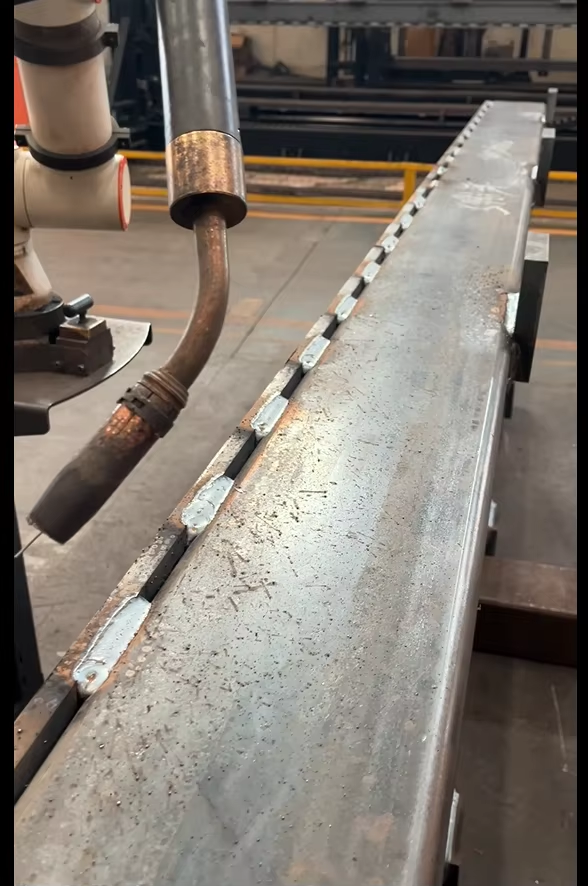
The “laser-ready” finish produced by the 6000W source eliminates the need for deburring and shot blasting of the cut edges. In the racking industry, where parts are often sent directly to automated welding cells, the consistency of the laser cut ensures that robotic welders do not encounter gaps or fitment issues, further streamlining the production chain.
7.0 Maintenance and Operational Stability
Operating a 6000W fiber laser in an industrial environment like Katowice requires specific environmental controls. The chiller system must be precisely calibrated to prevent condensation on the optical path, especially during the humid summer months. The use of a pressurized, filtered cabin for the laser source and the cutting head prevents the ingress of metallic dust, which is prevalent in structural steel shops. Scheduled maintenance of the protective windows and the ceramic nozzles is essential to maintain the beam quality required for zero-waste precision.
8.0 Conclusion
The deployment of the 6000W 3D Structural Steel Processing Center in Katowice marks a significant milestone for the storage racking industry. By synthesizing high-power fiber laser technology with sophisticated 3D kinematics and zero-waste nesting algorithms, manufacturers can achieve unprecedented levels of precision and material efficiency. This technical shift not only facilitates the production of more complex and safer racking systems but also provides a sustainable economic model for heavy steel processing in highly competitive markets. The success of this installation confirms that the future of structural steel fabrication lies in the integration of high-wattage oscillators with intelligent, waste-reducing mechanical platforms.













