Field Technical Report: Deployment of 6000W 3D Structural Steel Processing in Dubai Bridge Engineering
1. Project Overview and Environmental Context
The following report details the technical deployment and operational performance of a 6000W 3D Structural Steel Processing Center within the infrastructure sector of Dubai, UAE. Specifically, the evaluation focuses on the fabrication of complex structural components for large-span bridge engineering. In the Dubai theater, bridge engineering faces unique challenges: high ambient thermal fluctuations (often exceeding 50°C), high salinity levels near the coast, and a demand for iconic, geometrically non-linear designs. Traditional methods of drilling, sawing, and manual plasma beveling are increasingly insufficient for the tolerances required by modern Eurocode and AASHTO standards applied in the region.
The implementation of a 6000W fiber laser source, coupled with a 5-axis 3D cutting head and Zero-Waste Nesting algorithms, represents a shift from subtractive mechanical processing to high-energy density thermal processing. This report analyzes how these technologies converge to solve the dual challenges of precision and material yield.
2. 6000W Fiber Laser Synergy in Heavy-Duty Fabrication
The selection of a 6000W power rating is a calculated balance between piercing speed, kerf quality, and the Heat Affected Zone (HAZ). In structural bridge components—typically involving S355JR or S355J2+N grade steel with thicknesses ranging from 10mm to 25mm—the 6000W source provides the necessary power density to maintain a stable vapor capillary (keyhole) during the cut.
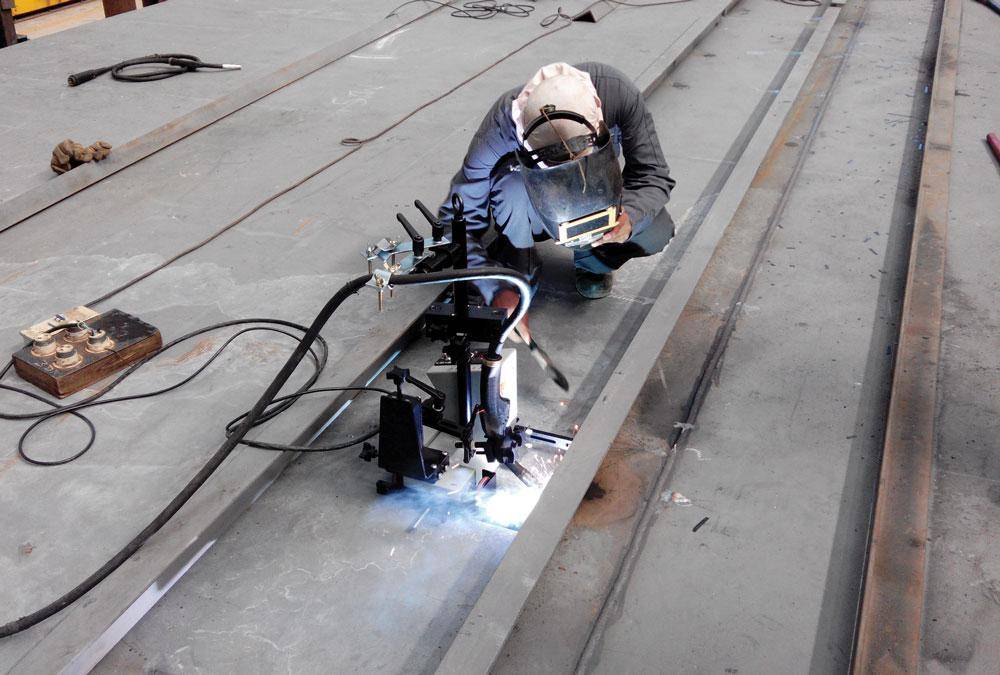
From a metallurgical perspective, the high-speed processing afforded by the 6kW source minimizes the duration of thermal exposure to the grain structure of the steel. In bridge engineering, fatigue resistance is paramount. By reducing the HAZ, the 3D laser center ensures that the structural integrity of the H-beam flanges and webs remains within the design parameters, preventing the embrittlement often associated with slower, lower-power thermal cutting methods. Furthermore, the fiber laser’s 1.07-micron wavelength is highly absorbed by structural steel, ensuring a high-efficiency energy transfer that allows for clean, dross-free cuts on the underside of thick-walled sections.
3. 5-Axis 3D Processing and Geometric Complexity
Bridge designs in Dubai, such as those spanning the Dubai Creek, often utilize intricate lattice structures and variable-angle intersections. Traditional 2D cutting is incapable of producing the necessary weld preparations (V, Y, K, and X-type bevels) required for high-load structural joints. The 3D Structural Steel Processing Center utilizes a 5-axis head capable of ±45-degree tilts.
This capability allows for the simultaneous cutting of the profile and the machining of the bevel in a single pass. In the field, this has reduced “fit-up” time by approximately 70%. When processing H-beams or large-diameter circular hollow sections (CHS), the system’s CNC controller synchronizes the rotation of the workpiece with the lateral and angular movement of the laser head. This synchronization ensures that the beam remains perpendicular or at the precise specified angle to the material surface, maintaining constant focal depth and preventing “undercutting” at the corners of structural sections.
4. Zero-Waste Nesting Technology: Engineering Logic
One of the primary cost drivers in bridge engineering is material wastage, particularly when dealing with long-span beams (12m to 15m lengths). Traditional laser tube/profile cutters often leave a “stub” or “tailing” of 200mm to 500mm due to the physical distance between the chuck and the laser head. In a high-volume Dubai fabrication yard, this cumulative waste represents a significant fiscal and environmental loss.
The “Zero-Waste Nesting” technology employed in this center utilizes a multi-chuck (typically triple or quadruple chuck) synchronization system. The engineering logic follows a “pass-through” sequence:
- Primary Support: The rear chucks feed the material through the mid-chuck, which maintains concentricity.
- Active Clamping: As the laser nears the end of the profile, the cutting head operates between the chucks.
- Final Piece Processing: The system uses a “pulling” rather than “pushing” motion for the final segment, allowing the laser to cut right up to the edge of the material held by the final chuck.
This allows for a theoretical material utilization rate of 99.5%. In the context of a 1000-ton bridge project, the reduction of scrap from 5% (industry average) to less than 1% translates to a direct saving of 40 tons of high-grade structural steel.
5. Solving Precision Issues in Heavy Steel
Precision in bridge engineering is not merely about dimensional accuracy but about “hole-to-hole” alignment for bolted connections and “face-to-face” alignment for welded joints. Traditional mechanical drilling suffers from bit deflection, particularly in thick-walled H-beams. The 6000W laser center eliminates this through non-contact processing.
The system’s integrated “Touch-Probe” or “Laser Scanning” sensors compensate for the inherent geometric imperfections of hot-rolled steel. Structural steel is rarely perfectly straight; it possesses “camber” and “sweep.” The 3D Processing Center scans the beam profile in real-time, adjusting the cutting path to match the actual physical center of the beam rather than the theoretical CAD center. This “Real-Time Compensation” ensures that bolt holes for splice plates are aligned with sub-millimeter precision (±0.05mm), which is critical for the rapid assembly of bridge segments in the field, reducing the need for on-site re-drilling or grinding.
6. Automated Workflow Synergy
The synergy between the 6000W laser and automatic loading/unloading systems is the cornerstone of the center’s efficiency. In Dubai’s labor market, the transition toward automation reduces the reliance on manual operation in harsh outdoor conditions. The processing center functions as a “Black Box” into which raw structural profiles are fed. The software automatically nests the parts, identifies the optimal cutting sequence to manage thermal expansion during the cut, and executes the 3D geometry.
The integration of the “TEKLA” or “STRUMIS” BIM (Building Information Modeling) data directly into the laser’s operating system eliminates manual data entry errors. The 3D processing center reads the DSTV files, allowing for a seamless transition from the engineer’s desk in the Dubai Design District to the fabrication floor in Jebel Ali. This digital thread ensures that every notch, cope, and hole is executed according to the structural analysis requirements.
7. Conclusion and Field Recommendations
The deployment of the 6000W 3D Structural Steel Processing Center with Zero-Waste Nesting has demonstrated a significant increase in throughput for bridge engineering components. The high power density of the 6kW source ensures metallurgical integrity, while the 5-axis head provides the geometric flexibility required for modern architectural bridges.
Key Findings:
- Material Efficiency: Zero-Waste Nesting reduced scrap rates by 82% compared to previous-generation laser cutters.
- Production Speed: Single-pass cutting and beveling increased fabrication speed by 4x over manual methods.
- Assembly Accuracy: Field assembly of laser-processed splice joints showed a 100% “first-time fit” rate, eliminating on-site corrective measures.
It is recommended that for future projects involving high-tensile steel above 20mm, the gas pressure for the assist O2/N2 be strictly regulated via proportional valves to maintain the edge quality validated in this report. The implementation of this technology is vital for Dubai to meet its aggressive infrastructure timelines while maintaining international standards of structural safety and material efficiency.













