The Evolution of Structural Fabrication in Edmonton’s Mining Sector
Edmonton has long served as the logistical and fabrication heartbeat of Canada’s heavy industry. From the oil sands of Fort McMurray to the sprawling coal and potash mines across the prairies, the demand for robust, precision-engineered machinery is constant. Historically, the fabrication of structural steel for mining—H-beams, I-beams, C-channels, and large-diameter tubes—relied on a fragmented workflow involving bandsaws, drill lines, and manual plasma torching.
The introduction of the 6000W 3D Structural Steel Processing Center marks the end of this fragmented era. As a fiber laser expert, I have witnessed many technologies attempt to bridge the gap between heavy-duty capacity and surgical precision, but the 6kW fiber source paired with 3D motion control is the first to truly succeed. This system is designed not just to cut, but to “process” structural members into ready-to-assemble components with zero secondary operation requirements.
The Power of 6000W: Why 6kW is the Mining Industry Standard
In the world of fiber lasers, wattage dictates both speed and the maximum thickness of the material. For mining machinery, which often utilizes high-tensile steels and thick-walled structural profiles, a 6000W (6kW) resonator is the “sweet spot.”
At 6kW, the laser achieves high-speed nitrogen cutting on thinner gauges and incredibly stable oxygen cutting on carbon steels up to 25mm (1 inch) thick. For Edmonton’s fabricators, this means the ability to slice through a heavy-duty H-beam flange or a thick-walled rectangular hollow section (RHS) with a Heat Affected Zone (HAZ) that is negligible compared to traditional plasma cutting. The result is a cleaner edge, preserved material integrity, and a part that is immediately ready for the welding robot or the assembly floor.
Infinite Rotation 3D Head: Redefining Kinematic Freedom
The “Infinite Rotation” capability is the crown jewel of this processing center. Traditional 3D laser heads are often limited by internal cabling, requiring a “rewind” motion after a certain degree of rotation. In a high-production environment like Edmonton’s industrial shops, these seconds of downtime add up.
An Infinite Rotation 3D Head utilizes advanced slip-ring technology and specialized optical pathways to allow the cutting head to rotate indefinitely around the A and C axes. When processing complex structural steel, this allows for:
– **Continuous Beveling:** Cutting consistent 45-degree bevels for V-groove weld preparations around the entire circumference of a pipe or the perimeter of a beam.
– **Complex Intersections:** In mining trusses, tubes often meet at compound angles. The 3D head can navigate these “saddle cuts” and “fish-mouth” joints with mathematical precision, ensuring a perfect fit-up.
– **High-Speed Cornering:** As the head moves around the sharp radii of square or rectangular tubing, the infinite rotation ensures the nozzle remains perpendicular to the path, maintaining optimal gas flow and cutting quality.
Structural Steel Versatility: Beyond Flat Plate
While flat-bed lasers are common in Edmonton, a 3D Structural Steel Processing Center is a different beast entirely. It features a specialized chuck system—often a four-chuck configuration—that supports and rotates massive structural profiles.
Mining machinery involves more than just sheets; it involves the skeleton of the machine. This system handles:
– **H-Beams and I-Beams:** For the main chassis of heavy haulers or conveyor supports.
– **C-Channels and Angle Iron:** For secondary structural supports and safety guarding.
– **Large Diameter Round Tubes:** Used in hydraulic systems and structural booms.
– **Square and Rectangular Hollow Sections:** The backbone of most mining equipment frames.
By automating the measuring, feeding, cutting, and unloading of these profiles, the center replaces up to four traditional machines, significantly reducing the footprint of a fabrication facility.
Application in Mining Machinery: Shovels, Crushers, and Conveyors
In the context of Edmonton’s specific industrial output, the applications are profound. Consider the construction of a primary crusher frame or a massive vibrating screen used in mineral processing. These structures are subjected to extreme vibration and cyclic loading.
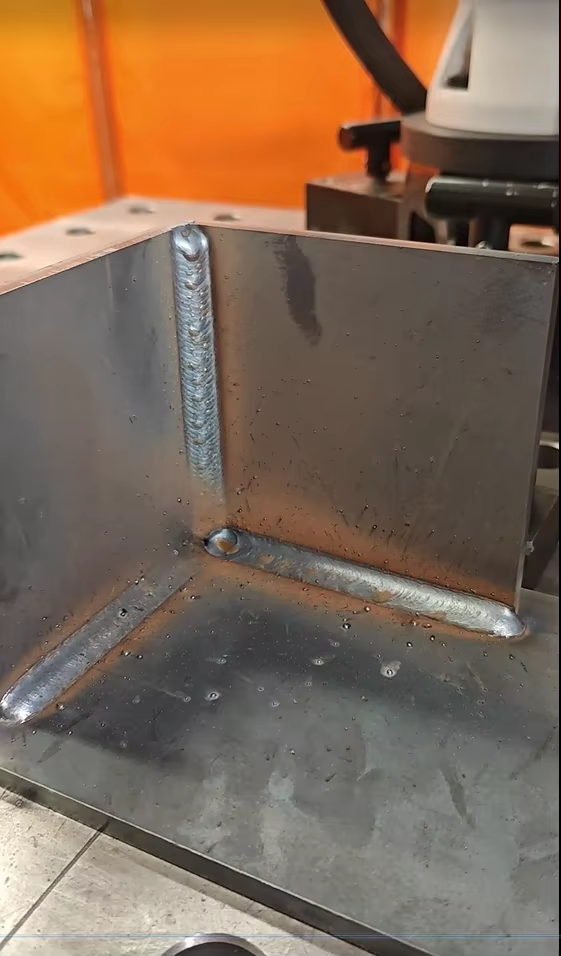
1. **Weld Integrity:** Because the 6000W laser produces a narrow kerf and the 3D head provides precise bevels, the “fit-up” of parts is nearly perfect. In mining, a 1mm gap in a weld joint can lead to catastrophic failure under load. This laser system ensures gaps are measured in microns, not millimeters.
2. **Wear-Resistant Materials:** Mining equipment frequently uses AR (Abrasion Resistant) steels like Hardox. These materials are notoriously difficult to drill or saw. The 6000W fiber laser cuts through AR plate and profiles with ease, maintaining the hardness of the material right up to the edge of the cut.
3. **Weight Reduction:** Through precise 3D cutting, engineers can design “tab-and-slot” architectures. This allows structural members to interlock, reducing the amount of heavy clamping and jigging required during assembly and allowing for lighter, stronger frames.
The Edmonton Advantage: Local Economic and Operational Impact
Implementing this technology in Edmonton provides a unique logistical advantage. Currently, many complex structural components are outsourced to specialized shops in other provinces or even overseas. By bringing a 6000W 3D Processing Center in-house or to a local service center, Edmonton fabricators can:
– **Reduce Lead Times:** Eliminate weeks of shipping and third-party scheduling.
– **On-Site Prototyping:** Mining equipment is often bespoke. The ability to modify a CAD file and cut a new 3D structural component in hours rather than days allows for rapid iteration.
– **Labor Efficiency:** Alberta’s skilled labor market is competitive. This machine automates the most tedious and dangerous aspects of structural fabrication, allowing skilled welders and fitters to focus on high-value assembly rather than grinding and prep work.
Technical Considerations for the Alberta Environment
As an expert, I must emphasize that operating such a high-precision machine in Edmonton requires specific environmental considerations. The temperature fluctuations in Alberta—from +30°C in summer to -40°C in winter—necessitate a climate-controlled enclosure for the laser resonator and the chiller system.
Furthermore, the 6000W fiber laser requires a stable high-pressure gas supply (Nitrogen or Oxygen). Many top-tier Edmonton facilities are now opting for liquid nitrogen tanks or high-capacity nitrogen generators to keep up with the sheer speed of the 3D processing center. The “Infinite Rotation” head also requires a sophisticated software suite (CAM) that can handle 5-axis nesting, ensuring that material waste is minimized when cutting expensive structural beams.
Conclusion: The Future of Heavy Fabrication
The 6000W 3D Structural Steel Processing Center with Infinite Rotation is more than just a cutting machine; it is a fundamental shift in how we build the machines that move the earth. For Edmonton’s mining machinery sector, it represents a transition from “brute force” fabrication to “intelligent” manufacturing.
By embracing the precision of fiber laser technology and the geometric freedom of 5-axis 3D cutting, local fabricators can produce equipment that is stronger, lighter, and more durable. In the harsh environments of the Canadian North, where equipment failure is not an option, the precision of a 3D fiber laser is the ultimate insurance policy. As we look to the future, the integration of such systems will define who leads the next generation of global mining infrastructure.