The Strategic Significance of Laser Technology in Dubai’s Power Sector
Dubai has long been a global beacon for rapid infrastructure development. As the region pushes toward its Energy Strategy 2050, the demand for robust, efficient, and high-capacity power transmission networks has skyrocketed. Power towers—the giant skeletal structures that carry high-voltage lines across the desert—are the backbone of this vision. However, fabricating these structures in the volume and precision required is a monumental task.
The introduction of a 6000W 3D Structural Steel Processing Center is not merely an equipment upgrade; it is a strategic industrial evolution. In the harsh climate of the UAE, structural components must be perfectly executed to withstand extreme thermal expansion and sand-laden winds. Fiber laser technology provides the heat-affected zone (HAZ) control and edge quality that traditional thermal cutting methods simply cannot match. By localizing this high-tech fabrication in Dubai, developers can slash lead times and ensure that every beam, angle, and tube meets the rigorous safety standards of international energy grids.
The Core Advantage: 6000W of Fiber Laser Power
The heart of this processing center is its 6000W fiber laser source. In the realm of structural steel, power is synonymous with versatility. While 3000W lasers are sufficient for thin-walled tubes, a 6000W source is the “sweet spot” for the heavy-duty profiles used in power towers, such as thick-walled H-beams, I-beams, and large-diameter pipes.
This wattage allows for high-speed nitrogen cutting of stainless steel and oxygen-assisted cutting of heavy carbon steel up to 25mm or more with exceptional clean-cut finishes. For power tower fabrication, where bolting accuracy is paramount, the 6000W laser ensures that bolt holes are perfectly cylindrical without the taper often seen in lower-power or plasma systems. This precision eliminates the need for secondary reaming, significantly reducing the labor cost per ton of steel. Furthermore, the fiber laser’s wall-plug efficiency (often exceeding 35%) makes it a sustainable choice for Dubai’s “green” manufacturing initiatives, consuming far less energy than legacy CO2 systems.
3D Structural Processing: Beyond Flat Sheet Cutting
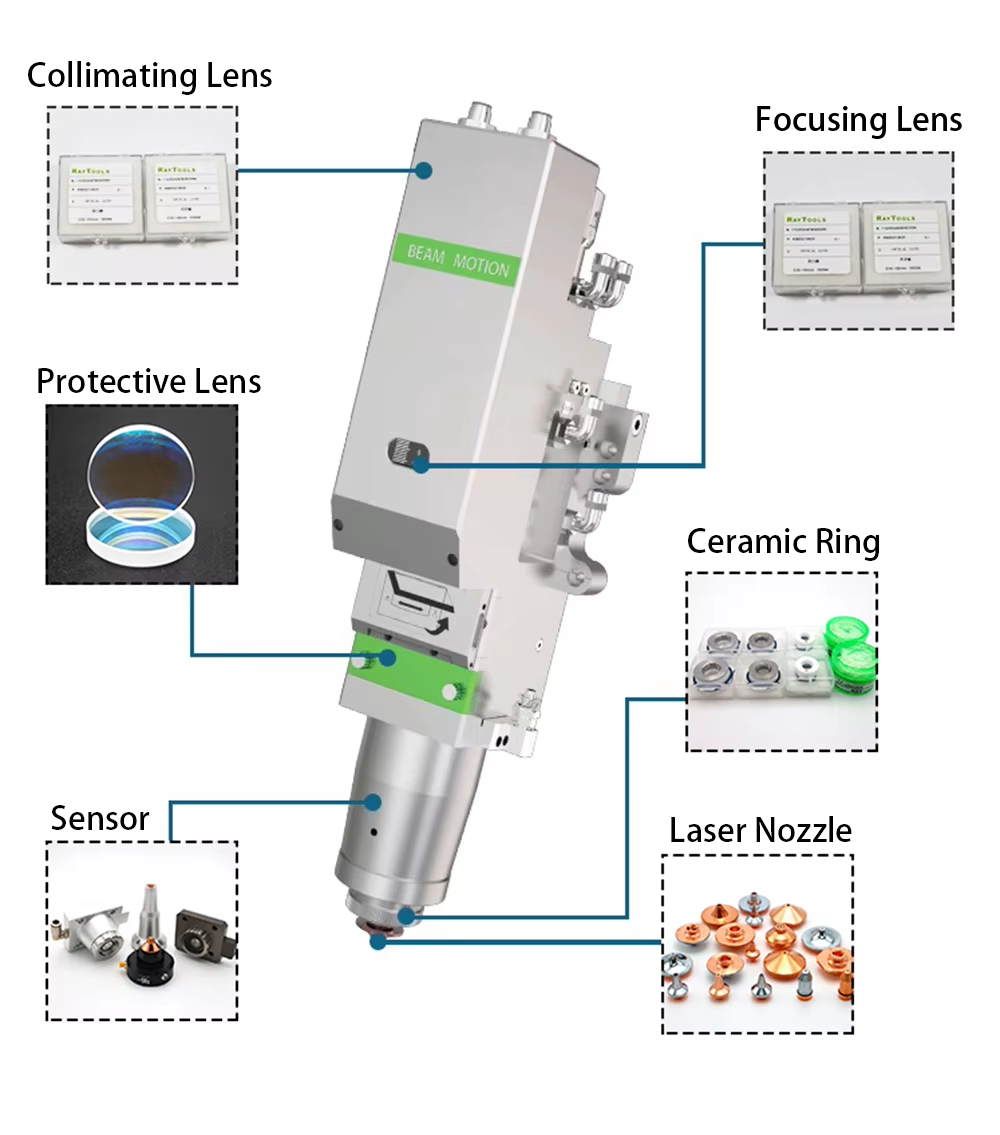
Power towers are complex three-dimensional puzzles. They consist of angle irons, channels, and hollow structural sections (HSS) that must intersect at precise angles. A 3D Structural Steel Processing Center utilizes a multi-axis cutting head—often featuring a rotating A and B axis—to perform complex bevels and miter cuts on these profiles.
In the fabrication of lattice towers, the “intersection” points are critical. The 3D laser head can cut weld preparations (K, V, and Y-type bevels) directly into the structural members. This allows for a “slot and tab” assembly approach, where components fit together with interlocking precision before welding. This 3D capability also extends to “one-hit” processing: a single program can cut the beam to length, create the cope for a joint, and drill all necessary mounting holes in one continuous motion. This eliminates the cumulative error inherent in moving parts between different machines (sawing to drilling to milling).
The Revolution of Automatic Unloading Systems
Perhaps the most overlooked yet vital component of this system is the automatic unloading mechanism. In a 6000W environment, the machine processes steel faster than a human crew can safely manually unload it. The automatic unloading system solves this bottleneck, transforming the processing center into a truly autonomous “lights-out” manufacturing cell.
As the laser completes a cut on a 12-meter H-beam, the unloading system utilizes a series of hydraulic lifters and chain-driven conveyors to gently move the finished part away from the cutting zone. This is crucial for maintaining the surface integrity of the steel, especially if it is destined for galvanization. More importantly, it enhances workplace safety. Handling heavy structural steel is a leading cause of industrial injuries; by automating the exit of the material, the facility minimizes the risk to operators. In Dubai’s high-temperature months, reducing the physical strain on workers by automating the heavy lifting is not just an efficiency gain—it is a significant improvement in labor welfare.
Optimizing Power Tower Fabrication Workflows
The specific requirements for power tower fabrication involve high-tensile steels that can be difficult to machine. The 6000W laser excels here, as it is indifferent to the hardness of the material. Whether processing S350 or S460 high-strength structural steel, the laser maintains its feed rate and precision.
One of the key challenges in tower fabrication is the sheer number of holes required for fasteners. A single tower can have thousands of bolt holes. Traditional mechanical drilling is slow and requires frequent tool changes. The laser “drills” these holes in a fraction of a second. Because the 3D processing center can handle tubes and angles up to 12 meters in length, it can process the massive “legs” of a transmission tower in a single setup. This ensures that the geometry of the entire component remains true to the CAD model, which is essential for the tower’s structural stability when it is erected 50 meters in the air.
Engineering for the Dubai Climate
Operating a high-power fiber laser in Dubai requires specific engineering adaptations. The 6000W 3D Structural Steel Processing Center is typically equipped with an oversized, dual-circuit industrial chiller. This system must maintain the laser source and the cutting head at a constant temperature, even when the ambient warehouse temperature fluctuates.
Additionally, dust and sand are the enemies of precision optics. These machines feature pressurized, sealed beam paths and advanced filtration systems to ensure that the internal environment of the laser remains pristine. For the Dubai market, these centers are often housed in climate-controlled enclosures that not only protect the machine but also provide a safer, more comfortable environment for the technicians overseeing the CNC operations.
Software Integration and the Digital Twin
In modern structural fabrication, the hardware is only as good as the software. These processing centers utilize advanced “nesting” software specifically designed for 3D profiles. The software can take a Tekla or SolidWorks model of a power tower and automatically generate the optimal cutting paths to minimize material waste.
This digital integration allows for “Just-in-Time” (JIT) manufacturing. If a specific tower design needs to be modified for a different terrain or wind load, the changes can be pushed to the laser center instantly. There is no need for new physical templates or jigs. In the context of Dubai’s fast-paced construction schedules, this agility provides a massive competitive advantage, allowing local fabricators to pivot between different tower designs (suspension, tension, or dead-end towers) without downtime.
Conclusion: The Future of Middle Eastern Steel Fabrication
The deployment of a 6000W 3D Structural Steel Processing Center with automatic unloading in Dubai marks a turning point for the region’s industrial capabilities. By marrying the power of fiber lasers with the flexibility of 3D motion and the efficiency of automation, fabricators can produce power towers that are safer, cheaper, and faster to assemble.
As the world moves toward decentralized energy and larger, more complex power grids, the demand for precision structural steel will only increase. Dubai, by adopting these advanced 6000W systems, positions itself as a global hub for high-tech manufacturing, capable of supporting the massive infrastructure projects that will define the 21st century. The era of manual layout and mechanical punching is over; the future of the power grid is being cut by light.