1. Technical Overview: The 6000W 3D Structural Steel Processing Center
In the contemporary landscape of heavy industrial fabrication, specifically within the offshore energy sector of the Middle East, the transition from traditional plasma or mechanical sawing to fiber laser technology represents a significant shift in metallurgical precision. The 6000W 3D Structural Steel Processing Center is not merely a cutting tool; it is an integrated robotic cell designed to handle the multi-dimensional complexities of H-beams, I-beams, channels, and hollow structural sections (HSS).
The 6000W fiber laser source provides a critical power density that balances speed with edge quality. At this wattage, the photon density is sufficient to achieve high-speed melt-expulsion in carbon steels ranging from 12mm to 25mm—the standard thickness for primary and secondary structural members in offshore platforms. The “3D” designation refers to the 5-axis or 6-axis kinematic capability of the cutting head, allowing for complex beveling, countersinking, and saddle cuts required for interlocking pipe-to-beam connections.
1.1. Beam Dynamics and Photon Synergy
The synergy between a 6000W source and structural processing lies in the Beam Parameter Product (BPP). Unlike flat-sheet cutting, structural cutting requires a longer focal length to navigate the flanges and webs of large beams. The 6000W resonator maintains a stable beam profile over varying distances, ensuring that the Heat Affected Zone (HAZ) remains minimal. This is paramount for offshore structures in Dubai, where high-salinity environments accelerate corrosion in compromised grain structures. By minimizing the HAZ, the laser preserves the integrity of the base metal’s crystalline structure, ensuring the longevity of the platform’s skeletal frame.
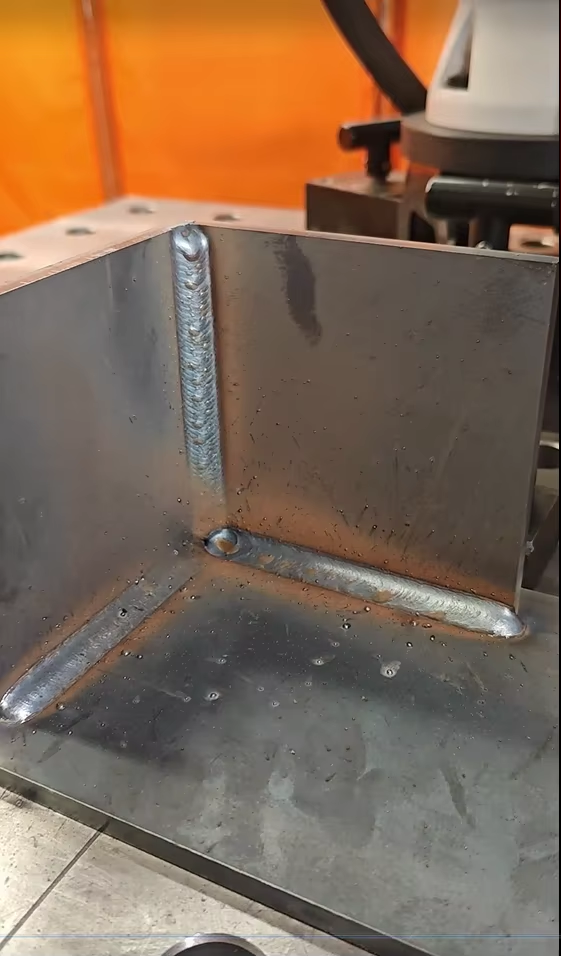
2. Strategic Application: Offshore Platform Fabrication in Dubai
Dubai serves as a global hub for maritime and offshore engineering. The fabrication of jack-up rigs, FPSO (Floating Production Storage and Offloading) modules, and fixed platforms demands rigorous adherence to international standards such as AWS D1.1 and ISO 19902. Traditional methods of preparing these structures—manual layout, mechanical sawing, and oxy-fuel beveling—introduce cumulative tolerances that complicate the final assembly.
2.1. Addressing Geometric Complexity
Offshore topsides require intricate lattice structures to support heavy machinery while minimizing wind and wave resistance. The 3D Processing Center executes “one-hit” fabrication. For instance, a single H-beam can be loaded, and the system can cut the length, miter the ends, pierce bolt holes, and cut out web openings for utility routing in a single automated sequence. In the context of Dubai’s massive scale projects, where thousands of tons of steel are processed monthly, the elimination of secondary handling is a force multiplier for throughput.
2.2. Environmental Factors and Material Resilience
The climatic conditions in Dubai, characterized by extreme ambient temperatures (exceeding 45°C) and high humidity, necessitate specialized cooling systems for the 6000W laser source and the machine’s linear drives. Thermal expansion of the structural steel itself during the cutting process must be compensated for by the system’s software. The 3D processing center utilizes real-time sensing to map the actual geometry of the beam, adjusting the cutting path to account for any pre-existing camber or sweep in the raw material.
3. The Mechanics of Automatic Unloading Technology
While the cutting speed of a 6000W laser is impressive, the primary bottleneck in heavy steel processing has historically been material handling. A 12-meter H-beam can weigh several tons; manual unloading via overhead crane is slow, dangerous, and prone to causing surface damage or deformation. The integration of “Automatic Unloading” technology addresses these inefficiencies directly.
3.1. Precision Alignment and Surface Integrity
The automatic unloading system utilizes a series of heavy-duty synchronized conveyors and hydraulic lifters. As the laser completes the final cut, the unloading arms support the workpiece across its entire length. This prevents “drop-off” deformation where the weight of the beam causes the final few millimeters of the cut to tear or bend, a common issue in manual operations. In the offshore sector, where weld prep must be exact to ensure ultrasonic-quality welds, this mechanical stability is non-negotiable.
3.2. Buffering and Continuous Workflow
The unloading module acts as a buffer zone. It allows the processing center to immediately begin the next cycle while the previously cut member is sorted or moved to the next station (e.g., shot blasting or painting). In a 24/7 Dubai fabrication yard, this translates to an estimated 35-40% increase in machine utilization rates compared to systems requiring manual intervention for part removal.
4. Synergy Between 6000W Power and Automation
The technical “sweet spot” of this system is found where high-power laser energy meets mechanical automation. A 6000W source allows for “Flying Cuts” and rapid piercing. Without automatic unloading, these speeds would be wasted as the machine would sit idle waiting for a crane.
4.1. Kerf Control and Nesting Efficiency
The precision of the 6000W laser allows for tighter nesting of parts within a single beam. Common-line cutting (sharing a single cut path between two parts) is made possible by the narrow kerf width of the fiber laser. When combined with the automatic unloading system’s ability to handle small “remnant” pieces alongside large structural members, material wastage is reduced by up to 12%. Given the high cost of specialized offshore-grade steel (such as S355 or API 5L), these material savings provide a rapid return on investment (ROI).
4.2. Digital Twin Integration
The processing center operates within a BIM (Building Information Modeling) ecosystem. Structural designs from Tekla or AutoCAD are imported directly into the machine’s controller. The automatic unloading system reports the completion of each part back to the ERP system in real-time. This provides project managers in Dubai’s fast-paced construction environment with minute-by-minute data on fabrication progress, ensuring that offshore windows for installation are met without delay.
5. Engineering Conclusion: Efficiency and Tolerance Management
The deployment of a 6000W 3D Structural Steel Processing Center with Automatic Unloading in the Dubai offshore sector represents the pinnacle of current fabrication technology. By shifting from a “tool-centric” approach to an “integrated-system” approach, fabricators can achieve tolerances previously thought impossible for heavy-section steel.
The 6000W laser provides the raw power and edge quality necessary for thick-walled offshore components, while the 3D kinematic head removes the need for manual layout and secondary machining. Most critically, the automatic unloading system solves the physics of “heavy-movements,” ensuring that the precision achieved by the laser is not lost during the transition from the machine bed to the assembly floor. For the demanding standards of the Persian Gulf’s energy infrastructure, this technology is no longer an option—it is a requirement for competitive, high-quality production.
Field Log Summary of Technical Advantages:
- Precision: +/- 0.2mm over a 12m span, far exceeding plasma or mechanical standards.
- Weld Prep: Integrated 45-degree beveling reduces fit-up time by 60%.
- Safety: Automatic unloading removes personnel from the “heavy lift” zone, reducing site incidents.
- Scalability: Modular design allows for the processing of larger sections as offshore platform designs evolve toward deeper-water applications.
Report submitted by: Senior Laser Systems Consultant
Location: Jebel Ali Industrial Zone, Dubai













