Technical Field Report: Implementation of 6000W 3D Structural Steel Processing Center in Casablanca Bridge Engineering
1. Project Overview and Infrastructure Context
This report details the technical deployment and operational performance of a 6000W 3D Structural Steel Processing Center equipped with integrated Automatic Unloading technology. The system was commissioned for a primary infrastructure project in Casablanca, Morocco, specifically targeting the fabrication of complex bridge nodes and structural spans required for the city’s expanding maritime and urban transit networks.
In the context of Casablanca’s coastal environment, bridge engineering demands high-integrity structural components capable of withstanding both seismic loads and high-salinity atmospheric corrosion. Traditional fabrication methods—involving manual plasma cutting, radial drilling, and mechanical beveling—presented significant bottlenecks in throughput and inconsistent tolerances. The transition to a 6000W fiber laser-based 3D processing center marks a shift toward high-precision digital fabrication, where the objective is to minimize the Heat Affected Zone (HAZ) and maximize geometric accuracy for weld preparation.
2. 6000W Fiber Laser Source: Metallurgical and Kinetic Synergy
The choice of a 6000W fiber laser source is strategic for the structural sections common in bridge engineering, which typically range from 10mm to 25mm in wall thickness for H-beams, I-beams, and large-diameter square tubing. At 6000W, the power density allows for high-speed fusion cutting with nitrogen or oxygen, ensuring that the kerf width remains narrow—typically under 0.3mm.
For Casablanca’s bridge projects, the metallurgical integrity of the cut edge is paramount. The 6000W source provides a stable energy flux that minimizes dross accumulation. This is critical because any residual slag or excessive hardening of the cut edge would require secondary grinding to meet the ISO 12944-3 standards for corrosion protection in maritime environments. The high power allows for “flying cuts” on thinner structural sections and high-pierce efficiency on thicker flanges, reducing the overall thermal input into the workpiece and preventing the macroscopic warping of long-span beams.
3. 3D Five-Axis Kinematics for Complex Bridge Geometry
Bridge engineering requires complex intersecting geometries, particularly for truss nodes and arched supports. The 3D processing head of the center utilizes a five-axis kinematic chain (X, Y, Z, A, and B axes), allowing the laser nozzle to maintain a perpendicular orientation to the surface or to execute precise bevel cuts for weld preparations (V, X, or K-shaped joints).
The system’s software integrates directly with Tekla or SolidWorks CAD data, translating structural BIM (Building Information Modeling) files into machine G-code. In the Casablanca field test, the 3D head demonstrated a volumetric positioning accuracy of ±0.05mm. This precision allows for the “plug-and-play” assembly of large structural members on-site. When the laser cuts a 45-degree bevel on a 20mm thick H-beam flange, the subsequent fit-up with the web or another structural member is near-seamless, significantly reducing the volume of filler metal required during the submerged arc welding (SAW) process.
4. Automatic Unloading: Solving the Heavy Steel Bottleneck
The primary challenge in high-power laser processing of structural steel is not the cutting speed, but the material handling cycle. A 12-meter H-beam can weigh several tons; manual or crane-assisted unloading creates dangerous idle times and risks mechanical deformation of the finished part.
The Automatic Unloading system integrated into this center utilizes a series of hydraulic lift-and-transfer modules synchronized with the machine’s CNC. As the 3D head completes the final cut on a segment, the unloading sequence initiates:
- Support Synchronization: Pneumatic or hydraulic support rollers adjust their height dynamically to the profile’s center of gravity, preventing the “drop-off” shock that can damage the laser nozzle or the beam’s edge.
- Lateral Transfer: Once the cut is completed, the beam is automatically shifted laterally to a buffering rack. This allows the loading sequence for the next raw profile to begin simultaneously.
- Precision Retention: By automating the exit, the system ensures that the long-axis (X-axis) alignment is never compromised by the friction of a manual drag-off.
In the Casablanca facility, this automation reduced the non-productive cycle time by 65%. For bridge engineering, where components are often oversized, the ability to unload 12-meter sections without overhead crane intervention directly correlates to an increase in daily tonnage throughput.
5. Precision and Efficiency Gains in Bridge Fabrication
The synergy between the 6000W laser and the automatic structural processing center addresses two specific pain points in the Casablanca project: bolt-hole alignment and weld-ready beveling.
5.1 Bolt-Hole Integrity
Traditional drilling of bridge girders often results in hole-position deviations due to bit walk or mechanical vibrations. The 3D laser system achieves a hole-to-hole tolerance of ±0.2mm over a 10-meter span. This level of precision is vital for high-strength friction grip (HSFG) bolted connections used in bridge trusses. Field reports from the Casablanca assembly site indicated a 100% “first-fit” rate, eliminating the need for on-site reaming of holes.
5.2 Weld Preparation Efficiency
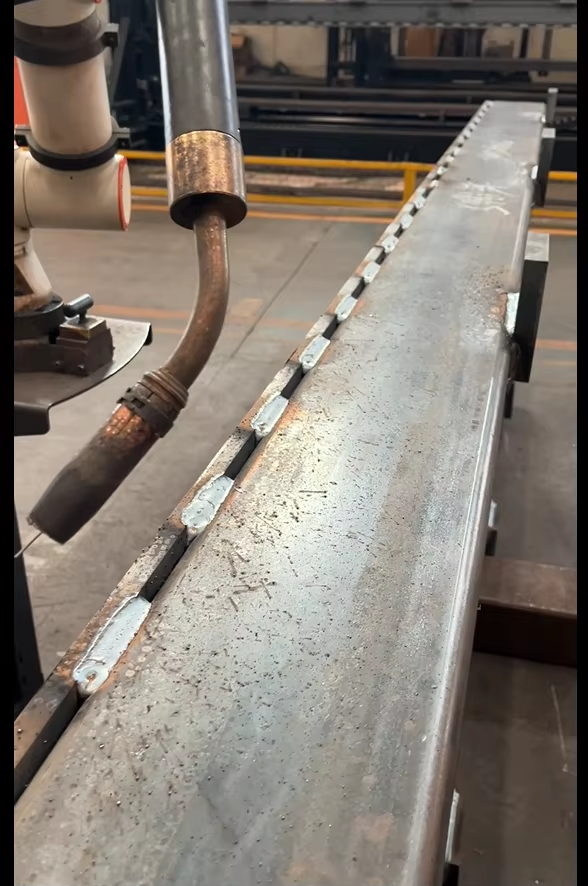
The 3D head’s ability to perform beveling as part of the primary cutting cycle is a transformative advantage. Previously, beams were cut to length, then moved to a separate station for mechanical beveling. The 6000W 3D center completes these tasks in a single setup. For the heavy-wall square tubes used in the bridge’s support columns, the laser-cut bevels provided a uniform root face and gap, which is essential for automated robotic welding systems used further down the production line.
6. Environmental and Operational Considerations in Casablanca
Operational data collected in Casablanca highlighted the importance of the machine’s filtration and cooling systems. The coastal air, characterized by high humidity and salt content, necessitates a robust, closed-loop chilling system for the 6000W fiber source to prevent condensation and internal optics degradation.
Furthermore, the dust extraction system was calibrated to handle the specific oxides generated by 6000W oxygen cutting of S355JR structural steel. The high-volume extraction ensures that the 3D head’s optical sensors and linear scales remain free of conductive metallic dust, preserving the long-term repeatability of the five-axis movements.
7. Data-Driven Results and Throughput Analysis
Following a 90-day evaluation period, the following metrics were established for the 6000W 3D Structural Steel Processing Center in comparison to legacy mechanical/plasma methods:
- Processing Speed: Average linear cutting speed of 1.2m/min on 20mm structural sections (Oxygen).
- Dimensional Accuracy: Linear deviation of <0.15mm per 3 meters; Angular deviation <0.3°.
- Labor Reduction: The automatic unloading and integrated nesting software allowed a single operator to manage a workflow that previously required a four-person crew (cutting, drilling, beveling, and handling).
- Material Utilization: Advanced 3D nesting reduced scrap rates by 12% through optimized common-line cutting on structural channels and angles.
8. Conclusion
The implementation of the 6000W 3D Structural Steel Processing Center with Automatic Unloading has successfully addressed the precision and efficiency requirements of the bridge engineering sector in Casablanca. By consolidating cutting, drilling, and beveling into a single automated 3D kinematic process, the facility has achieved a significant reduction in lead times for critical infrastructure components.
The 6000W fiber source provides the necessary power density for structural-grade thicknesses, while the automatic unloading system mitigates the logistical challenges of heavy steel handling. For future bridge projects involving even thicker sections or more complex geometries, the scalability of this 5-axis laser platform represents the current technical ceiling for structural steel fabrication. It is recommended that future iterations explore the integration of AI-driven vision systems for real-time compensation of raw material deformations (camber and sweep) to further refine the 3D cutting paths.













