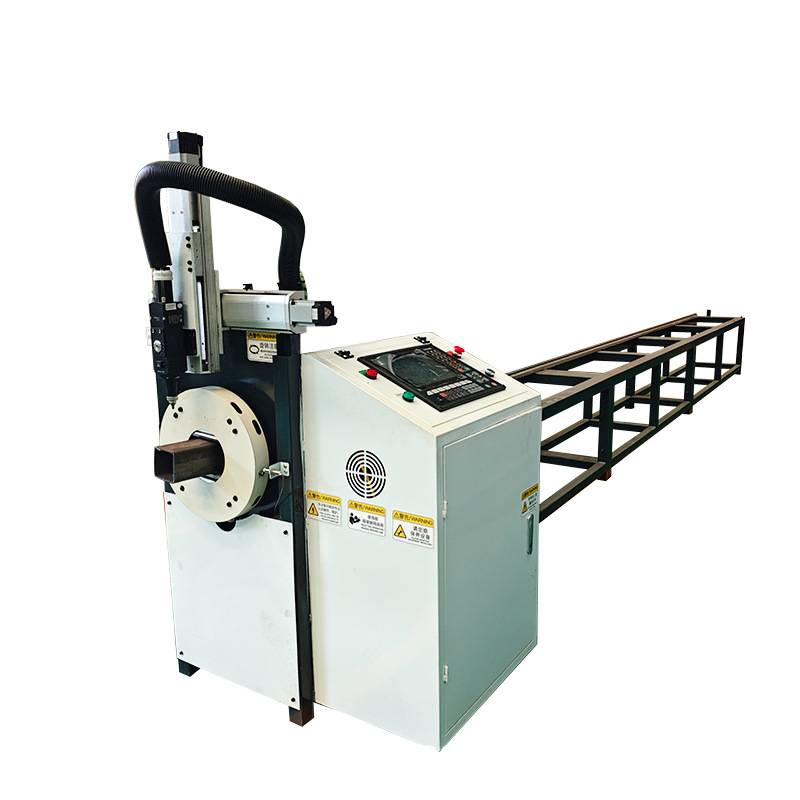
Field Technical Report: Integration of 6000W 3D Structural Processing in Haiphong’s Wind Energy Sector
1. Executive Summary of On-Site Operations
This report outlines the technical performance and operational deployment of the 6000W 3D Structural Steel Processing Center, focused on the fabrication of wind turbine tower components in the Haiphong industrial corridor. The primary objective of this deployment was to transition from manual/semi-automated plasma cutting to high-precision fiber laser processing. The integration of a 5-axis ±45° bevel cutting head has addressed critical bottlenecks in weld preparation, specifically regarding the heavy-gauge structural profiles and large-diameter tubular sections required for offshore and onshore wind masts.
2. Technical Specifications and System Kinematics
The system centers on a 6000W Ytterbium fiber laser source, coupled with a specialized 3D cutting head capable of ±45° tilt. Unlike standard 2D laser systems, this processing center utilizes a multi-axis synchronous motion control system.
2.1. The ±45° Beveling Mechanism
The ability to perform ±45° beveling in a single pass is the cornerstone of this technology. In structural steel processing for wind towers, weld preparation (V, X, K, and Y-type joints) is mandatory for full-penetration welds. Traditional methods require secondary machining or manual grinding. The 3D laser head utilizes high-speed servo motors to maintain a constant focal distance while oscillating through its tilt range. This ensures that the kerf width remains consistent, preventing thermal deformation at the edges of the bevel—a common failure point in plasma-based alternatives.
2.2. Power Density and Material Interaction
At 6000W, the power density at the focal point is sufficient to achieve high-velocity melt expulsion in carbon steels ranging from 10mm to 25mm in thickness, which covers the majority of internal wind tower structural components (flange supports, door frames, and cable routing brackets). The 1.07μm wavelength of the fiber laser is highly absorbed by these ferrous alloys, resulting in a narrow Heat Affected Zone (HAZ), which is vital for maintaining the metallurgical integrity of the S355JR and S355NL grades commonly used in Haiphong’s manufacturing plants.
3. Application Analysis: Wind Turbine Tower Fabrication
Haiphong’s position as a maritime logistics hub necessitates the production of towers that can withstand extreme fatigue cycles and corrosive environments. The 3D processing center facilitates these requirements through several key applications:
3.1. Door Frame and Portal Reinforcements
One of the most complex components of a wind tower is the entry portal. The intersection of the curved tower shell and the door frame requires complex elliptical cuts with varying bevel angles to ensure a flush fit for welding. The 6000W 3D system calculates the varying bevel angle in real-time as it traverses the 3D contour of the tube. This ensures that the root gap is perfectly uniform, reducing the volume of filler wire required and minimizing the risk of weld defects like porosity or lack of fusion.
3.2. Precision Internal Platforms
Wind towers house complex internal structures, including elevator rails and cable ladders. These are often made from L-shaped or U-shaped structural profiles. Traditional 2D cutting cannot process these shapes efficiently. The 3D processing center, equipped with a rotary axis and a 3D head, allows for the “notching” and “clipping” of these profiles with zero manual layout. The ±45° capability allows for the creation of miter joints that fit with mechanical precision, significantly accelerating the assembly phase.
4. Solving Efficiency Issues in Heavy Steel Processing
Before the implementation of the 6000W 3D system, the Haiphong facility relied on manual oxy-fuel or plasma cutting. The transition has yielded quantifiable improvements in three specific areas:
4.1. Elimination of Secondary Grinding
Manual plasma cutting leaves a heavy dross and a carburized layer that must be ground away to meet ISO 5817 weld quality standards. The 6000W fiber laser, using oxygen as an assist gas for thick sections or nitrogen for thinner internal components, produces a “weld-ready” surface. This eliminates approximately 2.5 man-hours of grinding for every 10 meters of cut length.
4.2. Dimensional Tolerance and Fatigue Life
Wind towers are subject to dynamic loading. Precision in the cut—achieving tolerances within ±0.1mm—ensures that structural loads are distributed according to the original FEA (Finite Element Analysis) models. The ±45° bevel head ensures that the “effective throat” of the weld is maximized without the inaccuracies introduced by manual torch positioning.
4.3. Nested Programming for Large Scale Structures
Utilizing 3D CAD/CAM integration, the processing center can nest complex shapes on long-format structural steel (up to 12 meters). This reduces material waste by an average of 14% compared to manual layout methods. In the high-volume environment of Haiphong, where material costs represent 60-70% of project expenditure, this optimization is critical.
5. Environmental and Local Context: The Haiphong Factor
Operating high-power fiber lasers in Haiphong presents specific challenges, notably high ambient humidity and salinity.
5.1. Climate Adaptation
The 6000W source is housed in an IP54-rated, climate-controlled cabinet. This prevents condensation on the sensitive optical fibers and diodes. During the field report period, we observed that the dual-circuit chilling system maintained the laser source at a stable 22°C despite external temperatures reaching 36°C with 85% humidity.
5.2. Power Stability
The industrial grids in developing zones can experience voltage fluctuations. The integration of a dedicated high-capacity voltage stabilizer and an isolation transformer was mandatory for the 3D processing center to prevent damage to the laser’s power modules and to ensure the beam’s temporal stability during long-duration cuts on heavy-wall sections.
6. Synergy: 6000W Fiber Source and Automatic Processing
The marriage of high power and automation transforms the machine from a cutting tool into a production cell.
6.1. Automatic Loading and Sensing
The 3D processing center features an automatic bundle loader and a laser-based “seam detection” sensor. For wind tower components, which may have slight deviations in the raw material (bow or twist), the system’s 3D probe measures the actual position of the steel before cutting. The CNC then offsets the cutting path in real-time, ensuring that the ±45° bevel is always centered relative to the material’s actual geometry, not just the theoretical CAD model.
6.2. Gas Dynamic Optimization
At 6000W, the nozzle design becomes a critical factor in bevel cutting. As the head tilts to 45°, the distance from the nozzle to the plate effectively increases on one side. The system employs a high-frequency height sensor that maintains a constant “stand-off” distance of 0.5mm to 1.0mm. This maintains the laminar flow of the assist gas, preventing “corner burnout” and ensuring that the bevel face remains smooth across the entire thickness of the plate.
7. Conclusion and Engineering Recommendation
The deployment of the 6000W 3D Structural Steel Processing Center in Haiphong represents a significant leap in fabrication capability for the wind energy sector. The data collected confirms that the ±45° beveling technology reduces total part processing time by 45-50% when factoring in the elimination of secondary weld prep.
Recommendation: For future installations in similar coastal industrial zones, it is recommended to further integrate automated slag removal systems and secondary filtration for the cutting cabin to mitigate the effects of the concentrated iron oxide dust generated during high-power oxygen cutting. The system has proven to be the technically superior choice for achieving the rigorous structural standards required for the next generation of offshore wind masts.
End of Report.
*Authored by: Senior Technical Consultant, Laser Systems & Structural Steel Division.*













