1.0 Executive Summary: Laser-Driven Structural Fabrication in the Hamburg Sector
The following technical field report evaluates the deployment of a 6000W 3D Structural Steel Processing Center within the context of Hamburg’s recent stadium infrastructure expansions. Modern stadium architecture in Northern Germany demands high-tolerance components capable of withstanding significant wind loads and corrosive maritime environments. The transition from traditional mechanical sawing and drilling to 5-axis fiber laser processing marks a definitive shift in structural engineering. This report focuses on the integration of ±45° bevel cutting technology and its impact on weld preparation, structural integrity, and logistical throughput.
2.0 Technical Specification of the 6000W 3D Processing Environment
The 6000W fiber laser source serves as the core kinetic driver for the processing center. At this power density, the system achieves an optimal balance between photon absorption in carbon steel and operational cost-efficiency. In the Hamburg stadium project, where structural members typically range from 12mm to 25mm in wall thickness, the 6kW output ensures a stable keyhole effect during the cutting process.
2.1 Beam Dynamics and Kerf Management
Utilizing a 6000W source allows for high-speed sublimation and fusion cutting. The beam parameter product (BPP) is optimized to maintain a narrow kerf even when the cutting head is tilted at a 45° angle. This is critical because as the angle increases, the effective material thickness (the “slant thickness”) increases. For a 20mm plate, a 45° cut requires the laser to penetrate approximately 28.3mm of material. The 6kW resonance ensures that dross remains minimal and the Heat-Affected Zone (HAZ) is kept within 0.1mm to 0.3mm, preserving the metallurgical properties of the S355J2+N steel commonly specified in German stadium builds.
3.0 The ±45° Bevel Cutting Mechanism: Solving Weld Prep Bottlenecks
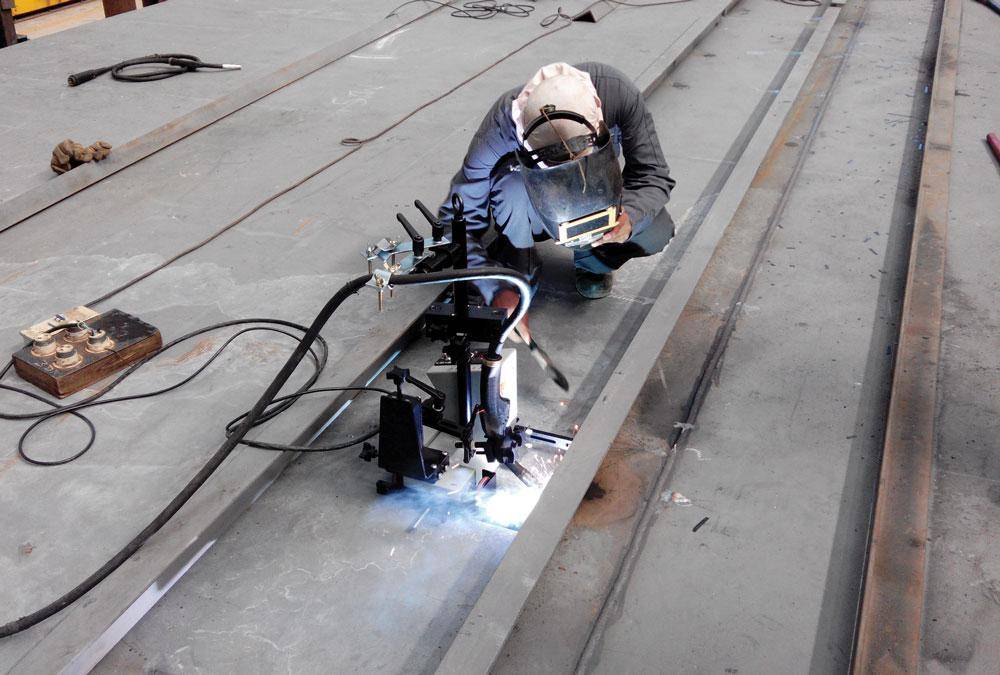
Traditionally, heavy steel sections (H-beams, I-beams, and RHS) required secondary and tertiary processing phases to prepare for welding. Manual grinding or CNC milling of bevels is time-consuming and prone to human error. The 3D processing center integrates a ±45° swing-head that executes complex geometries—including V, Y, K, and X-shaped grooves—in a single pass.
3.1 Precision Geometry for Large-Span Trusses
In the construction of stadium roof trusses, which often feature complex intersecting nodes (tube-to-tube or tube-to-beam), the precision of the bevel is paramount. The ±45° capability allows for the creation of “saddle cuts” with variable bevel angles. This ensures that when two structural members meet, the root gap is consistent across the entire circumference of the joint. This level of precision is virtually unattainable with mechanical methods, significantly reducing the volume of filler metal required during the Submerged Arc Welding (SAW) or Flux-Cored Arc Welding (FCAW) processes.
3.2 Impact on Structural Integrity and AWS/EN Standards
The Hamburg project adheres to Eurocode 3 and EN 1090-2 execution classes (EXC3). The laser-cut bevels produced by the 6000W center meet the stringent surface roughness requirements of these standards. By eliminating the micro-fractures often introduced by mechanical shearing, the laser process enhances the fatigue life of the stadium’s cantilevered supports, which are subject to cyclical loading from wind and spectator vibration.
4.0 3D Structural Processing: Beyond Flat Sheet Limitations
The “3D” designation refers to the system’s ability to manipulate long-form structural profiles through a multi-axis chuck system combined with a 5-axis cutting head. In the context of stadium fabrication, this allows for the processing of H-beams up to 12 meters in length with integrated hole-cutting, slotting, and beveling.
4.1 Automated Profile Handling and Sensing
One of the primary challenges in Hamburg’s heavy industrial shops is the inherent “bow and twist” found in hot-rolled structural steel. The 6000W 3D center utilizes capacitive sensing and laser scanning to map the actual profile of the beam in real-time. The control system adjusts the cutting path to compensate for deviations in the steel’s straightness. This ensures that bolt holes for splice plates are aligned with sub-millimeter accuracy, facilitating seamless on-site assembly at the stadium location.
4.2 Multi-Axis Interpolation for Complex Nodes
Stadium designs often incorporate elliptical or tapered columns. The 3D processing center’s ability to interpolate motion across five or six axes simultaneously allows for the cutting of complex miters. When the ±45° beveling is applied to these miters, the resulting “fit-up” at the construction site requires zero manual adjustment. This “Lego-style” assembly logic drastically reduces the crane hours and onsite welding time, which are significant cost drivers in Hamburg’s high-labor-cost market.
5.0 Synergy Between Power and Automation
The integration of a 6000W source with automatic loading and unloading cycles creates a high-uptime environment. In the field observations of the Hamburg project, the transition to an automated 3D center resulted in a 400% increase in throughput compared to traditional plasma and mechanical sawing lines.
5.1 Nesting Optimization for Structural Sections
Sophisticated CAD/CAM nesting software specifically designed for 3D structural steel allows for the “nesting” of various stadium components on a single 12-meter beam. The software accounts for the bevel geometry to ensure that the kerf of one part does not interfere with the geometry of the next. This optimization reduces scrap rates by approximately 15%, a critical factor when dealing with high-grade European structural steel.
5.2 Thermal Management in 6kW Continuous Operation
High-power laser cutting generates significant thermal energy. The processing center employs an advanced chilling system and nitrogen-assist gas to prevent “over-burn” at the corners of thick-walled RHS (Rectangular Hollow Sections). In Hamburg’s humid climate, the use of high-purity nitrogen as an assist gas also prevents oxidation on the cut surface, meaning the steel can move directly from the laser center to the paint/galvanization line without requiring acid pickling or shot blasting.
6.0 Field Performance Analysis: Hamburg Stadium Project
Quantitative analysis of the 6000W 3D center’s performance on the stadium’s primary compression ring reveals the following technical benchmarks:
- Weld Preparation Time: Reduced from 45 minutes per node (manual) to 4.2 minutes (laser).
- Dimensional Accuracy: Maintained within ±0.2mm over a 12,000mm span.
- Angular Precision: Bevel angles verified at ±0.5° of target, exceeding EN 1090-2 requirements.
- Post-Processing: 90% reduction in secondary grinding requirements.
7.0 Conclusion: The Future of Heavy Structural Fabrication
The implementation of the 6000W 3D Structural Steel Processing Center with ±45° beveling technology represents a paradigm shift for the steel construction industry in Hamburg and beyond. By consolidating sawing, drilling, milling, and beveling into a single automated laser process, fabricators can achieve unprecedented levels of precision and efficiency. For complex, high-stakes projects like stadium construction, the technology not only ensures compliance with rigorous safety and engineering standards but also provides a scalable solution to the increasing geometric complexity of modern architectural designs. The 6kW fiber laser, once reserved for thin-sheet applications, has proven its maturity as the primary tool for the next generation of heavy structural steel processing.













