Mastering the 4kW Tube laser cutter for Stainless Steel: A Monterrey Industrial Guide
Monterrey, Nuevo León, stands as the industrial heart of Mexico, a city where the “nearshoring” phenomenon has accelerated the demand for high-precision manufacturing. Within this competitive landscape, the 4kW tube laser cutter has emerged as a cornerstone technology for workshops and Tier 1 suppliers alike. Specifically, when processing stainless steel—a material prized for its corrosion resistance and aesthetic appeal—the 4kW power rating represents a “sweet spot” of efficiency, speed, and edge quality. This guide explores the technical intricacies of utilizing 4kW fiber laser cutting technology for stainless steel tube applications within the unique environmental and economic context of Monterrey.
The Technical Advantage of 4kW Power in Fiber Laser Cutting
In the realm of laser cutting, power is not merely about the ability to cut thicker materials; it is about the energy density and the speed at which that energy can be delivered. A 4kW fiber laser source provides a significant leap over 2kW or 3kW systems, particularly when dealing with the reflective nature of stainless steel. Fiber lasers operate at a wavelength of approximately 1.06 microns, which is more readily absorbed by metals compared to the 10.6 microns of traditional CO2 lasers.
For a 4kW system, the cutting speed on 2mm to 5mm stainless steel tubes is exponentially higher than lower-wattage counterparts. This speed is crucial for Monterrey-based manufacturers who must meet tight delivery windows for the automotive and appliance sectors. The 4kW threshold allows for high-pressure nitrogen cutting, which prevents oxidation and ensures that the stainless steel maintains its metallurgical properties at the cut edge. This results in a “bright finish” that requires no post-processing—a critical factor for the food processing equipment and medical device industries prevalent in the region.
Material Specifics: Processing Stainless Steel Grades
Stainless steel presents unique challenges in laser cutting due to its nickel and chromium content. In Monterrey’s industrial parks, such as those in Santa Catarina or Apodaca, the most common grades processed are AISI 304 and 316.
AISI 304: This is the workhorse of the industry. A 4kW tube laser can slice through 304-grade tubing with incredible precision. The primary concern is heat management. Because stainless steel has lower thermal conductivity than carbon steel, heat tends to build up at the cutting head. A 4kW system allows for faster travel speeds, which actually reduces the Heat Affected Zone (HAZ), preventing warping in thin-walled tubes.
AISI 316: Often used in marine or chemical environments, 316 contains molybdenum, making it slightly tougher to cut. The 4kW power provides the necessary “punch” to maintain a consistent kerf width even through varying wall thicknesses. When performing laser cutting on 316 stainless, the use of high-purity Nitrogen (99.999%) is non-negotiable to maintain the alloy’s corrosion resistance at the cut site.
Advanced Tube Geometry and CNC Interpolation
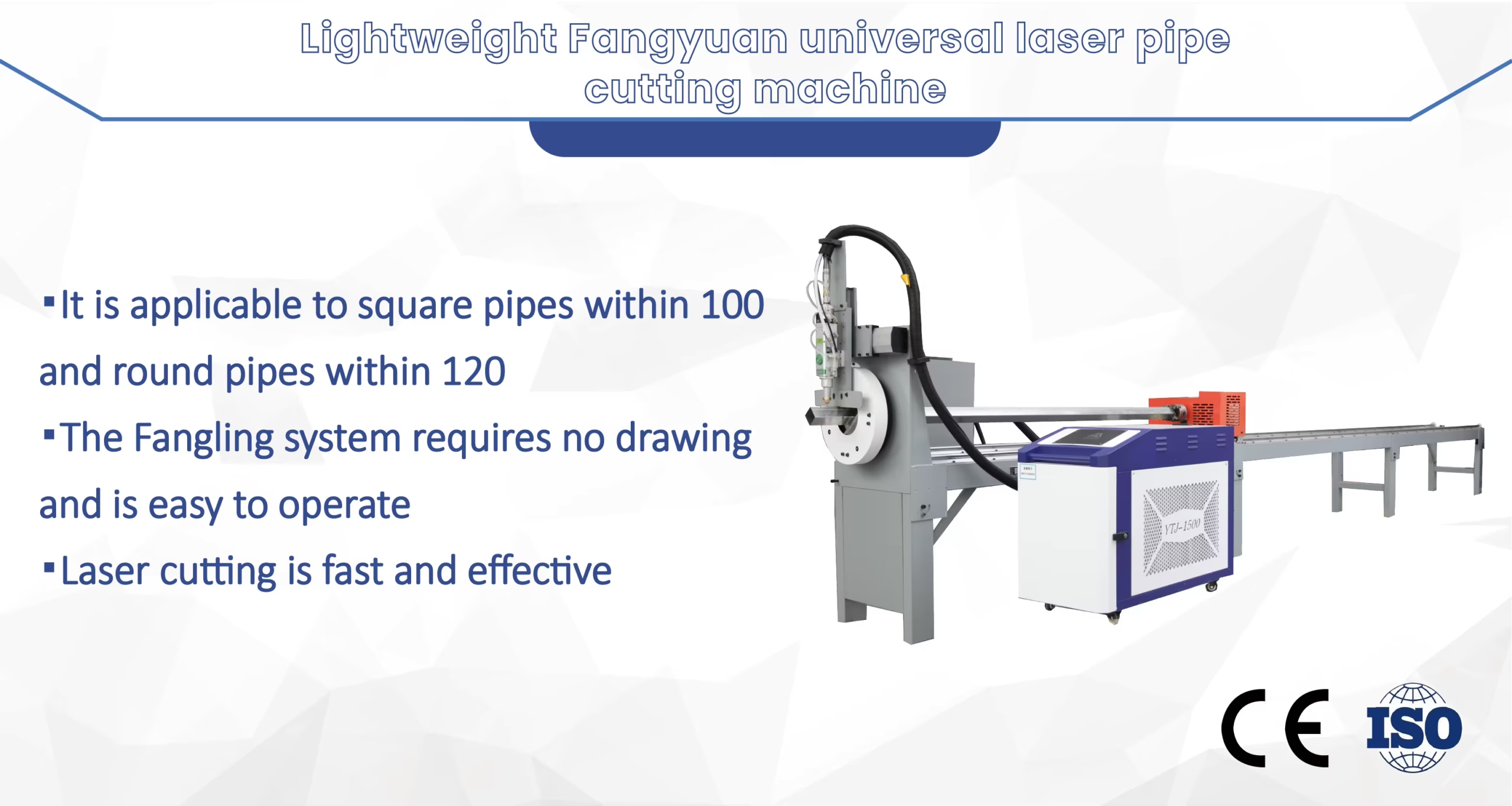
Modern 4kW tube laser cutters are not limited to simple round pipes. The sophisticated CNC controllers used in these machines allow for the processing of square, rectangular, oval, and even open profiles like C-channels or L-angles. In the Monterrey construction and structural steel sector, the ability to cut complex “fish-mouth” joints and interlocking tabs directly onto stainless steel tubes has revolutionized assembly times.
The 4kW beam quality (expressed as BPP or Beam Parameter Product) ensures that even when the laser is cutting at the corners of a square tube—where the thickness effectively increases due to the radius—the penetration remains consistent. This is achieved through “power ramping,” where the CNC adjusts the 4kW output in real-time based on the travel speed and the geometry of the part. This prevents “over-burning” at corners, a common defect in lower-powered machines that lack sophisticated modulation.

Environmental Considerations for Monterrey Manufacturers
Operating a 4kW laser cutting system in Monterrey requires specific attention to the local climate. The region is known for extreme temperature fluctuations and high dust levels.
Chiller Performance and Thermal Stability
A 4kW laser generates significant heat within the resonator and the cutting head. In Monterrey, where summer temperatures frequently exceed 40°C, the cooling system (chiller) must be oversized or high-efficiency. If the laser source exceeds its optimal operating temperature, the beam quality will degrade, leading to dross formation on the stainless steel tubes. It is recommended to house the 4kW system in a climate-controlled enclosure or ensure the chiller has a dual-circuit cooling system to handle both the fiber source and the optics independently.
Power Grid Reliability
The industrial zones of Monterrey sometimes experience voltage fluctuations. For a sensitive 4kW fiber laser, these fluctuations can be catastrophic to the laser diodes. Implementing a high-capacity voltage stabilizer and a dedicated grounding system is standard engineering practice to protect the investment. Laser cutting requires a stable power arc; any dip in voltage during the piercing phase of a thick-walled stainless tube can result in a failed cut or damage to the protective window of the cutting head.
Operational Best Practices for Stainless Steel
To maximize the ROI of a 4kW tube laser cutter, operators must master the relationship between gas pressure, focal position, and nozzle geometry.
Nozzle Selection and Centering
For stainless steel, double nozzles are often preferred to stabilize the gas flow. The 4kW beam is narrow, requiring precise nozzle centering. Even a 0.1mm misalignment can cause asymmetrical burrs on the tube. In Monterrey’s high-output environments, automated nozzle changers and centering sensors are highly recommended to maintain 24/7 operation without manual intervention.
Assist Gas Strategy
While Oxygen can be used to cut stainless steel (relying on an exothermic reaction), it results in a blackened, oxidized edge. For the premium markets Monterrey serves, Nitrogen is the standard. Nitrogen acts as a mechanical force to blow the molten metal out of the kerf without reacting with the material. At 4kW, the nitrogen pressure typically ranges between 12 and 18 bar. Ensuring a steady supply of bulk nitrogen or a high-pressure nitrogen generator is essential for continuous laser cutting operations.
Maintenance Protocols for Longevity
A 4kW tube laser cutter is a high-precision instrument that requires disciplined maintenance, especially when processing stainless steel, which produces fine metallic dust.
Optical Integrity
The protective windows (cover slips) are the most frequent consumable. Even a microscopic speck of dust can absorb the 4kW energy, causing the glass to shatter (thermal shock). Operators in Monterrey must be trained in “clean room” techniques for swapping optics, ensuring that the local humidity and dust do not contaminate the cutting head interior.
Mechanical Calibration
The chucks that hold and rotate the tubes must be checked for concentricity. When laser cutting long stainless steel tubes (often 6 meters or more), any slight wobble in the chuck will manifest as a dimensional error in the finished part. Regular lubrication of the rack and pinion system, as well as the linear guides, is vital to maintain the high acceleration rates that a 4kW system is capable of achieving.
The Economic Impact: Why Monterrey Chooses 4kW
The transition from manual sawing and drilling to 4kW laser cutting represents a seismic shift in productivity. A single 4kW tube laser can often replace three to four conventional machines. In the context of Monterrey’s labor market, where skilled welders and fabricators are in high demand, the ability to produce “self-jigging” parts—where tubes are cut to snap together perfectly—reduces the reliance on complex welding fixtures and highly skilled assembly labor.
Furthermore, the nesting software associated with these machines optimizes material usage. Given the high cost of stainless steel alloys, reducing scrap by even 5% can result in thousands of dollars in monthly savings. The speed of the 4kW system also allows Monterrey shops to take on “just-in-time” contracts that were previously impossible, cementing their position in the global supply chain.
Conclusion
The integration of a 4kW tube laser cutter into a Monterrey manufacturing facility is more than a simple equipment upgrade; it is a strategic move toward Industry 4.0. By understanding the nuances of fiber laser cutting—from the physics of nitrogen-assisted processing of stainless steel to the maintenance requirements in a semi-arid industrial climate—companies can achieve unprecedented levels of precision and throughput. As Monterrey continues to grow as a global manufacturing hub, the 4kW laser will remain the tool of choice for those looking to cut through the competition with speed and surgical accuracy.