1. Technical Overview: The Evolution of Structural Processing in Rayong’s Marine Sector
The transition from traditional thermal cutting methods—predominantly plasma and oxy-fuel—to high-power fiber laser technology represents a fundamental shift in the shipbuilding infrastructure of Rayong, Thailand. As a regional hub for the Eastern Economic Corridor (EEC), Rayong’s shipyards are increasingly tasked with the fabrication of complex offshore support vessels, barges, and modular marine structures. These projects demand a level of geometric precision that legacy systems cannot provide without extensive secondary processing.
The deployment of the 20kW 3D Structural Steel Processing Center addresses the core bottleneck: the fabrication of heavy-gauge H-beams, I-beams, channels, and bulb flats. By integrating a 20kW resonant fiber source with an infinite rotation 3D cutting head, the facility has effectively bypassed the limitations of mechanical cable-limited heads, allowing for continuous, multi-axis machining of structural members exceeding 12 meters in length. This report analyzes the technical integration and performance metrics of this system within a high-humidity, high-throughput shipyard environment.
2. Kinematics of the Infinite Rotation 3D Head
2.1 Mechanical Decoupling of Rotation Limits
Traditional 5-axis laser heads are typically constrained by a +/- 360-degree rotation limit due to the internal routing of cooling lines, assist gas hoses, and electrical harnesses. In a shipbuilding context, where complex bevels (V, X, Y, and K cuts) are required along the perimeter of a structural profile, these limits necessitate “rewind” cycles. These cycles introduce dwell marks on the cut surface and significantly increase cycle times.
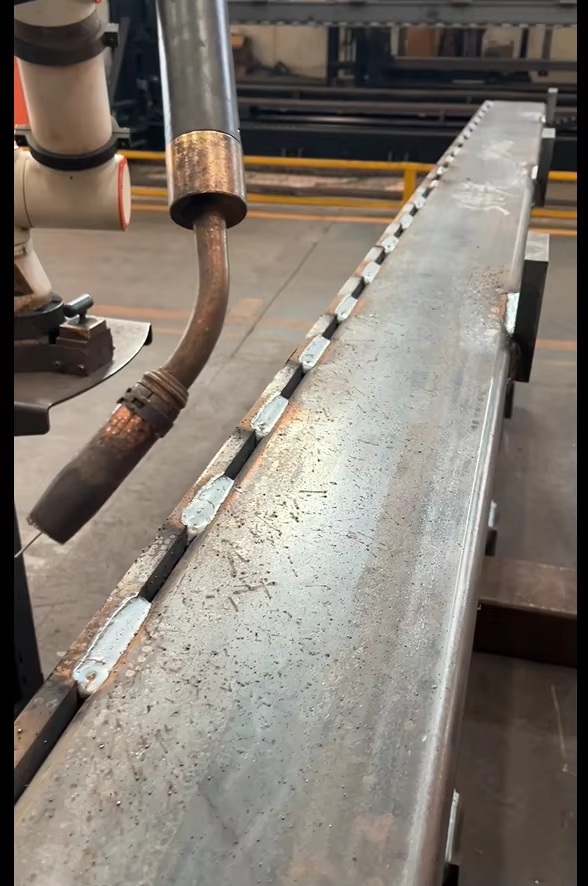
The “Infinite Rotation” technology utilized in this 20kW center employs a specialized rotary joint system and slip-ring architecture for gas and signal transmission. This allows the A and B axes to rotate indefinitely without mechanical stops. For the Rayong shipyard, this means that a single continuous path can be programmed for a complex pipe-to-beam intersection or a multi-sided flange bevel, maintaining constant focal positioning and beam stability. The result is a 25-30% reduction in processing time for complex structural joints compared to standard 3D laser heads.
2.2 Precision Beveling and Weld Preparation
Shipbuilding requires stringent weld preparations to ensure structural integrity under marine loading conditions. The 3D head achieves bevel angles up to ±45 degrees with micron-level repeatability. By utilizing the 20kW source, the system maintains a high energy density even at inclined angles, where the effective thickness of the material increases (e.g., cutting a 20mm flange at 45 degrees results in a ~28.3mm effective path). The infinite rotation capability ensures that the transition between different bevel angles—essential for variable-angle grooves in hull reinforcement—is seamless and free of thermal deviation.
3. Synergy of 20kW Fiber Laser Power Density
3.1 Thick-Walled Profile Penetration
The 20kW power rating is not merely for speed; it is for the stabilization of the vapor capillary (keyhole) in heavy-duty carbon steels such as DH36 and EH36 grades common in Rayong’s yards. At 20kW, the system can process flange thicknesses up to 25mm with oxygen-assisted cutting at speeds that prevent excessive heat accumulation, which otherwise leads to edge melting and slag adhesion. In nitrogen-assisted cutting, the system achieves dross-free edges on thinner structural sections, eliminating the need for manual grinding before welding.
3.2 Thermal Management in High-Ambient Environments
Rayong’s climate presents a challenge: high ambient temperatures and humidity can lead to beam divergence and lens contamination. The 20kW system integrated here features an isolated, climate-controlled laser source cabinet and a multi-stage filtration system for the assist gas. The 3D head is equipped with dual-circuit water cooling that services not only the collimator and focusing lenses but also the internal mechanics of the infinite rotation module. This prevents thermal expansion of the mechanical components, ensuring that the TCP (Tool Center Point) remains accurate to within ±0.05mm over an 8-hour shift.
4. Structural Steel Processing Center Integration
4.1 Automated Profile Detection and Compensation
Structural steel is rarely perfectly straight. H-beams often exhibit “camber,” “sweep,” or “twist” from the mill. A standard 2D laser would fail under these conditions. The 3D Structural Steel Processing Center utilizes a combination of mechanical probing and laser-based sensing to map the actual geometry of the profile before cutting. The CNC controller then dynamically offsets the 5-axis cutting path in real-time to match the detected deformation. This is critical for the Rayong yard, where large-scale structural assemblies require perfect fit-up to minimize “gap-filling” during automated welding processes.
4.2 Material Handling and Throughput
The center is equipped with an automated in-feed and out-feed system capable of handling profiles weighing up to 250kg per meter. The synergy between the 20kW source and the automated handling allows for the “batching” of structural members. While one beam is being processed with the 3D head, the next is being gauged and positioned. In the Rayong facility, this has transformed the workflow from a manual, station-to-station process into a continuous production line, effectively tripling the daily tonnage output of the structural shop.
5. Field Observations: Performance on Shipbuilding Specific Components
5.1 Bulb Flat and Angle Iron Processing
Bulb flats are essential in marine stiffening. Their asymmetrical geometry makes them notoriously difficult to cut using traditional automated systems. The Infinite Rotation 3D head excels here, as it can navigate the “bulb” section of the profile, maintaining the nozzle-to-workpiece distance via high-speed capacitive sensing. The 20kW power ensures that the transition from the thin web to the thick bulb is handled via instantaneous power modulation, preventing burn-through or incomplete cuts.
5.2 Circular and Rectangular Hollow Sections (CHS/RHS)
For offshore platforms and vessel railings, the system processes CHS and RHS with high efficiency. The infinite rotation allows for “saddle cuts” and “fish-mouth” joints to be executed in a single pass. The 20kW density allows for high-pressure air cutting on stainless steel railings, providing a clean finish that meets the aesthetic and corrosion-resistance requirements of the marine industry without requiring chemical pickling.
6. Engineering Conclusion and ROI Analysis
The implementation of the 20kW 3D Structural Steel Processing Center with Infinite Rotation in Rayong has redefined the yard’s operational capability. The technical advantages are summarized as follows:
- Precision: Elimination of manual layout and hand-cutting reduces errors by 98%.
- Efficiency: Infinite rotation removes the “dead time” of head repositioning, optimizing the 20kW duty cycle.
- Weld Quality: Precise beveling and minimal Heat Affected Zones (HAZ) result in higher NDT (Non-Destructive Testing) pass rates for hull welds.
- Labor Optimization: A single operator now performs the work previously requiring a team of five (layout, cutting, grinding, and beveling).
From a senior engineering perspective, the 20kW 3D system is not merely a cutting tool but a comprehensive fabrication solution. For shipyards in Rayong looking to compete on a global scale, the ability to process heavy structural steel with this level of speed and geometric accuracy is no longer optional—it is the baseline for modern naval architecture and offshore engineering.
Field Report End.
Ref: RS-3D-20KW-LOG-2024













