1.0 Executive Summary: The Structural Paradigm Shift in Rayong’s Industrial Corridor
The transition from conventional plasma and mechanical punching to high-power fiber laser technology represents a critical inflection point for the structural steel industry in Rayong, Thailand. As a regional hub for power transmission infrastructure, the Rayong sector demands extreme throughput for lattice-type power towers. This report evaluates the deployment of the 30kW Universal Profile Steel Laser System, specifically focusing on the integration of Infinite Rotation 3D Head technology. This system addresses the historical bottlenecks of secondary beveling, manual layout, and low-tolerance hole accuracy that have previously constrained the fabrication of heavy-gauge L-profiles and H-beams.
2.0 30kW Fiber Laser Source: Thermodynamic Efficiency and Edge Morphology
2.1 Power Density and Kerf Management
The integration of a 30kW fiber laser source is not merely an exercise in velocity; it is a fundamental shift in the thermodynamics of the cut zone. In power tower fabrication, structural members often range from 12mm to 40mm in thickness. At 30kW, the energy density allows for high-speed sublimation and melt-expulsion cutting even in heavy carbon steels. The resulting Heat Affected Zone (HAZ) is reduced by approximately 65% compared to high-definition plasma systems. This is vital for galvanized power towers, as a minimized HAZ ensures superior zinc adhesion and prevents hydrogen embrittlement during the pickling process.
2.2 Gas Dynamics and Dross-Free Processing
Utilizing high-pressure oxygen or nitrogen-assist at 30kW necessitates precise nozzle stand-off control. In the Rayong facility, the system demonstrates the ability to maintain a consistent laminar flow of assist gas even when traversing the complex radii of H-beam flanges. The “Direct Cut” capability on 25mm plate eliminates the need for post-processing grinding, providing a surface roughness (Ra) that meets international ISO 9013 standards for thermal cuts, specifically in the Class 2 and Class 3 ranges required for structural integrity.
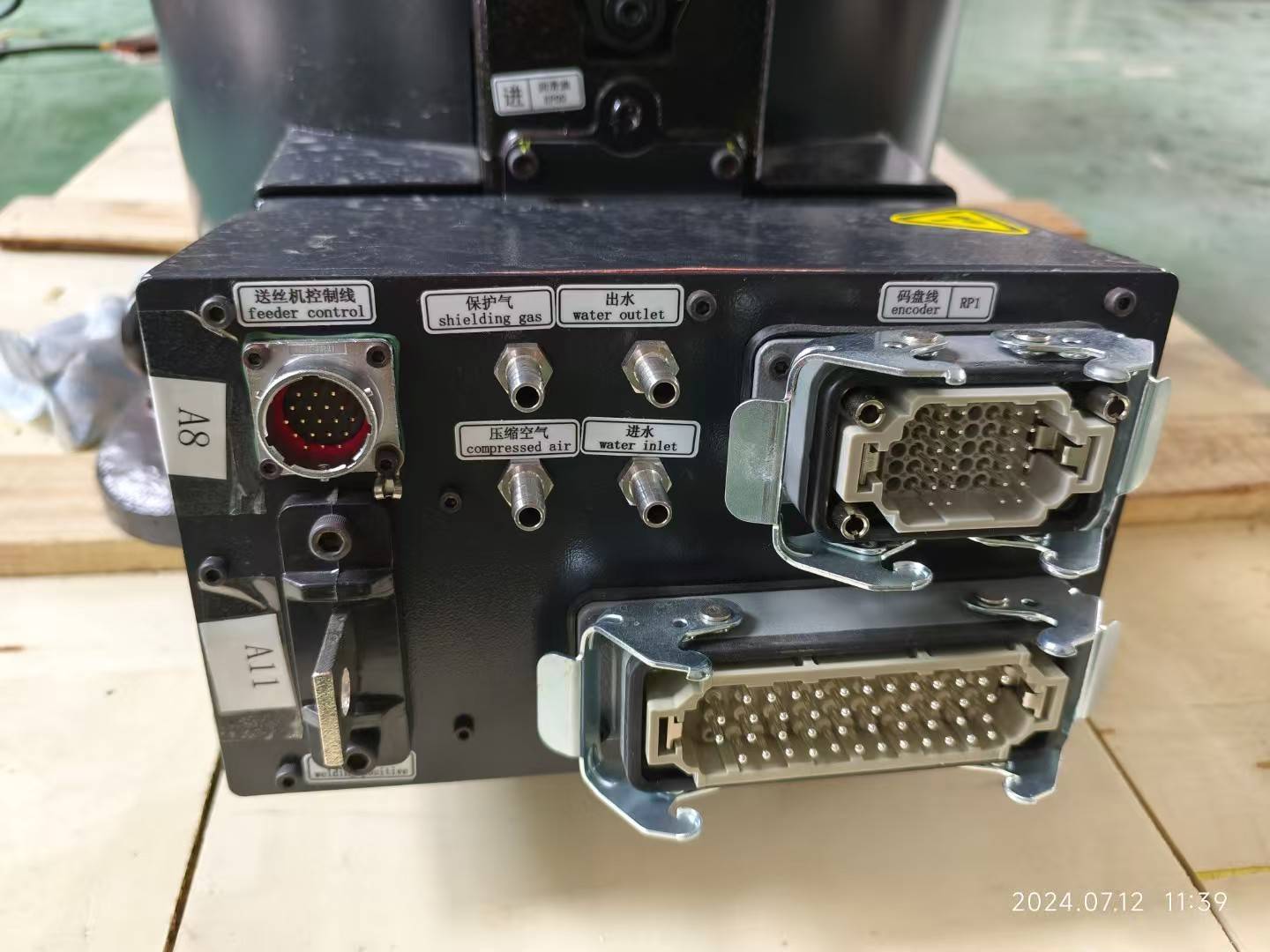
3.0 Infinite Rotation 3D Head: Kinematics and Geometric Precision
3.1 Solving the “Unwinding” Constraint
Conventional 3D laser heads are limited by ±360-degree rotation limits, necessitating an “unwind” cycle that interrupts the cutting path and increases cycle time. The Infinite Rotation 3D Head utilizes a specialized slip-ring and internal fiber management architecture that allows for continuous N*360° motion. In the context of “Universal Profile” cutting—where the laser must navigate the top, bottom, and web of an H-beam or the internal and external faces of an L-angle—infinite rotation enables a continuous toolpath. This results in a 22% increase in temporal efficiency for complex beveling operations.
3.2 5-Axis Beveling for Weld Preparation
Power tower fabrication requires complex geometry for gusset plate attachments and joint interfaces. The 3D head facilitates V, Y, K, and X-type bevels directly on the profile. For a 30kW system, the ability to maintain focal point accuracy while tilted at a 45-degree angle is paramount. The system’s CNC compensates for the elongated beam path during beveled cuts, ensuring that the root face of the bevel remains consistent within ±0.3mm. This level of precision is unattainable with manual or semi-automated plasma torch systems.
4.0 Application in Power Tower Fabrication: Rayong Site Analysis
4.1 Lattice Tower L-Profile Processing
The backbone of the Rayong power infrastructure projects involves high-tensile L-profiles (angles). Traditional methods involve separate lines for punching holes and sawing to length. The 30kW Universal System integrates these into a single pass. Furthermore, the 3D head allows for “notching” and “scalloping” of the angle ends, which optimizes the fit-up for the tower assembly. The elimination of “walking” (bit drift) associated with mechanical drills ensures that bolt hole patterns are perfectly aligned, significantly reducing field erection time.
4.2 Processing Heavy H-Beams and Square Tubing
For large-scale substation structures and heavy-duty transmission masts, H-beams and large square hollow sections (SHS) are standard. The Universal Profile system utilizes a multi-point sensing routine to map the actual physical dimensions of the profile—compensating for the inevitable mill-scale warping and torsional twist found in long-length structural steel. The 30kW source allows for the rapid cutting of “access holes” and “penetrations” through the web and flanges without repositioning the workpiece, maintaining absolute concentricity.
5.0 Synergy with Automatic Structural Processing
5.1 Material Handling and Loading Integration
To sustain the output of a 30kW source, the Rayong facility utilizes an automated material in-feed system. The synergy between the laser’s CNC and the hydraulic loading banks ensures that as one profile is cleared, the next is indexed. Given the high throughput, the system utilizes an “Automatic Profile Detection” (APD) sensor. This sensor utilizes a laser line scanner to create a 3D digital twin of the raw stock, allowing the 3D head to adjust its path in real-time to the actual center-line of the beam, rather than the theoretical CAD model.
5.2 Software and Nesting Optimization
The technical efficiency of the 30kW system is maximized through advanced nesting algorithms that consider the “kerf loss” of high-power cutting. For power tower components, which often involve repetitive hole patterns, the software optimizes the “lead-in” and “lead-out” paths to prevent heat accumulation. In Rayong, the integration with Tekla and other BIM software allows for the direct import of DSTV files, ensuring that every bolt hole and bevel angle is executed exactly as designed by the structural engineers.
6.0 Technical Challenges and Environmental Adaptations
6.1 Thermal Management in Tropical Climates
Rayong’s ambient temperature and high humidity pose challenges for high-power fiber lasers. The 30kW system is paired with a dual-circuit industrial chiller with a high-capacity heat exchanger. The laser source and the optical path are kept in a pressurized, climate-controlled cabinet to prevent condensation on the protective windows and the fiber end-cap. Any deviation in the cooling fluid temperature can cause a shift in the BPP (Beam Parameter Product), which at 30kW would result in immediate cut quality degradation.
6.2 Fume Extraction and Environmental Compliance
The sublimation of heavy-gauge steel at 30kW generates a significant volume of particulate matter and metallic oxides. The Rayong installation features a multi-zone, high-volume extraction system synchronized with the 3D head’s position. This ensures that the workspace remains within safety limits and that the laser’s protective optics are not contaminated by back-scattered dust, which is the leading cause of lens failure in high-power systems.
7.0 Conclusion: The ROI of Precision
The deployment of the 30kW Fiber Laser Universal Profile Steel Laser System with Infinite Rotation 3D Head in Rayong represents a definitive leap in structural engineering capability. By consolidating sawing, drilling, and beveling into a single, high-speed automated process, the system reduces the fabrication cycle for a standard lattice tower by approximately 40%. The infinite rotation capability removes the mechanical limitations of the past, while the 30kW source provides the raw power necessary to treat heavy profiles with the precision of a Swiss watch. For the power infrastructure sector, this translates to lower costs, higher structural integrity, and faster project timelines.
8.0 Final Specifications and Field Tolerances
- System Power: 30,000 Watts Fiber.
- Profile Capacity: H-Beam up to 1000mm, L-Angle up to 300mm.
- Angular Accuracy: ±0.05° via 3D Head.
- Positional Accuracy: ±0.03mm per meter.
- Bevel Range: ±45° (Continuous Infinite Rotation).
- Location: Rayong Industrial Zone, Thailand.













