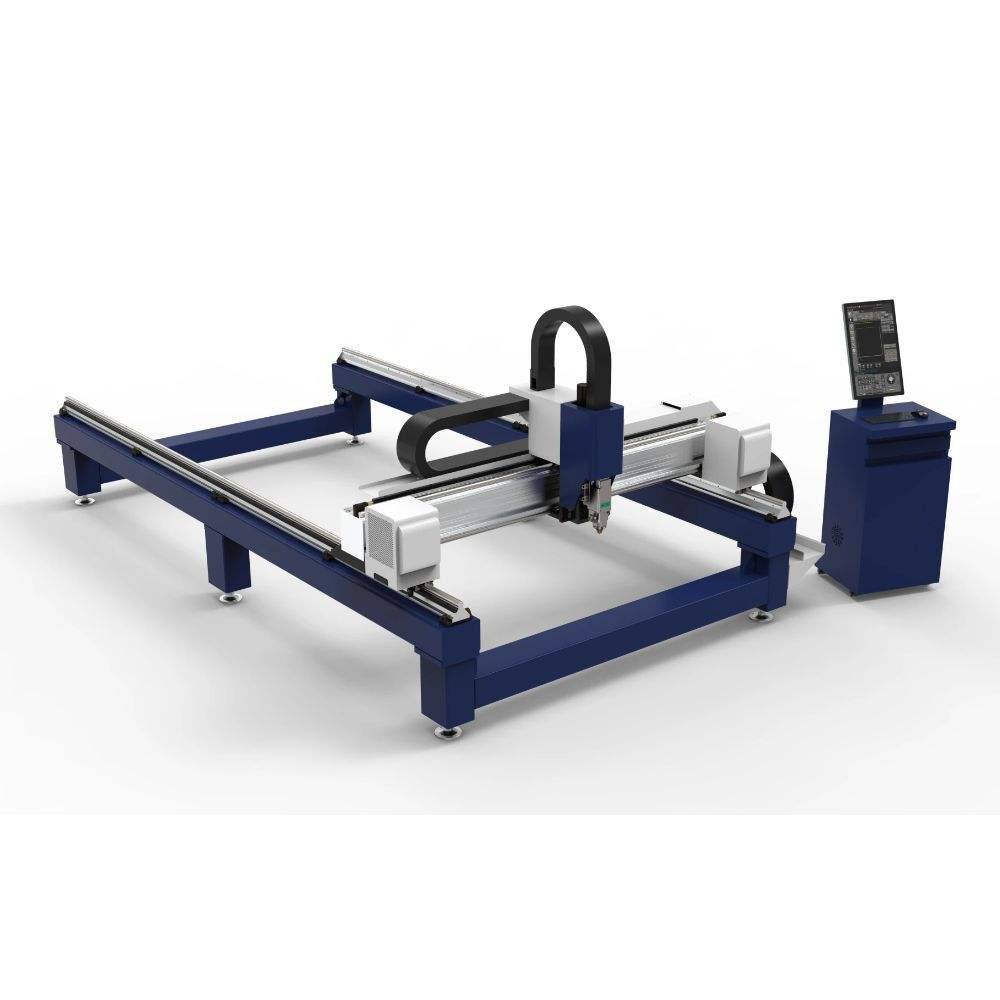
1. Field Report: Integration of 30kW High-Power Fiber Laser Systems in Hamburg’s Structural Sector
This technical report details the deployment and operational performance of a 30kW Universal Profile Steel Laser System within the high-density storage racking manufacturing sector in Hamburg, Germany. As a primary logistics hub, Hamburg’s demand for high-bay warehouses requires structural steel components that meet stringent Eurocode 3 standards. The transition from traditional mechanical processing (sawing, drilling, and manual milling) to an integrated 30kW fiber laser system with ±45° beveling capabilities represents a fundamental shift in structural steel fabrication.
The 30kW power threshold is not merely a benchmark for speed; it is a necessity for processing the heavy-walled sections (H-beams, I-beams, and heavy square hollow sections) required for automated storage and retrieval systems (ASRS). This report evaluates the synergy between ultra-high power, five-axis kinematics, and automated material handling.
2. Technical Analysis of the 30kW Fiber Laser Source
The heart of the system is the 30kW ytterbium-doped fiber laser source. At this power level, the energy density at the focal point exceeds 10^8 W/cm², allowing for the instantaneous sublimation of carbon steel.
2.1. Beam Quality and Kerf Management
In profile steel processing, maintaining a consistent Beam Parameter Product (BPP) is critical. The 30kW source utilized here is optimized for thick-section piercing and high-speed fusion cutting. For storage racking—where S355JR and S355J2+N grades are common—the 30kW source allows for high-pressure Nitrogen cutting on thicknesses up to 16mm, yielding an oxide-free surface ready for immediate coating or welding. For thicknesses exceeding 20mm (standard for base plates and heavy uprights), Oxygen-assisted cutting maintains a verticality tolerance within DIN EN ISO 9013 Class 2.
2.2. Thermal Loading and HAZ Control
A significant concern in structural steel is the Heat Affected Zone (HAZ). Excessive heat input can lead to local martensitic transformation, increasing brittleness. The 30kW system, by virtue of its high feed rate (up to 4x faster than 12kW systems on 20mm sections), minimizes the total heat input per linear meter. This ensures that the mechanical properties of the racking uprights—specifically yield strength and elongation—remain within the design parameters required for seismic-resistant storage structures.
3. ±45° Bevel Cutting: Solving the Weld Preparation Bottleneck
The inclusion of a ±45° 5-axis oscillating head is the most significant technological advancement in this installation. In traditional racking fabrication, beveling for full-penetration welds is a secondary process involving manual grinding or oxy-fuel beveling.
3.1. Kinematic Complexity of Profile Beveling
Unlike flat-sheet beveling, profile beveling requires the laser head to navigate the complex geometry of H-beams and U-channels. The system’s CNC controller must handle real-time height sensing (capacitive) while the B and C axes interpolate to maintain the required bevel angle across the web and flanges. The 30kW system in Hamburg achieves precise V, X, and Y-type preparations on profiles up to 600mm in width.
3.2. Precision and Tolerance in Structural Assembly
Storage racking, particularly those exceeding 30 meters in height, requires sub-millimeter tolerances. A deviation of 1mm at the base of a racking upright can result in a significant lean at the apex, compromising the safety of the ASRS. The ±45° laser beveling ensures that the “land” or “root face” of the weld preparation is consistent within ±0.3mm. This level of precision allows for the use of robotic welding cells downstream, as the fit-up gap is minimized, reducing weld wire consumption and cycle times.
4. Application in the Hamburg Storage Racking Sector
The Hamburg site specifically focuses on cold-formed and hot-rolled sections for the maritime logistics industry. The “Universal Profile” designation of the system means it handles IPE, HEA, HEB, and RHS (Rectangular Hollow Sections) without requiring tool changes.
4.1. Processing High-Density Uprights
The uprights of a storage rack are subject to immense axial compression. The 30kW laser processes the bolt-hole patterns and the “teardrop” or rectangular slots for beam attachment with zero mechanical deformation—a common issue with mechanical punching. By integrating the beveling of the base-plate interface directly into the cutting cycle, the factory has reduced the “Part-to-Finish” time by 65%.
4.2. Complex Intersections and Bird-Mouth Cuts
In the construction of racking trusses and bracing, “bird-mouth” cuts (where a circular or square tube meets another profile at an angle) are common. The 30kW laser, combined with the 5-axis head, executes these complex 3D intersections with a beveled edge that follows the contour of the mating part. This eliminates the “air gaps” typically found in saw-cut assemblies, significantly increasing the structural integrity of the racking frames.
5. Synergy with Automatic Structural Processing
The 30kW system does not operate in isolation. In the Hamburg facility, it is integrated into a fully automated material flow.
5.1. Automated Loading and In-feed Logistics
Heavy profiles (up to 12 meters in length and weighing several tons) are loaded via a transverse chain conveyor. The system utilizes laser scanning to detect the “real” dimensions of the profile, accounting for mill tolerances such as camber and twist. The 30kW laser’s CNC compensates for these deviations in real-time, ensuring that the cut geometry is always centered on the actual physical profile rather than a theoretical CAD model.
5.2. Slag and Spatter Management
High-power cutting, especially at 30kW, generates significant molten ejecta. The Hamburg system employs an internal suction “shuttle” that travels inside the profile (specifically for RHS and CHS) to capture slag. For open profiles like H-beams, high-pressure water-cooled slats and specialized fume extraction systems ensure that the underside of the flange remains clean, preventing “dross” that would otherwise require manual chipping.
6. Performance Metrics and Efficiency Gains
Data collected over the first six months of operation in the Hamburg facility shows a transformative impact on throughput.
* **Processing Speed:** On 25mm S355 steel, the 30kW system achieves a cutting speed of 2.2 m/min, compared to 0.6 m/min with a 12kW system.
* **Secondary Process Elimination:** The ±45° beveling has eliminated 90% of manual grinding operations for weld preparation.
* **Material Utilization:** Advanced nesting algorithms for profiles (including common-line cutting for certain sections) have increased material yield by 8%.
* **Energy Efficiency:** While the peak power draw is higher, the “Energy per Meter” cut is lower than 15kW systems due to the drastically reduced processing time.
7. Engineering Challenges: Beam Divergence and Vibrational Stability
Operating a 30kW laser over the long travel distances required for 12-meter profiles presents unique engineering challenges.
7.1. Optical Path Compensation
Even in fiber-delivered systems, the external optics (the cutting head) must be robust. At 30kW, thermal lensing in the protective window can shift the focal point. The Hamburg system utilizes an “Intelligent Focus” head that monitors the temperature of the optical elements and adjusts the Z-axis position to compensate for any thermal drift during long-duration cuts.
7.2. Dynamic Rigidity
The gantry must move the 5-axis head at high accelerations (up to 1.2G) to maintain efficiency in thin-walled sections, yet remain stable enough for heavy-section beveling. The machine bed is a reinforced, cement-filled welded structure designed to dampen the high-frequency vibrations generated by the high-speed motion of the heavy cutting head assembly.
8. Conclusion
The implementation of the 30kW Fiber Laser Universal Profile Steel Laser System in Hamburg marks a technological milestone for the European storage racking industry. By combining ultra-high power with precise ±45° beveling, manufacturers can now produce structural components that were previously impossible or economically unfeasible. The elimination of secondary processing, the reduction in HAZ, and the ability to feed robotic welding cells with high-precision parts have set a new standard for heavy steel fabrication. Future developments will likely focus on the integration of AI-driven defect detection and further optimization of gas dynamics to further reduce the cost-per-cut in high-tensile steel applications.













