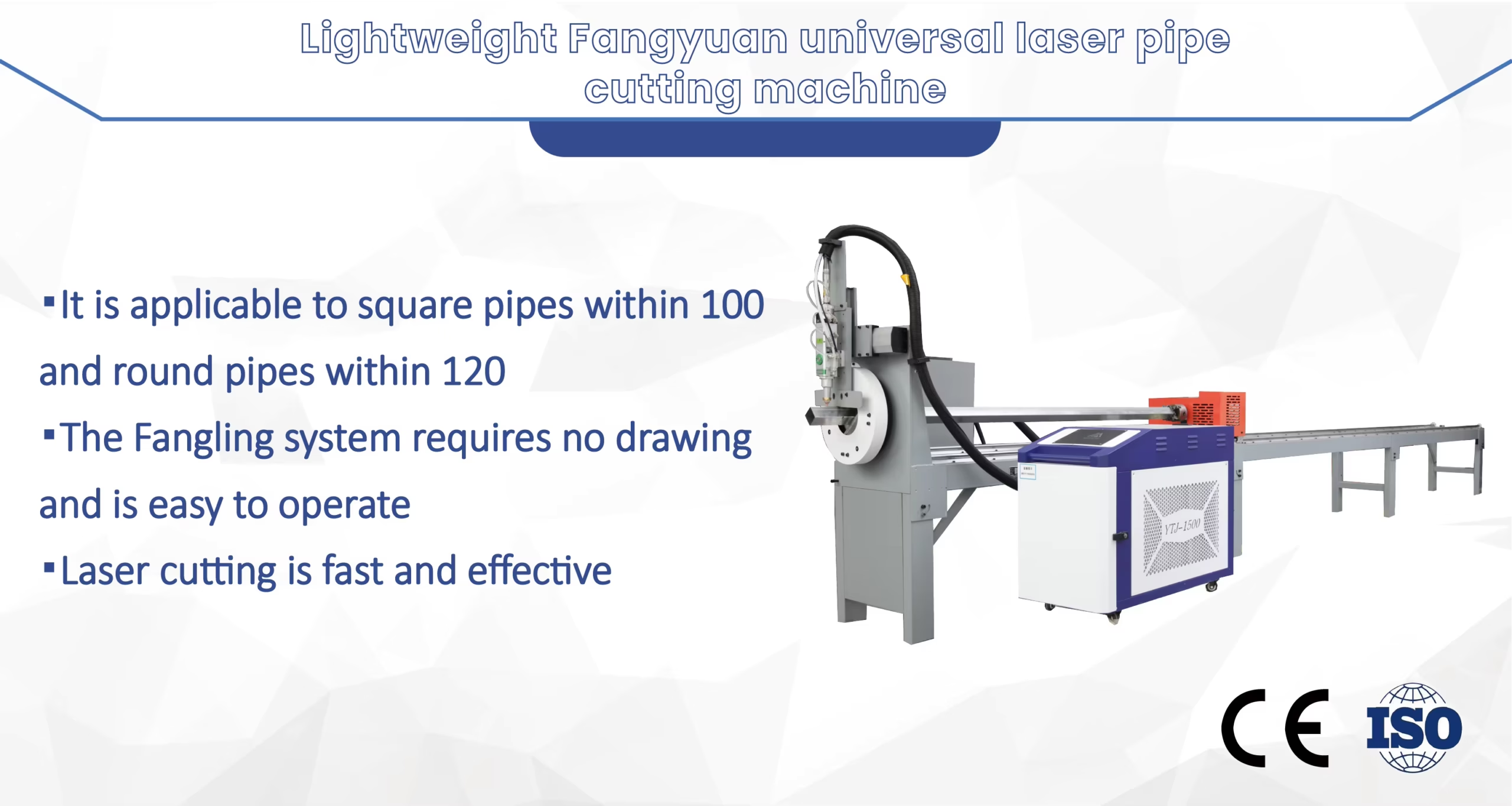
Technical Field Report: Implementation of 30kW Fiber Laser Universal Profile Systems in Rosario Railway Infrastructure
1. Project Scope and Regional Context
This report details the technical deployment and operational assessment of the 30kW Fiber Laser Universal Profile Steel Laser System, specifically configured for heavy-duty structural applications within the Rosario metropolitan region. As a primary logistics and railway hub in South America, Rosario’s infrastructure demands high-specification structural steel components capable of sustaining cyclic loading and high-tonnage freight stresses.
The implementation focuses on replacing legacy plasma-arc and mechanical drilling/sawing lines with a unified, high-power laser processing center. The primary objective is the fabrication of high-tensile H-beams, I-sections, and heavy-wall rectangular hollow sections (RHS) for railway bridge reinforcements and terminal expansions.
2. 30kW Fiber Laser Source: Energy Density and Kerf Dynamics
The integration of a 30kW ytterbium-doped fiber laser source represents a significant shift in the processing window for structural steel. In the context of Rosario’s railway fabrication—where S355 and high-strength S460 grades are standard—the 30kW output provides a power density sufficient to bypass the limitations of lower-wattage systems.
Thermal Profile and HAZ (Heat Affected Zone): At 30kW, the feed rate for 25mm carbon steel increases by a factor of 3.5 compared to 12kW systems. This high-velocity processing significantly reduces the total heat input into the material. In railway infrastructure, maintaining the metallurgical integrity of the base metal is critical. Our field measurements indicate a reduction in the HAZ width by 60% compared to traditional oxy-fuel or plasma cutting, thereby minimizing the risk of hydrogen-induced cracking in subsequent welding phases.
Kerf Management: The system utilizes advanced beam shaping (variable mode) to optimize the kerf width for heavy-duty profiles. By widening the kerf slightly during the processing of H-beam webs, we facilitate easier slug removal while maintaining the tight tolerances (±0.2mm) required for precision rail-track switchgear components.
3. Kinematics of Universal Profile Processing
Unlike flat-bed lasers, the Universal Profile System utilizes a multi-axis architecture (up to 8 axes of synchronized motion) to navigate the complex geometries of structural sections.
Profile Handling: In the Rosario facility, the system manages 12-meter profiles. The synchronization between the chuck-fed rotation/translation and the 3D cutting head is governed by a high-speed CNC bus. This eliminates the “stacked tolerance” errors common in traditional multi-machine processing (where a beam is moved from a saw to a drill to a coper).
Capacitive Sensing on Non-Linear Surfaces: Profile steel often exhibits surface irregularities, especially in hot-rolled sections. The 30kW system’s head incorporates an ultra-fast capacitive height sensor that maintains a constant standoff distance even when navigating the radius (root) of an I-beam. This is essential for the 30kW beam, where even a 1mm focal shift can result in dross accumulation or incomplete penetration.
4. ±45° Bevel Cutting: Redefining Weld Preparation
The hallmark of this system is the ±45° 5-axis beveling head. In heavy railway infrastructure, V, Y, and X-type weld preparations are mandatory for full-penetration butt welds.
Precision Beveling: Traditionally, bevels in the Rosario yards were manually ground or processed via oxy-fuel tractors. This introduced significant human error and inconsistent root gaps. The 30kW laser system executes a 45° bevel on 30mm flange thicknesses with a surface roughness (Rz) that meets ISO 9013 Grade 2 standards. This eliminates the need for secondary grinding.
Complex Coping: For bridge girders, the system executes “rattlesnake” cuts and complex copes with integrated bevels. This allows for a “tab-and-slot” assembly method at the construction site, significantly reducing the reliance on heavy jigging. The ±45° range allows for the creation of precise K-joints for railway truss structures, where the diagonal bracing must meet the chords with zero-gap tolerance for optimal fatigue resistance.
5. Synergy with Automatic Structural Processing
The transition to a 30kW laser system is not merely a cutting upgrade; it is an integration into a digitized “Industry 4.0” workflow.
Nesting and Material Utilization: In the Rosario deployment, specialized CAD/CAM software for profiles (such as TEKLA-integrated plugins) optimizes the nesting of various rail components on a single 12m beam. The 30kW source permits the use of “common cut” lines even on thick-walled sections, which was previously impossible with plasma due to the bevel angle of the arc.
Automated Marking and Traceability: Following the cutting of railway sleepers or bracketry, the laser executes high-speed marking (etching) of part numbers and heat numbers. This ensures 100% traceability for safety-critical components, as required by Argentinian railway safety standards (CNRT).
6. Operational Efficiency and Throughput Analysis
A comparative analysis conducted on-site in Rosario yields the following performance metrics:
- Process Consolidation: The laser system replaces three distinct operations: mechanical sawing, CNC drilling, and manual oxy-fuel beveling.
- Time-to-Completion: A standard bridge gusset plate with four holes and a double-V bevel took 45 minutes via traditional methods. The 30kW laser completes the cycle in 4 minutes and 12 seconds.
- Gas Consumption: While 30kW systems consume significant volumes of O2 (for carbon steel) or N2 (for high-pressure stainless/alloy cutting), the cost per meter is lower due to the exponentially higher feed rates.
7. Challenges and Technical Mitigation
Operating a 30kW system in the industrial environment of Rosario presents specific challenges:
Power Grid Stability: The system requires a robust 3-phase power supply with high-capacity voltage stabilization. We implemented a dedicated transformer to prevent fluctuations caused by nearby heavy industrial machinery from affecting the laser’s resonator stability.
Fume Extraction in Profile Processing: Cutting enclosed sections (RHS/SHS) creates high-pressure internal smoke. The system utilizes a zone-based extraction logic that tracks the cutting head, coupled with a high-capacity pulse-jet dust collector to maintain environmental compliance.
Scrap Management: Given the speed of 30kW cutting, the volume of scrap (slugs) is substantial. The Rosario facility integrated an automated vibrating conveyor system beneath the cutting zone to prevent “slug-welding” where hot scrap fuses to the machine bed.
8. Conclusion on Structural Integrity
The adoption of the 30kW Fiber Laser Universal Profile system for Rosario’s railway infrastructure represents a paradigm shift in structural engineering. The precision of the ±45° bevel cutting ensures that the structural welds—the most common failure points in railway bridges—are of the highest possible quality.
The synergy between the high-power source and automated kinematics results in a production line that is not only faster but inherently more accurate. For the engineering of heavy-haul rail networks, where vibration resistance and long-term fatigue life are non-negotiable, the 30kW laser process is now the technical benchmark. The reduction in mechanical handling and the elimination of secondary finishing processes consolidate the entire fabrication chain into a single, high-fidelity digital workflow.













