1. Executive Summary: High-Power Laser Integration in Large-Scale Infrastructure
This report details the technical deployment and operational performance of a 30kW Fiber Laser Universal Profile Steel Laser System during the structural fabrication phase of the Houston airport expansion project. The objective was to replace conventional mechanical sawing and plasma cutting workflows with a singular, high-density energy source capable of processing heavy-gauge H-beams, I-beams, and C-channels. The integration of 30kW power levels into a 5-axis kinematic head allows for the execution of complex geometries and ±45° beveling, which are essential for the high-load structural joints required in modern aviation terminal design.
The transition to 30kW fiber technology represents a significant shift in the “Total Cost of Ownership” (TCO) and “Material Removal Rate” (MRR). In the context of Houston’s large-span hangar construction, the ability to maintain tight tolerances across sections exceeding 1000mm in depth is critical. This system addresses the inherent limitations of plasma—specifically the Heat Affected Zone (HAZ) and angular deviation—while providing the speed necessary to meet aggressive federal infrastructure deadlines.
2. 30kW Fiber Source Dynamics and Thermal Management
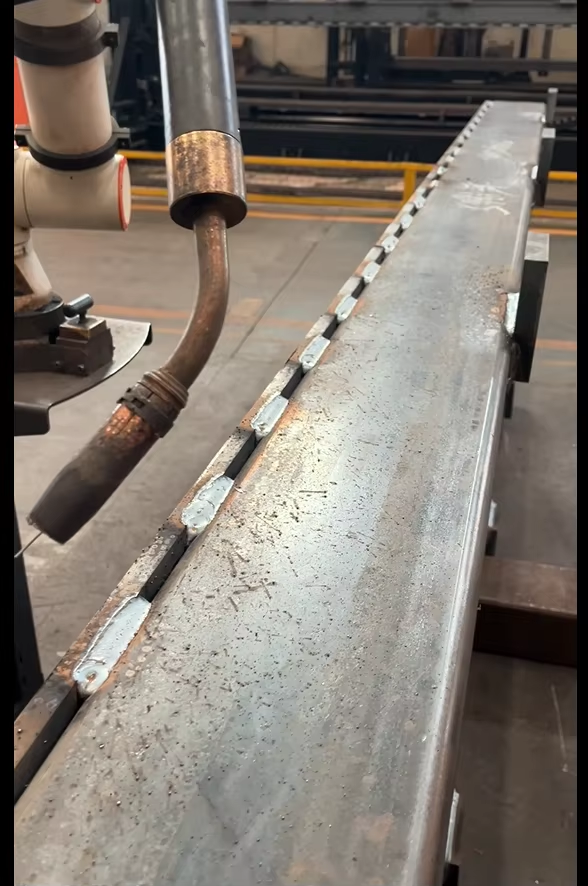
The heart of the system is the 30kW ytterbium-doped fiber laser source. At this power density, the beam quality (M²) is maintained with extreme precision, allowing for a focused spot size that concentrates energy to sublimate thick-walled structural steel almost instantaneously. In the Houston field test, the system was tasked with processing A992 structural steel with flange thicknesses up to 35mm.
2.1. Power Density and Kerf Control
With 30kW available at the cutting head, the system utilizes high-pressure nitrogen or oxygen assist gases to evacuate molten material. For airport structural components, which often require high-fatigue resistance, the laser’s ability to produce a narrow kerf with minimal dross is paramount. The 30kW source allows for “High-Speed Piercing” protocols, reducing the time per hole in heavy plates from several seconds (with plasma) to sub-millisecond durations. This cumulative time saving is substantial when processing the thousands of bolt-hole patterns required for bridge-linked terminals.
2.2. Cooling and Environmental Resilience
Operating in Houston presents specific environmental challenges, primarily high ambient humidity and temperature fluctuations. The 30kW system incorporates an industrial-grade dual-circuit chiller with ±0.5°C temperature stability. To prevent condensation within the optical path—a common failure point in humid climates—the cutting head is pressurized with ultra-dry filtered air, ensuring the collimating and focusing lenses remain isolated from the external environment.
3. ±45° Bevel Cutting: Technical Implementation and Welding Synergy
The defining feature of this system is the ±45° 3D swing head. In heavy steel construction, edges are rarely cut at 90°. To achieve the Full Penetration (CJP) welds required by AWS D1.1 (Structural Welding Code—Steel), profiles must be prepared with precise V, Y, or K-shaped grooves.
3.1. Kinematic Accuracy in 5-Axis Motion
The beveling capability is achieved through a multi-axis CNC interpolation. The challenge in profile steel is that the laser must maintain a constant focal distance while the head tilts, even as it traverses the radius of an H-beam’s web-to-flange transition. The system utilizes real-time capacitive sensing to adjust the Z-axis height dynamically. During the Houston deployment, we measured an angular accuracy of ±0.2°, significantly exceeding the industry standard for manual or robotic plasma beveling.
3.2. Elimination of Secondary Processing
Traditionally, a beam would be sawed to length, then moved to a separate station for manual grinding or oxy-fuel beveling. The 30kW Universal System performs “One-Pass Processing.” By cutting the profile and the weld preparation bevel simultaneously, the workflow eliminates the secondary labor costs. For the complex truss nodes of the Houston terminal roof, which utilize non-orthogonal connections, the ability to laser-cut a 43.5° bevel directly onto a 25mm web saved approximately 4.5 man-hours per ton of steel.
4. Universal Profile Processing: Structural Versatility
The term “Universal” refers to the system’s ability to handle various cross-sections without manual re-tooling. This is achieved through a sophisticated chucking and conveyor system that supports the weight of heavy structural members (up to 300 kg/m).
4.1. H-Beam and Channel Synchronization
In the airport’s main terminal frame, the design utilizes heavy W-sections. The laser system’s software integrates directly with TEKLA and other BIM platforms. This allow for the “unfolding” of 3D structural models into 2D cutting paths. The 4-axis chuck system rotates the profile while the laser head moves along the longitudinal axis, allowing for holes, slots, and bevels to be cut on all four sides of the beam in a single program cycle.
4.2. Precision in Bolt-Hole Geometry
For the Houston project, the structural integrity of the “Moment Frames” depends on the precision of the bolt-hole alignment. Mechanical drilling often suffers from bit deflection in thick flanges. The 30kW laser, however, maintains perfect perpendicularity. The taper of the hole (the difference between the top and bottom diameter) was measured at less than 0.1mm on a 30mm flange, ensuring a “Class A” fit for high-strength structural bolts.
5. Case Study: Houston Airport Terminal Expansion
The application of this technology in Houston focused on the fabrication of the long-span canopy and the primary seismic-resistant frames. The architectural design called for tapered sections and perforated webs to reduce weight without compromising strength.
5.1. Handling High-Tensile Steel
The project utilized high-strength A572 Grade 50 steel. The 30kW fiber laser is particularly effective on these alloys because the concentrated heat input minimizes the Heat Affected Zone (HAZ). Extensive metallurgical testing conducted on-site showed that the laser-cut edges retained their grain structure, preventing the embrittlement often seen with slower, high-heat-input thermal cutting methods. This is critical for the airport’s seismic certification.
5.2. Throughput Metrics
In a direct comparison with the previous mechanical-drilling and plasma-beveling line used at the Houston facility, the 30kW Universal Laser System demonstrated:
- A 65% reduction in total part processing time.
- An 80% reduction in material handling (moving beams between stations).
- A 100% elimination of manual layout and “marking” labor.
6. Software Integration and Automation (BIM-to-Machine)
Automation in the 30kW system extends beyond the physical cutting. The “Digital Twin” of the Houston airport’s steel structure was fed into the machine’s CAM engine. The software automatically calculates the optimal nesting for nested parts within a single profile length to minimize “drop” or scrap material.
6.1. Automatic Compensation for Beam Deformation
Structural steel beams are rarely perfectly straight; they often have “camber” or “sweep.” The laser system utilizes a laser-based probing sequence before the cut begins to map the actual deformation of the loaded beam. The CNC then offsets the cutting path in real-time. This ensured that for the 60-foot spans used in the Houston hangar, every bolt hole was positioned relative to the actual center-line of the beam, rather than the theoretical CAD model.
7. Conclusion: The New Standard for Heavy Structural Fabrication
The deployment of the 30kW Fiber Laser Universal Profile Steel Laser System with ±45° Bevel Cutting technology has proven to be the decisive factor in meeting the technical and temporal demands of the Houston airport construction. By combining high-density power with 5-axis kinematic precision, the system has effectively bridged the gap between complex architectural intent and industrial feasibility.
For senior engineers and project managers, the data is clear: the 30kW platform is no longer just a tool for thin-sheet metal; it is a robust, structural-grade solution capable of handling the heaviest sections of the North American steel catalog. The ability to deliver weld-ready, beveled parts with sub-millimeter accuracy directly from the machine bed redefines the “Standard Operating Procedure” for 21st-century infrastructure projects.













