The Dawn of Ultra-High Power in Southeast Asian Infrastructure
The structural steel industry in Ho Chi Minh City (HCMC) has historically relied on plasma cutting and mechanical sawing for the fabrication of I-beams and H-beams. However, as the city accelerates its “Master Plan” for urban rail and bridge connectivity, the limitations of these traditional methods—specifically regarding heat-affected zones (HAZ) and secondary processing—have become bottlenecks.
As a fiber laser expert, I have observed that the transition to 30kW power levels is not merely an incremental upgrade; it is a fundamental shift in physics. A 30kW fiber laser offers a photon density that allows for “vaporization” cutting even in thick-walled structural members. For the railway sector, where I-beams often exceed 20mm in flange thickness, the 30kW source provides the “reserve power” necessary to maintain high feed rates without sacrificing edge quality. This power level ensures that the laser can penetrate the varying thicknesses of an I-beam—from the thinner web to the thicker flanges—with a consistent, clean kerf.
Engineering the Heavy-Duty I-Beam Profiler
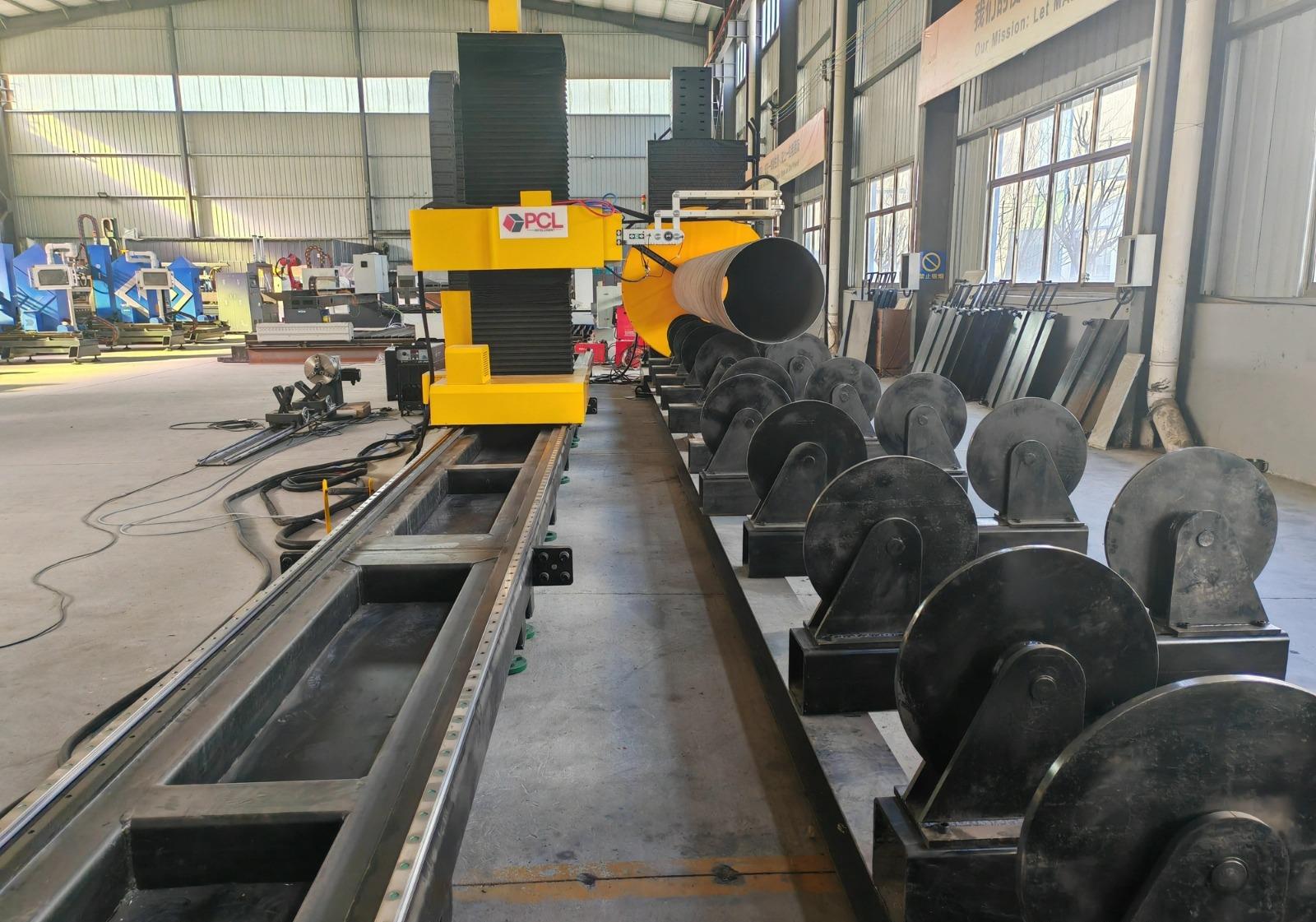
A 30kW laser source is only as effective as the motion system that carries it. For railway infrastructure, we deal with heavy-duty profiles that can weigh several tons. The profilers designed for this environment in HCMC are massive gantry-style or chuck-based systems capable of handling beams up to 12 meters in length.
The complexity of an I-beam lies in its geometry. Unlike flat sheets, an I-beam requires the laser head to navigate around flanges and deep into the web. This is achieved through a multi-axis robotic arm or a specialized 5-axis cutting head. In the context of HCMC’s railway fabrication shops, these machines often incorporate high-precision chucks that rotate the beam, allowing the laser to reach all four sides in a single program. This eliminates the need for manual flipping, which is the primary cause of dimensional inaccuracies in large-scale structural work.
The Critical Role of ±45° Bevel Cutting
In railway engineering, structural integrity is non-negotiable. Beams used in elevated track sections or station supports must be welded with full-penetration joints to withstand dynamic loads and vibrations. This is where the ±45° bevel cutting capability becomes indispensable.
Traditionally, creating a V, X, or K-shaped weld preparation on an I-beam required a secondary operation involving manual grinding or oxy-fuel beveling. A 30kW fiber laser equipped with a 3D beveling head can cut these angles simultaneously with the primary profile cut. The precision of a laser bevel (accurate to within ±0.5mm) ensures that the fit-up between two structural members is nearly perfect. In HCMC’s humid tropical environment, where weld porosity can be an issue, having a perfectly clean, laser-cut bevel reduces the risk of inclusions and ensures that the welding robots (or manual welders) can achieve X-ray quality seams on the first pass.
Speed and Efficiency: Meeting HCMC’s Aggressive Timelines
Ho Chi Minh City’s Metro Line 1 and the planned Line 2 are under immense pressure to meet deadlines. The 30kW fiber laser provides a throughput speed that is 3 to 5 times faster than a 12kW system and significantly faster than plasma. For instance, piercing 25mm carbon steel with a 30kW laser is nearly instantaneous, whereas lower power systems require a “ramped” pierce that consumes time and creates slag.
When processing hundreds of I-beams for a railway terminal, the time saved on piercing and the increased travel speed translate into weeks of saved production time. Furthermore, because the fiber laser produces a minimal heat-affected zone, the structural properties of the steel remain intact—a critical requirement for Bureau Veritas or other international inspection bodies overseeing HCMC’s infrastructure projects.
Thermal Management and Environmental Adaptation
Operating a 30kW laser in Ho Chi Minh City presents unique environmental challenges. The city’s high humidity and ambient temperatures (often exceeding 35°C) can be detrimental to high-power optics. As an expert, I emphasize that these machines must be equipped with specialized “Tropicalized” chilling systems and humidity-controlled enclosures for the laser source and the cutting head.
The 30kW source generates significant internal heat; therefore, the dual-circuit cooling system must be meticulously maintained. In HCMC, we implement pressurized optical paths to prevent the ingress of dust and moisture, which could otherwise lead to “thermal lensing”—a phenomenon where the laser focus shifts due to heat, resulting in a loss of cut quality. By controlling these variables, fabricators in District 9 or Thu Duc can maintain 24/7 operations regardless of the monsoon season.
Economic Impact on the Vietnamese Fabrication Sector
The investment in a 30kW I-beam profiler is substantial, but the ROI (Return on Investment) for railway infrastructure is compelling. Firstly, the “All-in-One” processing capability—cutting, hole-drilling, marking, and beveling in one machine—drastically reduces the footprint required in the factory. In a city like HCMC, where industrial land prices are rising, maximizing the output per square meter is essential.
Secondly, the reduction in labor cost is significant. One 30kW laser can replace two plasma cutters and three band saws, along with the associated material handling personnel. Finally, the “nesting” software used with these lasers optimizes the cutting path on the I-beam, reducing scrap rates. Given the high price of imported structural steel in Vietnam, a 5% saving in material wastage can equate to tens of thousands of dollars in savings on a single bridge project.
The Future: Toward Smart Railway Infrastructure
The integration of 30kW lasers is the first step toward Industry 4.0 in Vietnam’s construction sector. These machines are typically connected to a central MES (Manufacturing Execution System), allowing project managers at HCMC’s Department of Transport to track the fabrication progress of specific components in real-time.
Looking forward, the data captured by these laser profilers—such as cutting time, gas consumption, and beam stability—will allow for predictive maintenance, ensuring that the critical path of railway construction is never interrupted by machine downtime. The precision of the ±45° cuts also paves the way for the use of higher-strength steel grades (such as S355 or S460), which require the controlled heat input that only a laser can provide.
Conclusion: A New Standard for Excellence
The deployment of a 30kW Fiber Laser Heavy-Duty I-Beam Profiler with ±45° Bevel Cutting in Ho Chi Minh City is more than a purchase of machinery; it is an upgrade to the city’s industrial DNA. For railway infrastructure, where the margin for error is zero and the demand for durability is high, this technology provides the ultimate toolkit. It allows Vietnamese engineers to build faster, stronger, and more efficiently, ensuring that the tracks laid today will support the city’s growth for the next century. As HCMC continues to transform into a modern metropolis, the precision of the fiber laser will be etched into the very beams that hold the city together.