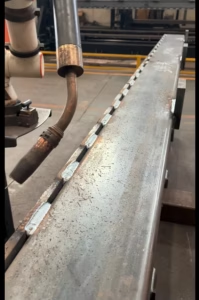
The Dawn of High-Power Laser Processing in Casablanca’s Maritime Sector
Casablanca has long served as the industrial heartbeat of Morocco, but its shipbuilding and repair yards are currently undergoing a massive technological metamorphosis. As the port expands its capacity to handle larger vessels and offshore structures, the demand for high-strength structural steel—specifically H-beams and I-beams—has skyrocketed. Traditionally, these components were processed using plasma cutting or manual oxy-fuel torches, methods that, while functional, introduce significant heat-affected zones (HAZ) and require extensive post-processing.
The introduction of the 30kW fiber laser H-beam cutting machine changes the equation entirely. At 30,000 watts, the laser density is sufficient to vaporize thick-walled structural steel almost instantaneously. In the context of a Casablanca shipyard, where efficiency is dictated by the ability to withstand the corrosive Atlantic environment through precise fit-up and welding, the fiber laser provides a level of edge quality that plasma simply cannot match.
The Technical Supremacy of 30kW Fiber Laser Power
Why 30kW? In the world of fiber lasers, power isn’t just about speed; it’s about the “quality-to-thickness” ratio. For shipbuilding, H-beams often feature web and flange thicknesses ranging from 12mm to over 30mm.
A 30kW source allows for “high-speed nitrogen cutting” on medium thicknesses and “oxygen-assisted cutting” on heavy sections with a drastically reduced kerf width. This high power enables the machine to maintain a stable keyhole during the cutting process, ensuring that the verticality of the cut on an H-beam’s flange remains perfect. This is critical because any deviation in the flange angle leads to gaps during the assembly of a ship’s bulkhead or hull framing, necessitating costly “filler” welding.
Furthermore, the 30kW power allows for the implementation of advanced piercing technologies. In heavy beams, traditional piercing can take seconds and create significant splatter. The 30kW system utilizes “frequency-modulated” piercing, which creates a clean entry point in milliseconds, protecting the nozzle and ensuring the integrity of the nesting start point.
Revolutionizing Geometry: 3D H-Beam Processing
Cutting an H-beam is infinitely more complex than cutting a flat sheet. It requires the machine to navigate the “web” (the center part) and the “flanges” (the top and bottom parts) without losing its focal position.
The machines deployed in Casablanca utilize a 5-axis or 6-axis 3D cutting head mounted on a gantry or a robotic arm. This allows for:
1. **Bevel Cutting:** Essential for shipbuilding, the laser can cut “V,” “Y,” and “K” shaped bevels in a single pass. This prepares the H-beam for immediate welding, eliminating the days of manual grinding previously required.
2. **Bolt Hole Precision:** Ships are often modular. The laser can cut bolt holes with a tolerance of ±0.1mm, ensuring that modular sections of a vessel’s internal frame bolt together perfectly on the first attempt.
3. **Complex Notching:** For pipes or other beams to pass through the structural H-beam, complex “scallops” or notches must be cut. The 3D head maneuvers around the profile of the beam, maintaining a constant standoff distance via capacitive sensing.
Zero-Waste Nesting: The Economics of Efficiency
In a shipyard, steel is the primary variable cost. Traditional beam sawing and drilling lead to “short ends”—remnants of beams that are too short to be used but too expensive to scrap. Zero-waste nesting software is the “brain” that makes the 30kW laser a profit center rather than a cost center.
**Common-Line Cutting:** The software identifies instances where two parts share a geometry. Instead of cutting two separate lines, the laser makes one cut to separate two components. In H-beam processing, this is particularly effective for straight cross-cuts, effectively doubling the cutting speed and saving gas.
**Remnant Management:** The “Zero-Waste” moniker refers to the software’s ability to nest small parts—such as gussets, brackets, or stiffeners used in the ship’s interior—into the “web” of the H-beam between larger structural cuts.
**Micro-Jointing and Lead-in Optimization:** To prevent the beam from shifting during the cut (which would ruin the precision), the nesting software uses intelligent micro-joints. In Casablanca’s high-volume yards, these algorithms calculate the exact weight and center of gravity of the cut piece to ensure it stays stable until the operator is ready to unload it, minimizing the “dead zone” at the end of the beam where the machine’s chucks hold the material.
Operational Challenges and Solutions in the Casablanca Environment
Operating a 30kW laser in a coastal city like Casablanca presents unique challenges, primarily salt-laden air and humidity. Fiber lasers are sensitive to particulates and moisture.
To combat this, these machines are equipped with pressurized, climate-controlled laser power source cabinets and specialized dust extraction systems. The cutting head utilizes a “double-cooled” circuit to prevent thermal expansion of the optics under the intense 30kW load.
Furthermore, the local workforce in Morocco is rapidly upskilling. The interface of these machines has transitioned from complex G-code programming to intuitive, 3D-visual CAD/CAM integration. A technician in Casablanca can import a Tekla or AutoCAD file of a ship’s frame, and the software automatically generates the nesting pattern and the 5-axis toolpath, reducing the barrier to entry for high-tech manufacturing.
The Impact on Shipbuilding Productivity
The metrics for a shipyard using a 30kW fiber laser versus traditional methods are staggering.
* **Time Savings:** A process that took 4 hours (marking, sawing, drilling, and manual beveling) is reduced to approximately 12 minutes of laser time.
* **Labor Reduction:** The machine replaces three separate workstations (saw, drill line, and grinding station), allowing the yard to reallocate skilled labor to the complex assembly and outfitting phases.
* **Welding Quality:** Because the laser-cut edges are pristine and the bevels are mathematically perfect, the volume of welding wire required is reduced by up to 15%. This also results in less “thermal distortion” of the ship’s hull, leading to a more hydrodynamic and aesthetically superior vessel.
Sustainability and the Green Shipyard Initiative
Morocco is increasingly focused on green industrialization. The 30kW fiber laser aligns with this vision. Compared to CO2 lasers, fiber lasers have a wall-plug efficiency that is 3 to 4 times higher. Compared to plasma cutting, the fiber laser produces far fewer hazardous fumes and eliminates the need for water-table chemical treatments.
The “Zero-Waste” aspect is perhaps the strongest environmental argument. By squeezing every possible centimeter of usable part out of an H-beam, the shipyard drastically reduces its carbon footprint associated with steel production and transport.
Conclusion: Setting the Standard for the Mediterranean and Beyond
The deployment of a 30kW Fiber Laser H-Beam Cutting Machine in Casablanca is more than a simple equipment upgrade; it is a strategic investment in the future of Moroccan maritime sovereignty. By leveraging zero-waste nesting and ultra-high-power laser technology, Casablanca’s shipyards are positioning themselves to compete with the premier yards of Europe and Asia.
For the shipbuilder, the result is a vessel that is stronger, lighter, and built with a level of precision that was once thought impossible in heavy structural engineering. As the laser slices through massive H-beams with the ease of a scalpel, it carves out a new path for Casablanca as a leader in the global blue economy.