The Dawn of Ultra-High Power: Why 30kW Matters for Structural Steel
As a fiber laser expert, I have watched the industry climb from the modest 2kW systems of the early 2010s to the 30kW behemoths we deploy today. In the context of H-beam cutting—the backbone of power transmission towers—power is not merely about speed; it is about the physics of the cut and the integrity of the material.
A 30kW fiber laser source provides a power density that allows for “lightning-fast” sublimation cutting. When dealing with the heavy-gauge carbon steel used in H-beams (often ranging from 12mm to 25mm in flange thickness), a lower-power laser struggles with dross accumulation and a wider heat-affected zone (HAZ). The 30kW system, however, moves so rapidly that the thermal input into the surrounding metal is minimized. For power tower fabrication, where structural integrity is non-negotiable, a smaller HAZ means the steel retains its original metallurgical properties, reducing the risk of brittle fractures under high wind loads.
Precision Engineering: Navigating the 3D Geometry of H-Beams
Cutting a flat sheet of metal is straightforward. Cutting an H-beam is a complex three-dimensional challenge. The 30kW fiber laser machines designed for this purpose utilize a sophisticated multi-axis head, often mounted on a robotic arm or a high-speed gantry with 360-degree rotation capabilities.
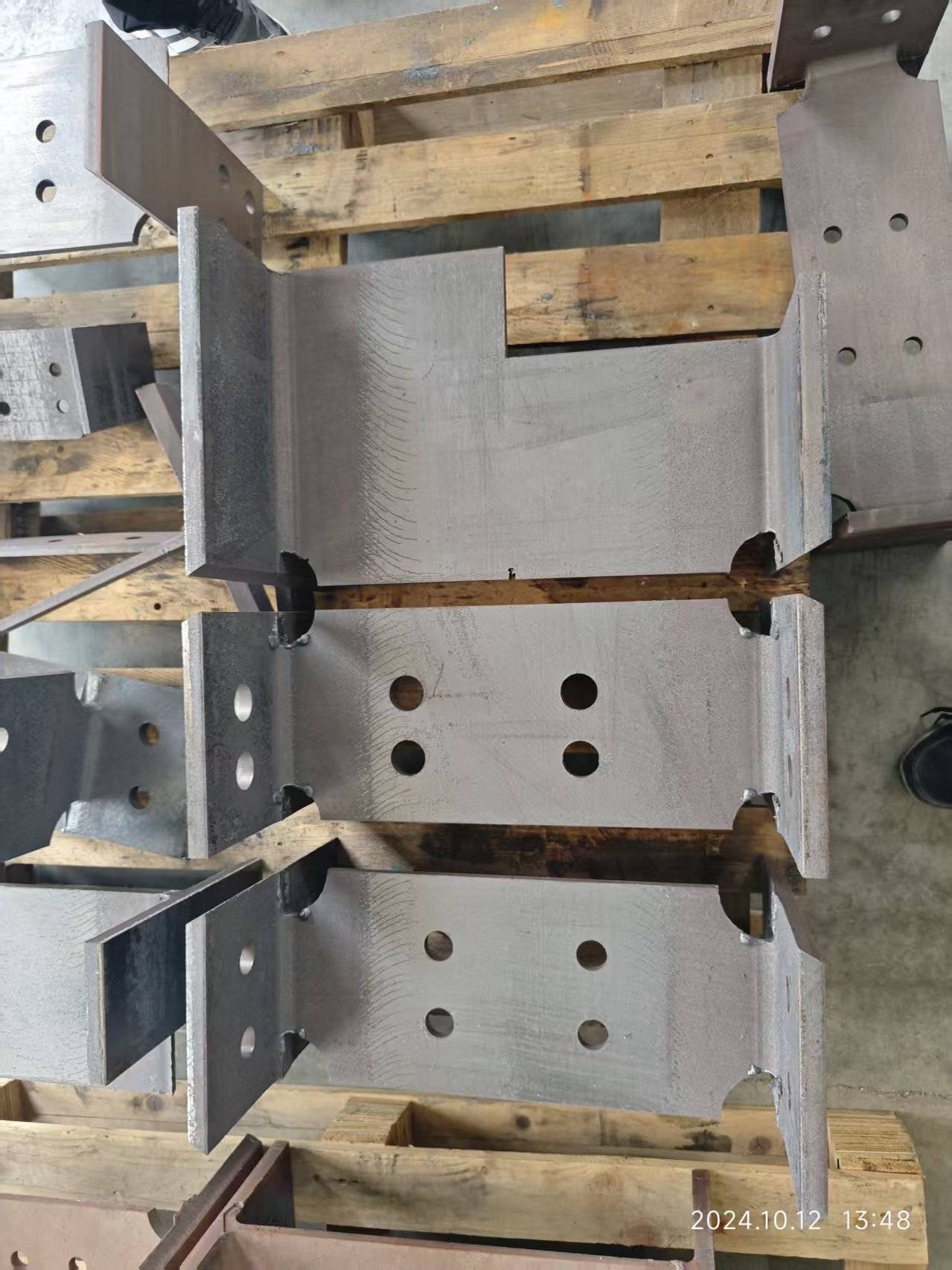
In Charlotte’s fabrication shops, these machines are replacing three or four traditional tools. Previously, a beam would be sawed to length, moved to a drill line for bolt holes, and then manually torched for coping or beveling. The 30kW laser performs all these functions in a single setup. It slices through the web and the flanges with synchronized precision, ensuring that the bolt holes for the power tower’s cross-arms align perfectly during field assembly. This “one-hit” processing is what allows Charlotte-based firms to outcompete international suppliers on lead times.
The “Zero-Waste” Revolution: Algorithmic Nesting for Beams
In the world of structural steel, material is the highest cost. “Zero-Waste” nesting is often misunderstood as a marketing buzzword, but in 30kW laser processing, it is a mathematical reality driven by advanced CAD/CAM software.
Traditional sawing always leaves a “kerf” (the width of the cut) and requires a “buffer” between parts. For H-beams, traditional methods often result in 5% to 10% scrap rates due to “end-remnants.” Zero-waste nesting algorithms utilize “common-line cutting.” Because the 30kW laser has a remarkably narrow kerf—often less than 1mm—the software can nest the end of one tower component directly against the start of the next.
Furthermore, the software analyzes the entire project’s bill of materials and identifies “micro-parts” or smaller brackets that can be cut from the “windows” or cutouts of the larger H-beams. In a 30kW system, the speed of piercing is so fast that these internal cuts don’t slow down production, effectively turning what would be scrap into functional components.
Charlotte: The Strategic Hub for Power Tower Fabrication
Why is Charlotte, North Carolina, becoming the epicenter for this technology? The answer lies in the intersection of logistics, the energy sector, and a skilled workforce. Charlotte is home to some of the largest utility providers and energy engineering firms in the United States. As the demand for grid modernization increases—driven by renewable energy integration and the hardening of the grid against extreme weather—the demand for transmission towers is skyrocketing.
Local fabricators are investing in 30kW fiber lasers to serve this regional demand. The ability to produce a tower section in Charlotte and ship it via the robust rail and highway networks of the Carolinas provides a significant logistical advantage. Moreover, the proximity to the Charlotte research corridor means that these facilities have access to the software engineers and laser technicians required to maintain such high-tech machinery.
Meeting Rigorous Standards: AISC and Beyond
Power towers must withstand immense tension and environmental stress. The American Institute of Steel Construction (AISC) has strict guidelines regarding the quality of cuts and holes in structural members. Historically, there was skepticism regarding laser-cut holes due to “hardening” of the hole edge.
However, the 30kW fiber laser has changed that narrative. Because the cut speed is so high, the “dwell time” of the beam is negligible. Testing has shown that 30kW laser-cut holes meet or exceed the requirements for bolt-bearing surfaces without the need for secondary reaming. This is a game-changer for power tower fabrication, where a single tower might require hundreds of high-strength bolts. The precision of the 30kW beam ensures that every hole is perfectly cylindrical, with zero taper, ensuring a snug fit that is vital for the tower’s long-term vibration resistance.
Operational Efficiency: Gas Consumption and Maintenance
As an expert, I must highlight that the move to 30kW also brings operational efficiencies that aren’t immediately obvious. While the power draw is higher, the “time-on-task” is significantly lower. A 30kW laser can cut three times faster than a 10kW laser in 16mm steel, meaning the total kilowatt-hours used per part is actually lower.
Additionally, these machines often utilize high-pressure air cutting rather than expensive oxygen or nitrogen for carbon steel. The sheer power of the 30kW beam allows it to clear the molten pool using compressed air, which is nearly free compared to bottled gases. In a high-volume environment like power tower fabrication, the savings on assist gas alone can contribute thousands of dollars to the bottom line every month.
The Future: AI-Driven Fabrication in the Queen City
The next step for Charlotte’s 30kW H-beam machines is the integration of Artificial Intelligence (AI). We are already seeing “smart” cutting heads that use sensors to monitor the cut quality in real-time. If the sensor detects a slight change in the sparks—indicating a variation in the steel’s composition—it automatically adjusts the focus and gas pressure to maintain a perfect cut.
For power tower fabrication, this means “zero-defect” manufacturing. Every beam that leaves the shop floor in Charlotte is digitally logged, with a “birth certificate” showing that the laser parameters remained within tolerance for every cut and every hole. This level of traceability is becoming a requirement for federal infrastructure projects.
Conclusion: Strengthening the Grid from the Heart of the Carolinas
The 30kW fiber laser H-beam cutting machine is more than just a piece of equipment; it is a catalyst for industrial renewal. By implementing zero-waste nesting and leveraging the massive power of the 30kW source, Charlotte fabricators are doing more than just cutting steel—they are building the future of the American energy grid.
In the competitive landscape of structural fabrication, the margin for error is thin, but the potential for innovation is thick. As we continue to push the boundaries of what fiber laser technology can achieve, the combination of high-power hardware and intelligent software will ensure that the power towers of tomorrow are stronger, cheaper to produce, and delivered faster than ever before. For the Charlotte industrial sector, the 30kW revolution isn’t just coming—it’s already here, and it is glowing with the intensity of a thousand suns.