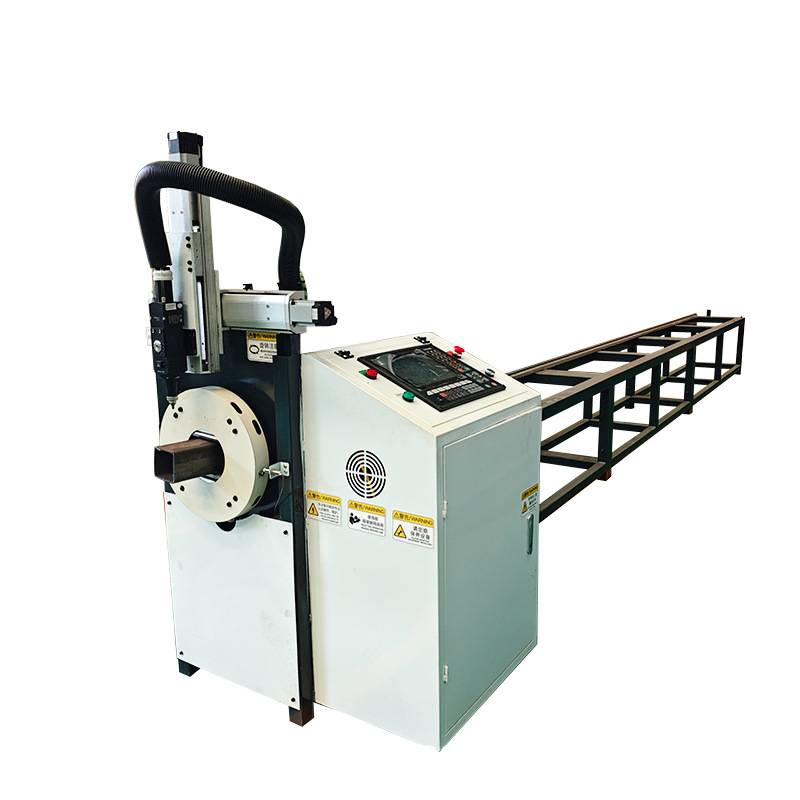
The Dawn of Ultra-High Power in Structural Steel: The 30kW Advantage
In the realm of fiber laser technology, the leap to 30kW is not merely an incremental upgrade; it is a fundamental transformation of what is possible in structural fabrication. For years, the industry relied on 6kW to 12kW systems, which were efficient for thin plates but struggled with the thick-walled sections of heavy H-beams and I-beams. A 30kW fiber laser source provides the photon density required to “vaporize” thick carbon steel with a speed that traditional plasma or mechanical methods cannot match.
In Rayong’s industrial landscape—where time-to-market is critical for Eastern Economic Corridor (EEC) projects—the 30kW laser offers superior piercing capabilities. It can penetrate the thick flanges of structural H-beams in milliseconds, creating clean, slag-free entries. The high power also allows for a smaller heat-affected zone (HAZ), ensuring that the structural integrity of the steel is maintained, which is a non-negotiable requirement for high-rise modular components.
Precision 3D Processing: Beyond Flat Sheet Cutting
Cutting an H-beam is significantly more complex than cutting a flat metal sheet. An H-beam consists of two parallel flanges connected by a central web. To process this effectively, the 30kW machine utilizes a specialized 3D five-axis cutting head. This head can rotate and tilt, allowing for complex miter cuts, bevels for weld preparation, and the cutting of precise bolt holes across all three surfaces of the beam in a single pass.
For modular construction, this precision is vital. Modular units are built off-site and assembled like LEGO bricks. If a beam is even three millimeters out of alignment, the entire module may fail to lock into place. The 30kW fiber laser ensures tolerances within ±0.05mm. In Rayong’s fabrication shops, this eliminates the need for “on-site adjustments,” which are the primary cause of cost overruns in modular projects.
Zero-Waste Nesting: The Economics of Sustainability
In heavy industry, material cost typically accounts for 60-70% of the total project budget. Traditional H-beam processing often results in significant “drop” or scrap—short segments of beams that are too small to be used. The “Zero-Waste Nesting” software integrated into these 30kW systems uses advanced algorithms to solve the “bin packing problem” for structural steel.
The software analyzes the entire production queue and identifies how to fit various components into a standard 12-meter H-beam with minimal leftover material. Features like “Common Line Cutting”—where one cut serves as the edge for two different parts—and “Micro-jointing” allow the machine to process continuous lengths of steel with almost 99% utilization. In a city like Rayong, where steel prices fluctuate with global markets, the ability to squeeze an extra component out of every ten beams can be the difference between a profitable contract and a loss.
Impact on Rayong’s Modular Construction Sector
Rayong has positioned itself as the high-tech manufacturing hub of Southeast Asia. The rise of modular construction in this region is driven by the demand for rapid infrastructure, including data centers, worker accommodations, and specialized industrial facilities.
A 30kW fiber laser H-beam machine acts as a “factory in a box.” Traditionally, a beam would move from a band saw to a drilling station, then to a manual layout table, and finally to a coping station. In a Rayong-based modular factory equipped with a 30kW laser, all these steps are consolidated. The beam is loaded onto the automated rack, and the laser performs the cutting, hole-making, and marking (for assembly instructions) in one continuous flow. This “Single-Pass Fabrication” reduces labor costs by up to 80% and slashes production cycles from days to hours.
The Role of Advanced Motion Control and Automation
A 30kW laser is a beast that must be tamed by world-class motion control. The machines deployed in Rayong often feature heavy-duty pneumatic chucks and a multi-point support system to handle beams that can weigh several tons. Because fiber lasers are sensitive to vibrations, the machine bed is usually made of high-strength, heat-treated steel or even mineral casting to ensure stability during high-speed movements.
Furthermore, the automation goes beyond the cutting. Integrated loading and unloading systems use hydraulic lifts and conveyor belts to move raw H-beams into the cutting zone and transport finished parts to the welding area. This level of automation is essential for Rayong’s “Industry 4.0” initiatives, allowing factories to operate with minimal human intervention, thereby increasing safety in an environment where handling heavy steel is a high-risk activity.
Optimizing Gas Dynamics for 30kW Output
As a fiber laser expert, I must emphasize that the laser power is only half the story; the other half is the auxiliary gas. At 30kW, the management of oxygen or nitrogen is critical. Most H-beam cutting in Rayong utilizes high-pressure air or oxygen for thick carbon steel.
The machine’s nozzle design must be aerodynamically optimized to blow away molten metal at supersonic speeds. If the gas dynamics are off, the 30kW beam will simply “burn” the steel rather than “cut” it, resulting in heavy dross. Modern systems use frequency-conversion gas control to adjust pressure in real-time based on the thickness of the flange or web being cut. This ensures that the bottom edge of the H-beam is as smooth as a machined surface, ready for immediate welding without the need for grinding.
Sustainability and the Green Building Movement
Modular construction is inherently more sustainable than traditional building methods, and the 30kW fiber laser amplifies this benefit. By reducing scrap through zero-waste nesting, the carbon footprint associated with steel production is lowered. Additionally, fiber lasers are significantly more energy-efficient than older CO2 lasers or plasma cutters.
In the context of Thailand’s “BCG” (Bio-Circular-Green) economic model, adopting zero-waste laser technology in Rayong is a strategic move. It allows companies to apply for “Green Industry” certifications, which are becoming increasingly important for securing international contracts in modular housing and green infrastructure.
The Future: AI-Driven Fabrication
The next step for the 30kW H-beam laser machines in Rayong is the integration of Artificial Intelligence. We are already seeing “Vision Systems” that can detect if a raw H-beam is slightly warped (a common occurrence with hot-rolled steel) and automatically adjust the cutting path in real-time to compensate.
Combined with cloud-based nesting, a project manager in Bangkok could upload a BIM (Building Information Modeling) file, and the 30kW laser in Rayong could begin cutting the exact components needed within minutes. This connectivity is what will solidify Rayong’s position as a global leader in modular construction technology.
Conclusion: A New Era for Structural Engineering
The 30kW fiber laser H-beam cutting machine is more than just a tool; it is the backbone of a modern industrial revolution in Thailand. For the modular construction industry in Rayong, it represents the end of the “measure twice, cut once” era and the beginning of “design once, click print.”
By embracing ultra-high power, 3D precision, and zero-waste algorithms, fabricators are not only increasing their profit margins but also contributing to a more efficient, sustainable, and technologically advanced built environment. As the EEC continues to grow, the hum of 30kW lasers in Rayong will be the sound of the future being built, one perfectly cut H-beam at a time.