The Dawn of Ultra-High Power in Dubai’s Steel Sector
Dubai has long been a city that defies the limits of traditional construction. As the region prepares for a new generation of sports infrastructure and iconic public spaces, the demand for structural steel that is both lightweight and incredibly strong has surged. Historically, the fabrication of H-beams—the backbone of stadium skeletons—relied on a combination of band sawing, drilling, and plasma cutting. However, as architects push for more complex designs involving massive spans and intricate junctions, these traditional methods have hit a ceiling.
Enter the 30kW fiber laser. As a fiber laser expert, I have witnessed the transition from 6kW to 12kW, and now to the 30kW threshold. This is not merely an incremental upgrade; it is a fundamental shift in the physics of material processing. At 30kW, the power density is sufficient to vaporize thick-walled carbon steel almost instantaneously. In the context of Dubai’s stadium projects, where H-beams can feature flange thicknesses exceeding 25mm, the 30kW laser provides the “brute force” necessary to maintain high feed rates without sacrificing the edge quality required for structural certification.
The Complexity of H-Beam Processing
Cutting a flat sheet is a two-dimensional challenge. Cutting an H-beam (or I-beam) is a complex 3D operation. The machine must navigate the web and the flanges of the beam, often requiring the laser head to rotate and tilt to reach difficult angles.
For stadium structures, H-beams are rarely cut at simple 90-degree angles. They must be notched, slotted, and profiled to interlock with other members of the truss system. The 30kW fiber laser machines designed for this purpose utilize a sophisticated 5-axis motion system. The gantry moves along the length of the beam (X-axis), the cutting head moves across the beam (Y-axis) and vertically (Z-axis), while the head itself rotates (A-axis) and tilts (B-axis). This synchronized dance allows the laser to follow the profile of the H-beam with sub-millimeter accuracy, ensuring that when these massive steel components are lifted by cranes at a Dubai construction site, they fit together with the precision of a Swiss watch.
The Revolution of ±45° Bevel Cutting
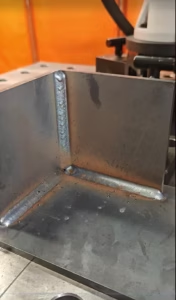
Perhaps the most critical feature for stadium construction is the ±45° bevel cutting capability. In structural engineering, joints are the points of greatest stress. To ensure maximum strength, H-beams must be welded using full-penetration or partial-penetration groove welds. This requires the edges of the steel to be “beveled”—cut at an angle to create a V, Y, or K-shaped groove when two pieces are joined.
Traditionally, this beveling was a secondary process. A beam would be cut to length, then moved to another station where a technician would use a hand-held plasma torch or a mechanical milling tool to create the bevel. This was slow, labor-intensive, and prone to human error.
With a 30kW fiber laser equipped with a 5-axis beveling head, the bevel is cut simultaneously with the profile. The ±45° range allows for the most aggressive weld preparations required by international building codes (such as AWS D1.1). Because the laser is CNC-controlled, the bevel is perfectly uniform across the entire length of the cut. For a stadium project involving thousands of tons of steel, the elimination of secondary grinding and manual beveling saves tens of thousands of man-hours and significantly reduces the project’s carbon footprint.
Why 30kW Matters for Structural Integrity
One might ask: “Why 30kW? Wouldn’t 15kW suffice?” In the world of high-stakes infrastructure, the answer lies in the “Heat Affected Zone” (HAZ).
When you cut steel with a laser, you are introducing heat. Lower power lasers must move more slowly through thick material, which allows heat to dissipate into the surrounding steel. This can alter the metallurgical properties of the H-beam, potentially making the edges brittle or causing thermal distortion.
At 30kW, the cutting speed is so high that the heat is concentrated almost entirely in the kerf (the width of the cut). The material is vaporized and blown away by high-pressure assist gas before the surrounding steel has time to absorb significant heat. This results in a negligible HAZ, preserving the structural integrity of the H-beam. In a stadium, where thousands of spectators will sit beneath cantilevered roof structures, the metallurgical purity of every cut and weld is a matter of public safety.
Tailoring Technology to the Dubai Environment
Operating high-power fiber lasers in Dubai presents unique challenges that are not found in Europe or North America. The primary adversary is the environment: extreme heat and fine desert dust.
A 30kW laser generates an immense amount of heat within the resonator and the cutting head. In Dubai, where ambient temperatures can exceed 45°C, the cooling system (chiller) must be oversized and exceptionally robust. As an expert, I recommend dual-circuit cooling systems with high-precision temperature stability (±1°C) to prevent thermal lensing in the laser optics.
Furthermore, the dust of the UAE can be catastrophic for sensitive optical components. The H-beam cutting machines deployed in this region must feature pressurized, sealed bellows and advanced dust extraction systems. These systems not only protect the machine’s internal components but also ensure a clean working environment for operators, adhering to the UAE’s increasingly stringent occupational health and safety standards.
Economic Impact and ROI in the UAE Market
The capital investment for a 30kW H-Beam laser cutting Machine is significant. However, in the context of Dubai’s fast-tracked construction schedules, the Return on Investment (ROI) is compelling.
1. **Throughput:** A 30kW laser can process H-beams 3 to 5 times faster than a 10kW system and up to 10 times faster than traditional mechanical methods.
2. **Consumable Savings:** While power consumption is higher, the “cost per cut” is lower because the machine produces more parts in less time. Additionally, fiber lasers have no moving parts in the resonator and require far less maintenance than CO2 lasers.
3. **Labor Reduction:** By automating the beveling and profiling in a single pass, a fabrication shop can reduce its headcount for secondary processing by up to 70%.
4. **Material Optimization:** Advanced nesting software designed for 3D profiles allows fabricators to minimize waste, a crucial factor when dealing with the high price of structural steel in the global market.
The Architectural Possibilities for Future Stadiums
Dubai is known for pushing the envelope of what is possible. The use of 30kW fiber lasers allows architects to design stadium structures with organic, flowing lines and complex junctions that were previously impossible or too expensive to manufacture.
Imagine a stadium roof supported by a web of H-beams that twist and taper to mimic natural forms. To create such a structure, every single beam must be cut with a unique profile and a varying bevel angle. Manually fabricating such a design would be a nightmare of logistics and errors. With the 30kW laser and 5-axis head, the architectural vision is translated directly from a BIM (Building Information Modeling) file to the machine. The laser doesn’t care if the cut is a simple straight line or a complex 3D curve; it executes both with the same effortless precision.
Conclusion: Setting a New Global Standard
The deployment of 30kW fiber laser H-beam cutting machines with ±45° beveling in Dubai is more than just a local upgrade; it is a signal to the global construction industry. It demonstrates that the future of infrastructure lies in the fusion of high-power photonics and sophisticated robotics.
As Dubai continues to build stadiums that will host the world’s premier sporting events, the “invisible” work of the fiber laser will be the foundation upon which these icons stand. For the fabricator, it offers a path to higher profitability and unmatched quality. For the architect, it offers freedom from the constraints of traditional steel processing. And for the city of Dubai, it reinforces its reputation as a place where the most advanced technology is harnessed to build the future. In the world of structural steel, the 30kW fiber laser is no longer a luxury—it is the cutting edge of progress.