1. Technical Scope and Executive Summary
This report details the operational deployment and technical integration of a 30kW Fiber Laser CNC Beam and Channel laser cutting system within the structural fabrication sector of Mexico City, specifically targeting the maritime and shipbuilding supply chain. The transition from conventional plasma and mechanical oxy-fuel processes to high-density fiber laser technology represents a fundamental shift in structural steel throughput. The primary objective of this assessment is to analyze the synergy between high-power photonics and automated material handling, focusing on the elimination of manual secondary operations through high-precision beveling and automatic unloading cycles.
1.1 Engineering Context: Mexico City’s Industrial Infrastructure
While Mexico City is geographically removed from the coastline, it serves as the engineering and pre-fabrication hub for Mexico’s primary shipbuilding yards in Veracruz and Tampico. The demand for complex structural profiles—specifically H-beams, I-beams, and C-channels—requires a centralized facility capable of high-volume, high-accuracy output. The 30kW laser system addressed in this report is designed to process ASTM A36 and A572 Grade 50 steel, common in ship hull framing and internal bulkheads, with a specific focus on mitigating thermal distortion across large-scale cross-sections.
2. 30kW Fiber Laser Source: Physics and Structural Synergy
The implementation of a 30kW laser source is not merely an upgrade in speed; it is a fundamental shift in the material-interaction physics of structural steel. At this power density, the system achieves a state of “high-speed melt expulsion” that significantly reduces the Heat Affected Zone (HAZ) compared to 10kW or 12kW alternatives.
2.1 Piercing and Cutting Dynamics in Thick-Walled Profiles
In shipbuilding, channels and beams often feature variable wall thicknesses. A 30kW source allows for “Flash Piercing” on web thicknesses up to 25mm, reducing the piercing time from seconds to milliseconds. This prevents localized heat accumulation that typically leads to structural warping in thinner sections of the channel. Furthermore, the 30kW power reserve allows for the use of compressed air or nitrogen as a cutting gas on thicknesses where oxygen was previously mandatory, resulting in a weld-ready surface free of oxide layers.
2.2 Beam Quality and Focus Control
For CNC beam cutting, the Rayleigh range of the laser must be meticulously managed. The system utilizes an intelligent cutting head with motorized focal positioning to maintain optimal power density as it transitions from the flange to the web of an H-beam. The 30kW source provides the necessary “headroom” to maintain a stable kerf width even when the beam path length varies during 5-axis maneuvers required for complex beveling and cope cuts.
3. Kinematics of CNC Beam and Channel Processing
The processing of three-dimensional structural members necessitates a multi-axis approach that differs significantly from flat-sheet cutting. The system analyzed utilizes a four-chuck rotation system and a 5-axis 3D laser head.
3.1 5-Axis Beveling for Weld Preparation
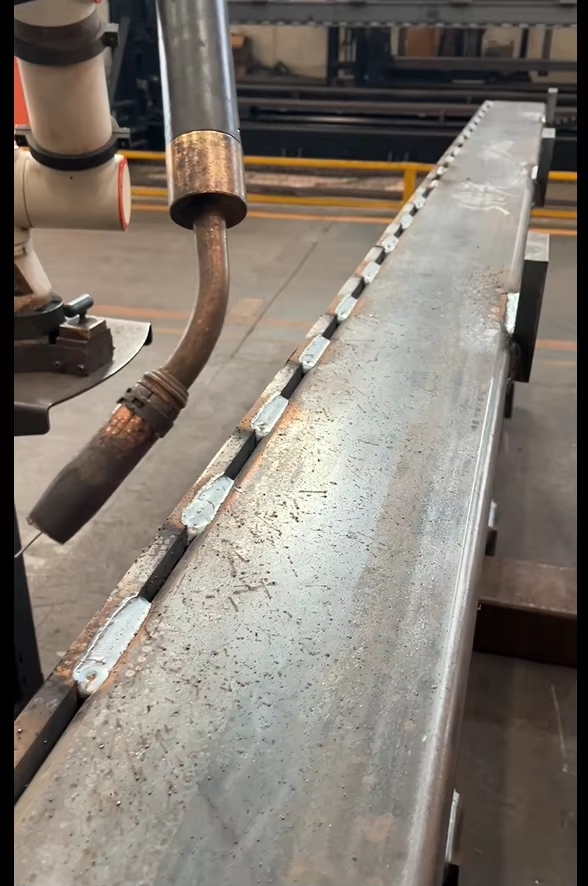
In the shipbuilding yard, weld preparation (V, X, and K-type bevels) is the most labor-intensive phase of assembly. The CNC laser system integrates 3D path planning to execute these bevels during the primary cutting cycle. The 30kW source ensures that even at steep angles—where the effective material thickness increases—the feed rate remains high enough to prevent dross accumulation. This precision eliminates the need for manual grinding, ensuring that the structural integrity of the joint meets maritime Lloyd’s Register or ABS (American Bureau of Shipping) standards.
3.2 Compensating for Structural Irregularities
Raw structural steel is rarely perfectly straight. The CNC system employs mechanical and optical sensors to map the actual profile of the beam in real-time. By applying a coordinate transformation to the cutting path, the laser compensates for “twist” and “bow” in the channel. This is critical in Mexico City’s high-altitude environment where atmospheric pressure affects cooling rates of hot-rolled steel, often leading to slight geometric variances in raw stock.
4. Automatic Unloading: Solving Throughput Bottlenecks
The bottleneck in heavy structural processing is rarely the cutting speed, but the material handling. A 12-meter H-beam can weigh several tons; manual unloading is not only a safety risk but a precision killer. The integration of “Automatic Unloading” technology is the cornerstone of this system’s efficiency.
4.1 Mechanical Synchronization and Support
The automatic unloading system consists of a series of synchronized servo-driven lifters and heavy-duty conveyor chains. As the laser completes the final cut, the unloading mechanism supports the finished part along its entire length. This prevents “cantilever sag” at the moment of separation, which in manual systems often results in a “tab” or a “burr” that requires manual finishing. In shipbuilding, where parts must fit into tight assemblies, this millimetric precision in the final drop-off is non-negotiable.
4.2 Intelligent Sorting and Buffer Management
The system is programmed to categorize scrap and finished parts. Small cutouts and slugs are diverted via a secondary conveyor, while large structural members are moved to a buffer zone. In the Mexico City facility, this automation has allowed for a 40% reduction in crane wait-times, as the laser can continue cutting the next profile while the previous one is being staged for transport to the coast. This continuous flow is essential for maintaining the “Just-In-Time” (JIT) manufacturing cycles required by modern naval shipyards.
5. Operational Efficiency and Precision Metrics
Data collected from the Mexico City site indicates a radical shift in performance metrics. The following technical advantages have been quantified:
5.1 Dimensional Tolerance and Repeatability
Traditional plasma cutting typically offers a tolerance of ±2.0mm to ±3.0mm on large beams. The 30kW CNC laser achieves a dimensional accuracy of ±0.2mm over a 12-meter length. For shipbuilding, where modular sections are fabricated independently and then welded together, this reduction in variance minimizes the need for “forced fit-ups” and internal stresses in the ship’s hull.
5.2 Energy Consumption and Gas Optimization
While a 30kW source has a higher peak power draw, its “Time-per-Part” is significantly lower than lower-power alternatives. The system’s high-speed processing reduces the total kilowatt-hours per meter cut. Furthermore, the use of high-pressure air cutting for 12mm-15mm channels—made possible by the 30kW intensity—has reduced oxygen consumption costs by 65%, a significant factor in the high-cost industrial gas market of Central Mexico.
6. Integration with Shipbuilding CAD/CAM Workflows
The CNC software on the 30kW system is designed to ingest STEP and IGES files directly from naval architectural software such as Aveva Marine or Tribon. The “nesting” algorithms optimize the placement of cuts across various beam lengths to minimize “drop” (scrap). In the Mexico City context, where raw material logistics from northern mills can be complex, maximizing material utilization is a primary economic driver.
6.1 Traceability and Part Marking
The 30kW laser is also utilized for high-speed vaporized marking. Each beam is etched with a DataMatrix code and alignment markers for subsequent welding. This ensures full traceability of the steel from the mill in Monterrey to the final assembly in the Veracruz shipyard, complying with international maritime safety regulations.
7. Conclusion
The deployment of the 30kW Fiber Laser CNC Beam and Channel Laser Cutter with Automatic Unloading in Mexico City represents a pinnacle of structural engineering technology. By combining extreme power density with sophisticated 5-axis kinematics and automated material handling, the system addresses the two greatest challenges in heavy steel fabrication: thermal deformation and logistical stagnation. The result is a production line that delivers maritime-grade structural components with unprecedented speed, accuracy, and repeatability, setting a new benchmark for the Mexican industrial sector.













