1.0 Technical Overview: The Proliferation of High-Power Fiber Lasers in Heavy Structural Steel
The transition from traditional plasma and mechanical sawing to high-kilowatt fiber laser technology marks a paradigm shift in the fabrication of heavy structural sections. In the industrial corridor of Rayong, Thailand, the demand for high-speed, high-precision railway infrastructure components—specifically those required for bridge girders, station frameworks, and track support systems—has necessitated the deployment of 30kW Fiber Laser CNC Beam and Channel cutters.
At 30kW, the power density at the focal point exceeds 50 MW/cm². This intensity allows for the sublimation and expulsion of molten material in heavy-walled H-beams, I-beams, and U-channels with unprecedented speed. Unlike lower-powered sources (6kW–12kW), a 30kW source maintains a stable plasma keyhole even in thicker cross-sections (up to 40mm in carbon steel), significantly reducing the Heat Affected Zone (HAZ). This is critical for railway applications where the fatigue life of the steel is a primary engineering constraint.
2.0 Kinematics and Multi-Axis Synchronization for Beam Processing
Structural profiles like channels and beams present a non-linear challenge compared to flat-sheet processing. The CNC system must manage the rotation and positioning of long-format members (often 12 meters or more) across multiple axes.
2.1 5-Axis vs. 8-Axis Coordination
The specific machines deployed in Rayong utilize a multi-chuck system synchronized with a 3D cutting head. The primary chucks provide the rotational (A/B) and longitudinal (X) movement, while the laser head manages the vertical (Z) and tilting (Y/U) axes. For “C” and “U” channels, the CNC must calculate real-time kerf compensation as the laser transitions from the flange to the web. The thickness variation at the radius of the channel requires the 30kW source to modulate its power frequency and duty cycle via the CNC logic to ensure a consistent dross-free edge.
2.2 Precision in Bolt-Hole Integrity
Railway infrastructure relies heavily on bolted connections for modular assembly. Traditional drilling is slow and requires secondary deburring. The 30kW fiber laser allows for “single-pass” hole cutting. Because the beam remains perfectly perpendicular to the material surface through the CNC’s orientation logic, the taper of the hole is minimized to less than 0.1mm. This level of precision ensures that high-strength structural bolts achieve 100% bearing surface contact, eliminating the risk of vibration-induced loosening in rail gantries.
3.0 The Role of Automatic Unloading Technology in Industrial Efficiency
The bottleneck in heavy structural processing is rarely the cutting speed itself, but rather the material handling. A 12-meter H-beam can weigh several tons; manual unloading via overhead cranes introduces significant downtime and safety risks.
3.1 Solving the Precision-Efficiency Paradox
Automatic unloading systems utilize a series of synchronized hydraulic lifts and conveyor beds that receive the processed member immediately after the final cut. In the Rayong facility, the synergy between the CNC software and the unloading hardware ensures that as the “tail” of the beam is released from the chuck, the unloading arms engage at the exact center of gravity.
This prevents “drop-off deformation.” If a heavy beam is allowed to drop even a few centimeters onto a hard surface, the resulting shock can induce micro-fractures or slight bending, throwing the component out of the tight +/- 0.5mm tolerance required for railway assembly. The automatic system gently lowers the component and transports it to a buffer zone, allowing the next raw member to be loaded into the chucks without a transition delay.
3.2 Reducing Surface Damage and Secondary Processing
In railway infrastructure, the surface integrity of the steel is vital for corrosion resistance and paint adhesion. Manual handling often results in “scuffing” or deep scratches from crane chains. Automatic unloading systems use non-marring rollers or nylon-coated supports, ensuring that the mill scale or pre-applied primer remains intact. This eliminates the need for rework or grit blasting post-fabrication.
4.0 Application in Rayong’s Railway Infrastructure Sector
Rayong, as a central node in the Eastern Economic Corridor (EEC), is currently undergoing a massive expansion of its rail network, including high-speed link structures and heavy freight lines.
4.1 Bridge Girders and Truss Sections
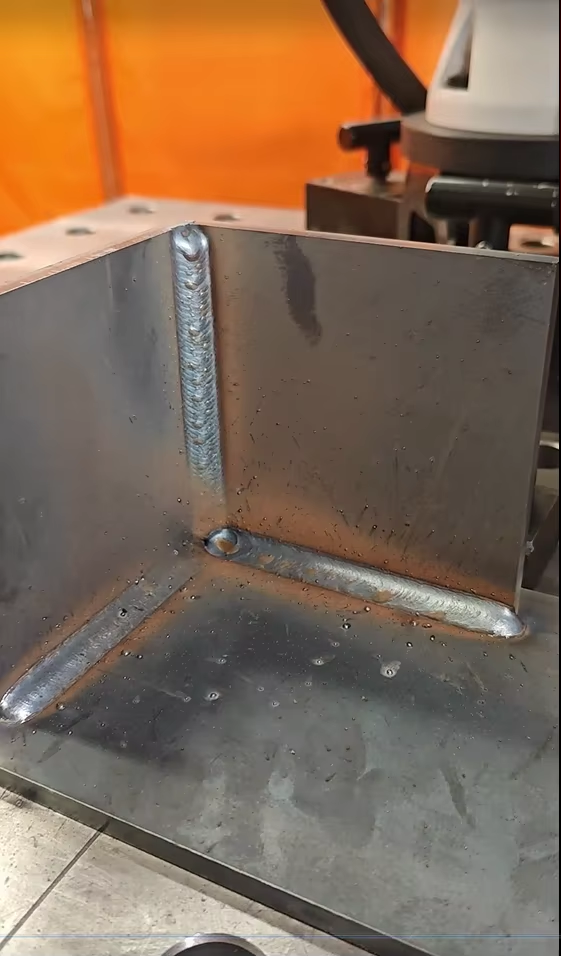
The 30kW laser is utilized to cut complex “fish-mouth” joints and interlocking notches in massive I-beams. These joints are the backbone of overhead rail bridges. The ability of the CNC to execute complex 3D paths means that these beams can be fitted together with zero-gap tolerances, significantly improving the quality of subsequent robotic welding processes.
4.2 C-Channel and U-Channel Processing for Electrification
The electrification of rail lines requires thousands of overhead catenary masts. These are typically constructed from galvanized U-channels. The 30kW laser source, when paired with Nitrogen as a shielding gas, produces a clean, oxide-free cut on these channels. This is essential for the longevity of the structure; an oxidized cut edge would lead to premature rusting in Rayong’s high-humidity, saline coastal environment.
5.0 Technical Synergy: 30kW Power Dynamics and CNC Integration
The synergy between a high-wattage source and automated structural processing is found in the “Total Cycle Time.”
5.1 Gas Dynamics and Nozzle Technology
At 30kW, the volume of molten metal being expelled is significant. The CNC system must precisely control the auxiliary gas pressure (Oxygen for carbon steel, Nitrogen for stainless or high-alloy). High-speed sensors in the cutting head monitor the back-reflection of the laser. If the beam encounters a thick slag inclusion in the steel, the CNC instantly adjusts the feed rate and gas pressure to prevent a “blow-out,” which would otherwise ruin a high-value structural member.
5.2 Real-time Nesting and Material Utilization
The integration of CAD/CAM software allows for the “common-line cutting” of beams and channels. By nesting multiple components on a single 12-meter member, the system reduces “end-scrap” waste. In the context of the Rayong rail projects, where material costs for S355JR steel are a major budgetary factor, increasing material utilization by even 5% via intelligent CNC nesting results in massive operational savings.
6.0 Structural Integrity and Compliance Standards
All railway components processed by the 30kW CNC system must adhere to international standards such as EN 1090-2 (Execution of steel structures) and ISO 9013 (Thermal cutting classification).
The 30kW laser provides a “Range 2” or “Range 3” perpendicularity tolerance, which is far superior to plasma cutting. Furthermore, the limited heat input prevents the formation of a brittle “Martensite” layer on the cut edge. For structural engineers in Rayong, this means that the laser-cut edges do not require grinding before welding, as the metallurgical properties of the base metal remain largely unaltered.
7.0 Conclusion: The Future of Steel Fabrication in Southeast Asia
The deployment of the 30kW Fiber Laser CNC Beam and Channel cutter with automatic unloading in Rayong represents the pinnacle of modern structural engineering. By combining extreme power density with sophisticated multi-axis kinematics and automated material handling, fabricators can meet the rigorous demands of railway infrastructure with a level of precision and speed that was previously unattainable.
The elimination of manual unloading not only increases throughput by 40-50% but also ensures that the mechanical properties and dimensional accuracy of the steel members are preserved from the first cut to the final assembly. As the EEC continues to develop, this technology will remain the cornerstone of high-performance steel fabrication in the region.













