1.0 Executive Summary: Advancing Structural Fabrication in the EEC
This technical report evaluates the deployment of a 30kW Ultra-High Power 3D Fiber Laser Structural Steel Processing Center in Rayong, Thailand. As the regional hub for wind energy infrastructure, Rayong’s manufacturing sector requires a transition from traditional oxy-fuel and plasma methodologies to high-radiance fiber laser systems. The integration of 30kW power levels, coupled with 5-axis 3D motion control and “Zero-Waste Nesting” algorithms, addresses the critical challenges of processing heavy-gauge S355 and S420 structural steel used in wind turbine tower segments. The focus of this evaluation is on the intersection of thermal management, geometric precision, and material utilization efficiency.
2.0 Technical Specifications of the 30kW Fiber Laser Source
The core of the processing center is a 30kW ytterbium fiber laser source. Unlike lower-power alternatives, the 30kW threshold allows for a significant increase in the power density at the focal point, enabling high-speed melt-shearing even in thicknesses exceeding 50mm.
2.1 Beam Parameter Product (BPP) and Kerf Control
At 30kW, the Beam Parameter Product (BPP) must be meticulously managed to prevent excessive kerf width at the bottom of the cut. In the Rayong facility, the system utilizes a variable beam mode tool, allowing the operator to adjust the energy distribution (flat-top vs. Gaussian) depending on the thickness of the tower flange or shell plate. This flexibility is vital for ensuring that the Heat Affected Zone (HAZ) remains within the strict tolerances required by international wind energy standards (IEC 61400-1), preserving the metallurgical integrity of the structural steel.
2.2 Thermal Lensing and Optical Stabilization
High-power laser processing often suffers from thermal lensing, where the optical elements slightly deform due to heat absorption, shifting the focal position. The 3D processing center employs an actively cooled, nitrogen-purged cutting head with real-time focal shift compensation. This is particularly relevant in the humid, tropical environment of Rayong, where ambient temperature fluctuations can impact the refractive index of the cutting atmosphere.
3.0 3D Structural Processing: Kinematics and Beveling
Wind turbine towers are not simple cylinders; they are complex conical structures requiring precise beveling for subsequent Submerged Arc Welding (SAW). Traditional 2D cutting requires secondary beveling operations, which introduce cumulative geometric errors.
3.1 5-Axis Interpolation for Conical Sections
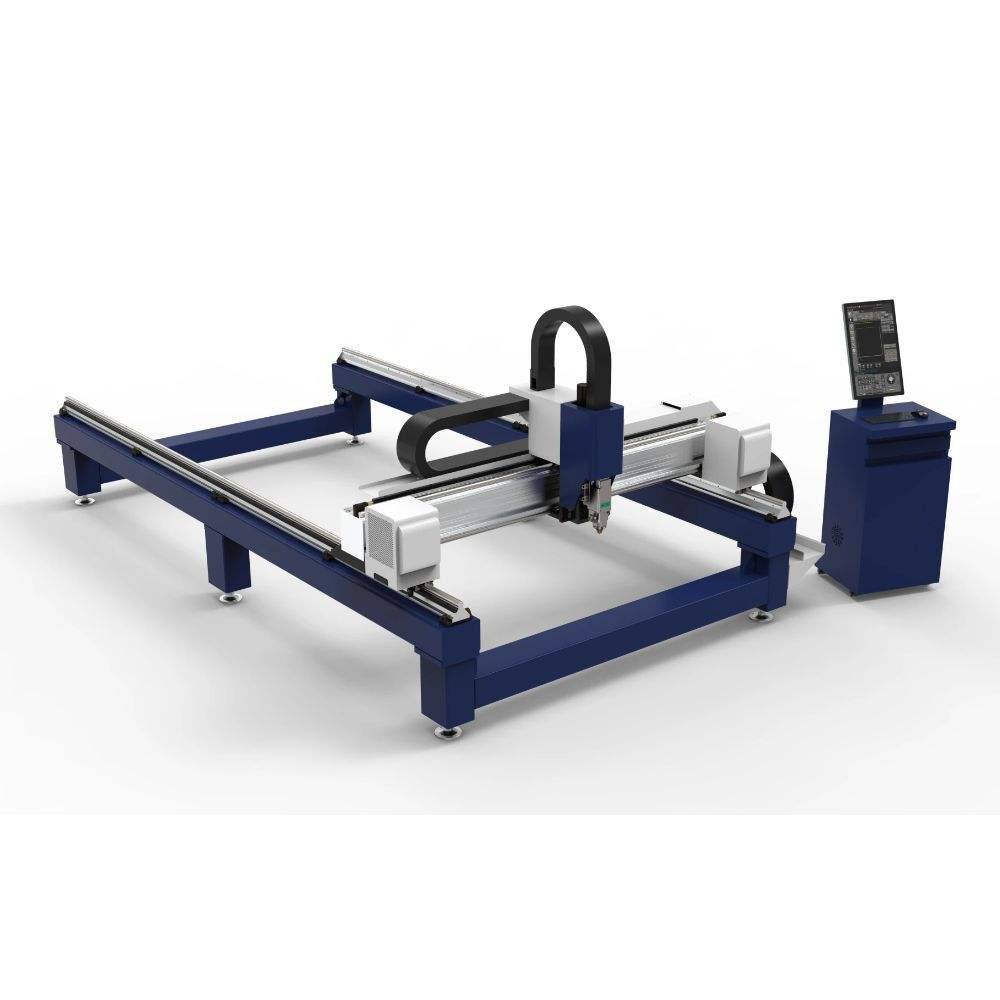
The 3D Structural Steel Processing Center utilizes a multi-axis gantry capable of ±45° bevel angles. The CNC controller integrates 5-axis simultaneous interpolation, allowing the laser head to follow the curvature of a conical shell while maintaining a constant standoff distance. This “True-Hole” and “True-Bevel” technology ensures that bolt holes for flange connections are perfectly perpendicular to the tangent of the curve, eliminating the need for post-process reaming.
3.2 Dynamic Edge Detection and Compensation
Structural steel profiles, particularly large-diameter pipes and H-beams used in tower foundations, often possess inherent dimensional instabilities from the rolling mill. The processing center utilizes a high-speed capacitive sensing system and laser line scanners to map the actual workpiece geometry in 3D space. The software then compensates the cutting path in real-time, ensuring that the structural apertures are cut relative to the actual center-line of the part rather than a theoretical CAD model.
4.0 Zero-Waste Nesting Technology: Material Optimization
In the heavy steel industry, material costs account for approximately 60-70% of the total project expenditure. “Zero-Waste Nesting” is not merely a marketing term but a sophisticated algorithmic approach to part geometry arrangement and common-line cutting.
4.1 Common-Edge Cutting (CEC) Algorithms
The Zero-Waste software identifies adjacent part boundaries that share the same geometric profile. By executing a single cut for two parts, the system reduces the total piercing count and the total travel distance. In the context of wind tower door frames and internal platforms, this technology has demonstrated a 15% reduction in gas consumption and a 12% improvement in plate utilization. The 30kW source facilitates this by maintaining a stable kerf that does not degrade the edge quality of the second part during the common cut.
4.2 Remnant Management and Skeleton Reduction
Traditional nesting leaves significant “skeleton” scrap to maintain plate rigidity. The 3D Processing Center utilizes a “micro-jointing” strategy controlled by the nesting engine, which allows for the extraction of parts while maintaining structural integrity of the remaining sheet. Advanced algorithms allow for “filler-part” insertion, where smaller internal components (brackets, washers, cable trays) are nested within the scrap voids of larger tower segments, effectively pushing material utilization rates toward 96%.
5.0 Field Application: Wind Turbine Towers in Rayong
The Rayong implementation specifically targets the manufacturing of onshore and offshore wind tower segments. These structures demand high fatigue resistance, which is directly influenced by the quality of the laser cut.
5.1 Mitigating the Heat Affected Zone (HAZ)
At 30kW, the cutting speed is high enough that the “dwell time” of the heat source on any given point is minimized. This results in a narrower HAZ compared to plasma cutting. Laboratory analysis of S355JR samples cut at the Rayong site indicates a 40% reduction in the width of the martensitic layer at the cut edge. This is critical for the long-term structural health of wind towers subjected to cyclic loading in the Gulf of Thailand.
5.2 High-Pressure Nitrogen vs. Oxygen Cutting
For the Rayong project, nitrogen (N2) is the preferred assist gas. While oxygen (O2) allows for thicker cuts at lower power, it leaves an oxide layer that must be mechanically removed before welding or painting. The 30kW fiber laser provides sufficient energy to use high-pressure N2 for melt-expulsion in thicknesses up to 30mm, resulting in a clean, oxide-free surface ready for immediate coating. This eliminates an entire stage of the production line (shot blasting/grinding), drastically increasing throughput.
6.0 Synergistic Integration: 30kW Power and Automation
The efficiency of the 30kW source would be bottlenecked without synchronized material handling. The Rayong facility employs a heavy-duty automated shuttle table and a robotic loading system for structural profiles.
6.1 Real-Time Monitoring and Industry 4.0
The processing center is equipped with IoT sensors that monitor laser power stability, gas pressure, and nozzle condition. In the high-humidity environment of Rayong, the system’s internal climate control for the optical cabinet is monitored 24/7. Any deviation in the beam’s focal position is flagged by the system’s “Smart Piercing” sensor, which uses acoustic and optical feedback to determine when the material has been fully penetrated, reducing pierce times by up to 2.0 seconds per hole in 25mm plate.
7.0 Conclusion: Engineering Impact and ROI
The deployment of the 30kW Fiber Laser 3D Structural Steel Processing Center with Zero-Waste Nesting represents a paradigm shift for wind energy fabrication in Rayong. By synthesizing high-power laser physics with multi-axis kinematics and advanced computational nesting, the facility has achieved:
- A 300% increase in cutting speed compared to traditional plasma systems on 20mm+ plate.
- A reduction in scrap material by 18% through Zero-Waste Nesting.
- Superior weld preparation quality, reducing the failure rate in ultrasonic testing (UT) of tower seams.
The technical evidence suggests that 30kW fiber technology is not merely an incremental upgrade but a foundational requirement for the next generation of heavy structural steel processing in Southeast Asia.













