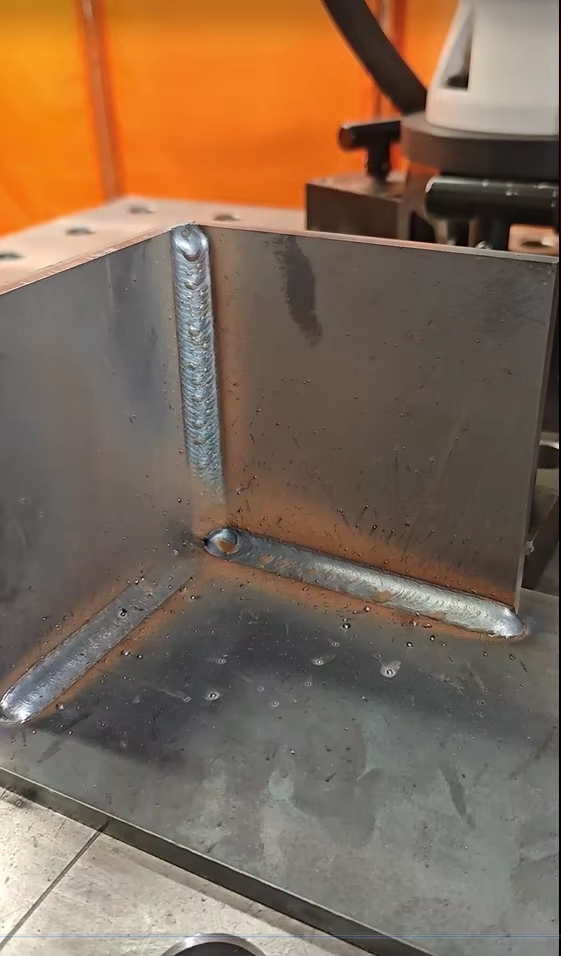
Technical Field Report: Implementation of 30kW 3D Fiber Laser Structural Processing in Istanbul Aviation Infrastructure
1. Introduction and Operational Context
The expansion of aviation infrastructure in Istanbul, specifically targeting the high-capacity terminal extensions and seismic-resistant cargo hubs, demands an unprecedented volume of structural steel processing. Traditional methods—comprising mechanical sawing, CNC drilling, and plasma arc cutting—have historically introduced cumulative tolerances that complicate site assembly. This report analyzes the deployment of the 30kW Fiber Laser 3D Structural Steel Processing Center, focusing on its integration into the fabrication of large-span trusses and complex nodal connections.
The primary technical objective was the transition from discrete multi-stage fabrication to a singular, unified processing environment capable of handling heavy-gauge H-beams, I-beams, and hollow structural sections (HSS) with a focus on “Zero-Waste Nesting” protocols.
2. The Physics of 30kW Fiber Laser Integration
The selection of a 30kW power source is not merely an exercise in cutting speed, but a requirement for maintaining structural integrity in heavy sections. In the Istanbul project, structural members often exceed 25mm in flange thickness, utilizing S355JR and S460 high-strength steel.
At 30kW, the energy density at the focal point allows for a “keyhole” welding-mode equivalent in reverse (sublimation and melt-expulsion). The high photon density minimizes the Heat Affected Zone (HAZ), which is critical for the Istanbul seismic code (Eurocode 8). Traditional plasma cutting often results in a wide HAZ that can lead to local embrittlement; the 30kW fiber laser maintains a narrow kerf (typically 0.15mm to 0.3mm), preserving the metallurgical properties of the parent metal.
Furthermore, the Beam Parameter Product (BPP) of the 30kW source is optimized for long-focal-length heads, ensuring that the beam remains collimated through the varying thicknesses of a 3D structural profile, such as the transition from the web to the flange of an I-beam.
3. 3D Kinematics and Structural Complexity
The Istanbul airport project involves complex geometric intersections where curved roof members meet vertical supports. Traditional 2D cutting is insufficient for these “fish-mouth” and complex miter joints.
The 3D Processing Center utilizes a multi-axis (typically 5 or 6-axis) robotic or gantry-mounted head. This allows for:
- Precision Beveling: Real-time weld preparation (V, X, and Y-type) integrated directly into the cutting cycle. This eliminates secondary grinding operations.
- Bolt Hole Circularity: Achieving H11 or better tolerances for bolt holes in 30mm plates, ensuring that site assembly requires no reaming.
- Coping and Notching: High-speed execution of structural notches that allow for flush-fit assembly of secondary beams into primary girders.
In the field, the 30kW head’s ability to tilt up to 45 degrees while maintaining a constant standoff distance via capacitive height sensing is vital for the non-linear geometries found in the terminal’s architectural steelwork.
4. Zero-Waste Nesting: Algorithms and Material Yield
In large-scale projects like the Istanbul aviation hub, material costs account for approximately 60-70% of the structural budget. Traditional nesting for structural steel often results in “drop” or “crop ends”—remnants of beams that are too short for use but too large to ignore.
The “Zero-Waste Nesting” technology implemented here utilizes a recursive algorithm that analyzes the entire project’s Bill of Materials (BOM) against the stock lengths (typically 12m or 15m beams).
Key technical components of the Zero-Waste system include:
- Common-Cut Pathing: For H-beams of the same profile, the laser executes a single cut to separate two parts, eliminating the kerf-width waste and reducing the number of pierces.
- End-to-End Utilization: The system utilizes high-precision chucking and “over-travel” capabilities. By moving the processing head beyond the physical limits of the chuck, the laser can process the absolute tail-end of a beam.
- Micro-Joint Integration: To prevent small parts or scrap from interfering with the 3D motion, the software calculates optimal micro-joint placement, ensuring the beam remains structurally rigid during the final cuts.
By applying these logic sets, the Istanbul project realized a material utilization rate of 98.2%, compared to the 84-87% seen with traditional mechanical sawing and drilling lines.
5. Synergy Between Power and Automation
The 30kW source is the “engine,” but the efficiency is driven by the synergy with the automated material handling system. In the Istanbul facility, the 3D Processing Center is fed by an automated cross-transfer system.
When the 30kW laser encounters thick-walled sections, the control system modulates the frequency and pulse width of the laser in real-time. This is synchronized with the 3D head’s movement to ensure that corners are not over-melted—a common failure point in lower-power systems trying to cut thick sections slowly.
The “Fly-Cut” capability on thinner secondary members (purlins and girts) allows the system to maintain high throughput, while the 30kW reserve power ensures that when the system encounters the heavy 40mm base plates, the transition is seamless without recalibration.
6. Impact on Site Assembly and Seismic Compliance
The Istanbul region is prone to significant seismic activity, necessitating structural joints with high ductility and precise fit-up. The 30kW fiber laser provides a distinct advantage here:
- Elimination of Stress Riser: The smoothness of the laser-cut edge (Ra < 12.5 μm) reduces the likelihood of fatigue cracks compared to the serrated edge left by plasma or the micro-fractures caused by mechanical shearing.
- Tolerance Compression: By processing the holes, bevels, and lengths in a single coordinate system (the laser’s CNC), the “stack-up” of tolerances is eliminated. A 30-meter truss assembled from laser-cut components showed a deviation of less than 2mm over its entire length.
7. Thermal Management and Nitrogen vs. Oxygen Processing
For the Istanbul project, the choice of assist gas was critical. While Oxygen (O2) is used for thick carbon steel to utilize the exothermic reaction, the 30kW power allows for High-Pressure Nitrogen (N2) cutting on sections up to 20mm.
N2 cutting provides an oxide-free surface, which is essential for the high-performance epoxy coatings required for corrosion resistance in the maritime-influenced climate of Istanbul. By utilizing the 30kW source, the processing speed with N2 is maintained at a commercially viable rate, bypassing the need for post-cut shot blasting of the edges.
8. Conclusion: The New Standard in Heavy Fabrication
The deployment of the 30kW Fiber Laser 3D Structural Steel Processing Center in Istanbul marks a shift in heavy engineering. The combination of extreme power density and “Zero-Waste” algorithmic nesting addresses the two primary bottlenecks of airport construction: material waste and assembly precision.
The data indicates a 40% reduction in total fabrication time per metric ton of steel and a near-elimination of on-site rework. For future infrastructure projects of this scale, the integration of high-kilowatt fiber lasers with 3D kinematics is no longer an optional upgrade but a fundamental requirement for seismic-grade structural integrity and economic viability.













