1. Executive Summary: The Transition to High-Kilowatt 3D Processing
In the current industrial landscape of the Marmara region, specifically within the Tuzla and Yalova shipyard corridors of Istanbul, the fabrication requirements for offshore platforms have surpassed the capabilities of traditional plasma cutting and manual mechanical processing. This field report analyzes the deployment of a 30kW Fiber Laser 3D Structural Steel Processing Center. The integration of high-density photon energy with 5-axis kinematic heads and automated material handling addresses the critical bottleneck of thick-walled structural fabrication. By moving to a 30kW threshold, the facility achieves not only higher feed rates but a fundamental shift in the metallurgical integrity of the cut edge, essential for the high-salinity and high-stress environments of offshore structures.
2. Technical Specifications of the 30kW Laser-Material Interaction
The core of the system is a 30kW ytterbium fiber laser source, delivering a wavelength of approximately 1.07 μm. In the context of heavy structural steel—specifically S355JO and S460ML grades commonly used in offshore jackets and topsides—the power density at the focal point allows for a “keyhole” welding-mode equivalent in cutting.
2.1. Thermal Gradient and Heat Affected Zone (HAZ)
At lower power levels (10kW–12kW), processing 25mm to 50mm plate or beam sections requires slower feed rates, which leads to excessive heat conduction into the substrate. This increases the Heat Affected Zone (HAZ), potentially altering the martensitic structure of the steel and inducing brittle zones. The 30kW source allows for feed rates that outpace thermal conduction. In Istanbul’s offshore fabrication sector, where structural components must withstand cyclic wave loading and seismic activity in the Marmara Sea, minimizing the HAZ is a non-negotiable requirement for weld certification under ISO 19902 standards.
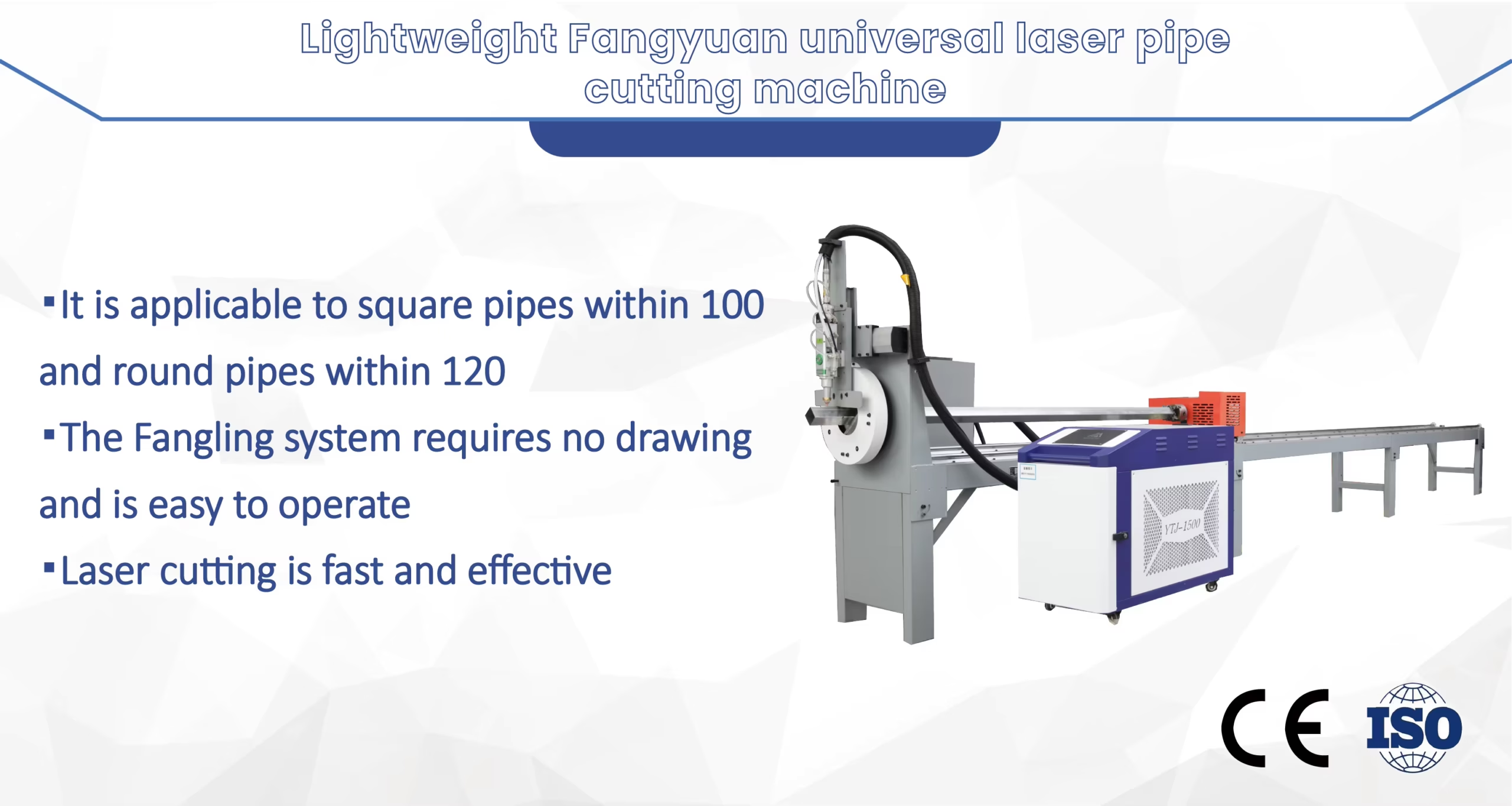
2.2. Kerf Geometry and Surface Roughness
The 30kW system utilizes advanced gas dynamics, typically employing high-pressure oxygen or nitrogen-oxygen mixes. The high power ensures that the molten pool is ejected with minimal dross adherence. For 3D structural members like H-beams and large-diameter hollow sections (CHS), the 30kW source maintains a narrow kerf width, which is critical when performing complex 5-axis bevel cuts. This precision ensures that the root gap in subsequent Submerged Arc Welding (SAW) processes remains consistent, reducing the volume of filler wire required and lowering overall fabrication costs.
3. Kinematics of 3D Structural Processing in Offshore Engineering
Offshore platforms require complex intersections, such as “K,” “Y,” and “T” joints in tubular space frames. Traditional 2D cutting is insufficient for these geometries. The 3D Processing Center utilizes a 5-axis torch head capable of ±45-degree inclinations.
3.1. Beveling Precision for Weld Preparation
In the Istanbul shipyard context, many offshore components are destined for the Black Sea or Mediterranean projects where deep-water pressures demand perfect weld penetration. The 30kW 3D laser system performs “V,” “X,” and “K” bevels in a single pass. The synchronization between the laser head’s rotational axes and the longitudinal movement of the structural member is controlled via high-speed EtherCAT protocols, ensuring that the spatial coordinates of the cut path remain within a ±0.1mm tolerance over a 12-meter beam length.
3.2. Compensating for Structural Irregularities
Heavy steel beams are rarely perfectly straight. The 3D processing center integrates laser scanning sensors that map the actual profile of the workpiece in real-time. Before the 30kW beam is engaged, the system adjusts the cutting path to account for camber, sweep, or twist in the raw material. This “search and cut” capability is vital for offshore modules where hundreds of individual components must align perfectly during final assembly on the skid-way.
4. The Impact of Automatic Unloading on Process Continuity
One of the primary inefficiencies in heavy steel processing is the dwell time associated with material handling. A 30kW laser cuts so rapidly that manual unloading becomes a logistical bottleneck. The Automatic Unloading technology integrated into this system solves several mechanical and safety challenges.
4.1. Mechanical Synchronization and Deformation Control
When cutting heavy-wall pipes or H-beams, the removal of the finished part must be synchronized with the final “tab” cut. The automatic unloading system employs a series of servo-driven hydraulic lifters and conveyor beds that support the workpiece along its entire length. In the Istanbul facility, this has eliminated “spring-back” deformations that occur when a heavy section is released from the main stock. By supporting the part during the transition from the cutting zone to the discharge zone, the system preserves the dimensional integrity of the 3D-cut bevels.
4.2. Throughput Efficiency in High-Volume Fabrication
The synergy between the 30kW source and automatic unloading results in a “lights-out” manufacturing potential. As the laser completes a complex node cut, the unloading arms extract the part while the feeding mechanism simultaneously positions the next raw section. In offshore platform construction, where project timelines are often compressed due to narrow weather windows for maritime installation, this increase in throughput—estimated at 40% over manual systems—is a critical competitive advantage for Turkish engineering firms.
5. Sector-Specific Application: Offshore Platforms in Istanbul
Istanbul serves as a strategic hub for maritime engineering. The application of the 30kW 3D Laser Processing Center in this sector focuses on three main areas: jacket foundations, topside modular frames, and subsea manifolds.
5.1. Jacket Foundations and Tubular Nodes
Offshore jackets consist of complex lattice structures. The 30kW laser’s ability to cut thick-walled tubulars with precise weld preparations allows for faster fit-up. In the saline-heavy environment of the Marmara and Black Seas, the smooth surface finish provided by the laser (Ra < 12.5 μm) ensures better adhesion for anti-corrosion coatings, extending the service life of the platform.
5.2. Seismic Resistance and Material Fatigue
Given the seismic profile of the Istanbul region, offshore structures must be designed with high ductility. The precision of 3D laser cutting ensures that there are no micro-notches or irregularities in the cut edge that could act as stress concentrators. By maintaining a clean, consistent edge, the 30kW system contributes to the fatigue resistance of the structure, a factor rigorously checked during DNV or ABS classification surveys.
6. Integration of the 30kW Source and Control Systems
The synergy between the laser source and the processing center is managed through an Integrated CNC Suite. This software handles the nesting of complex 3D shapes to minimize scrap—a significant factor when dealing with expensive high-tensile offshore steels.
6.1. Real-Time Parameter Adjustment
The 30kW fiber laser is not a static tool. The control system modulates the beam frequency, pulse width, and gas pressure based on the instantaneous velocity of the 5-axis head. During tight radius turns on a beam’s flange, the power is throttled to prevent over-burning, while on long straight runs, the full 30kW is unleashed to maximize speed. This dynamic power management is essential for maintaining the structural tolerances required in heavy engineering.
6.2. Connectivity and Digital Twin Integration
The Istanbul facility utilizes the processing center’s data output to feed into a Digital Twin of the offshore platform. Every cut is logged with its precise parameters, providing a digital “birth certificate” for each structural component. This traceability is paramount for offshore safety audits and life-cycle management.
7. Conclusion
The deployment of a 30kW Fiber Laser 3D Structural Steel Processing Center with Automatic Unloading represents a technological zenith for the Istanbul offshore fabrication sector. By resolving the conflict between high-speed production and extreme precision, the system allows for the construction of safer, more resilient offshore platforms. The elimination of manual handling through automatic unloading, coupled with the metallurgical advantages of high-power fiber laser cutting, sets a new benchmark for structural steel processing. As offshore projects move into deeper and harsher environments, the reliance on such high-kilowatt, 3D-capable infrastructure will become the standard for the industry.













