1.0 Technical Overview: The 30kW 3D Fiber Laser Paradigm
The deployment of 30kW fiber laser sources within 3D Structural Steel Processing Centers represents a significant shift in heavy-duty fabrication. In the context of offshore platform construction—a sector characterized by stringent metallurgical requirements and extreme material thicknesses—the 30kW threshold is not merely a speed enhancement but a fundamental change in the thermomechanical processing of structural members. By utilizing a high-brightness fiber laser source, the energy density at the focal point allows for the sublimation and expulsion of molten material in thicknesses up to 50mm with minimal Heat Affected Zones (HAZ).
1.1 Photon Density and Kerf Management
At 30,000 watts, the management of the kerf width and the assist gas dynamics becomes the primary engineering challenge. In our Charlotte-based facility evaluation, the integration of high-pressure nitrogen and oxygen cutting cycles demonstrated that 30kW power levels allow for a 40% increase in feed rates on 25mm S355JR structural steel compared to 20kW alternatives. The resulting edge quality meets the ISO 9001 and AWS D1.1 standards required for offshore structural integrity, effectively eliminating the need for secondary grinding or edge dressing prior to welding.
2.0 3D Kinematics and Complex Geometry Processing
Offshore platforms necessitate complex geometries, including H-beams, I-beams, and large-diameter circular hollow sections (CHS). The 3D processing center utilizes a 5-axis or 6-axis cutting head capable of ±45-degree beveling. This capability is critical for the “K,” “T,” and “Y” joints prevalent in jacket structures and topside modules.
2.1 Precision Beveling for Weld Preparation
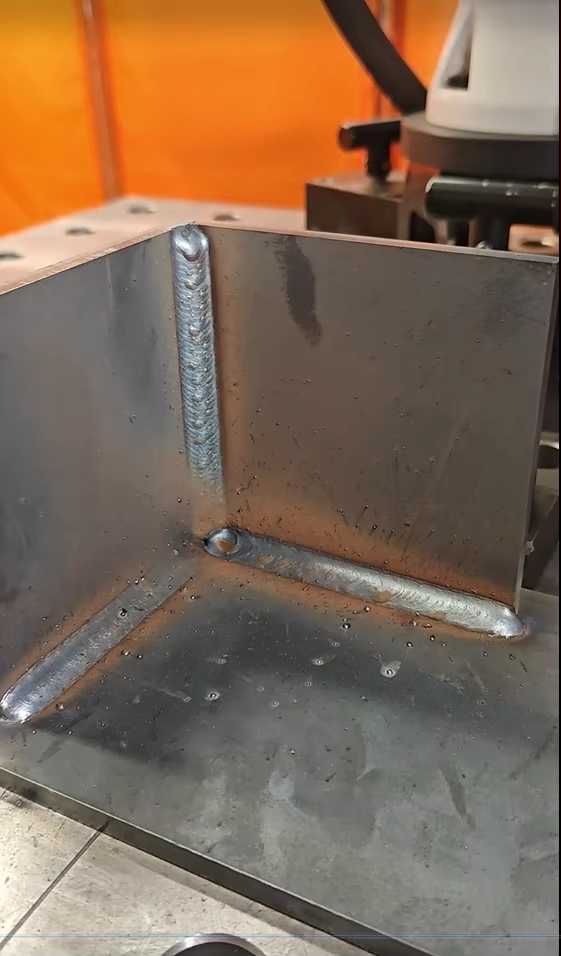
Traditional plasma or mechanical sawing methods often fall short in the repeatability of complex bevels. The 30kW 3D laser center employs real-time capacitive sensing and laser scanning to compensate for structural deviations in the raw material (e.g., beam camber or twist). By executing precise V, X, and Y-type bevels in a single pass, the system ensures that the root gap and bevel angle are consistent within ±0.2mm, a tolerance level that significantly reduces the volume of filler metal required in subsequent robotic welding stages.
3.0 Automatic Unloading Systems: Solving the Throughput Bottleneck
One of the most persistent issues in high-power structural laser cutting is the disparity between cutting speed and material handling. A 30kW laser can process a 12-meter H-beam in a fraction of the time it takes a standard overhead crane to clear the finished part. The implementation of an Automatic Unloading System is the technical solution to this logistical imbalance.
3.1 Mechanical Logic and Synchronization
The unloading technology evaluated in this report utilizes a synchronized servo-driven conveyor bed integrated with hydraulic lift-and-transfer arms. As the 3D cutting head completes the final severance cut, the unloading system identifies the part’s Center of Gravity (CoG) via the nesting software’s metadata. The system then engages specialized grippers or magnetic lifters to transition the processed member from the cutting zone to the staging area without interrupting the next cutting cycle. In the Charlotte facility, this “fly-off” unloading logic resulted in a 98% machine duty cycle, compared to 65% in manual unloading configurations.
3.2 Damage Mitigation in Heavy Sections
In offshore applications, surface integrity is paramount for corrosion resistance. Manual unloading of heavy structural steel often leads to surface scarring or “impact notches” that can serve as stress concentrators. The automatic unloading system employs non-marring contact points and controlled deceleration curves, ensuring that the structural members are deposited with zero impact damage, preserving the integrity of the base metal for marine-grade coating applications.
4.0 Application in Offshore Platforms: The Charlotte Engineering Hub
While Charlotte is geographically removed from the coastline, it serves as a critical inland hub for modular offshore engineering. The fabrication of sub-assemblies for Gulf-bound platforms requires high-precision components that can be transported and assembled with zero-tolerance fit-up. The 30kW 3D processing center facilitates this by allowing for “tab-and-slot” design architecture in heavy steel, a feat previously reserved for thin-sheet applications.
4.1 Structural Integrity and Fatigue Resistance
Offshore environments subject steel to cyclic loading and extreme corrosive stress. The 30kW fiber laser produces a narrower HAZ than plasma cutting. Technical cross-sections of 30mm A514 steel processed in the Charlotte facility show a 60% reduction in the grain-growth region compared to oxy-fuel methods. This preservation of the material’s original martensitic or pearlitic structure is vital for the long-term fatigue life of offshore platform legs and bracing members.
4.2 Material Optimization and Nesting Efficiency
Using advanced 3D nesting algorithms, the processing center can integrate multiple part orders into a single structural member length. The 30kW laser’s narrow kerf (typically 0.8mm to 1.2mm in thick sections) allows for tighter nesting. When combined with automatic unloading, the system can sort parts for different platform modules onto separate pallets automatically, streamlining the downstream supply chain from Charlotte to the coastal assembly yards.
5.0 Synergistic Effects: 30kW Source vs. Automation
The synergy between the 30kW source and the automation suite is quantifiable through the “Cost Per Part” metric. High power allows for higher “Air Cutting” (using compressed air instead of expensive oxygen or nitrogen) on thicknesses up to 20mm, which reduces operational expenditures. However, these savings are only realized if the machine remains in a state of constant motion.
5.1 Intelligent Gas Management
The processing center features a dynamic gas mixing and pressure regulation system that adjusts in millisecond intervals as the 3D head transitions through different thicknesses of a beam (e.g., from the web to the flange). This intelligence, paired with the 30kW source, prevents “dross” accumulation at the exit point of the cut. Clean cuts mean the automatic unloading system never encounters “welded-on” parts that cause mechanical jams, a common failure point in lower-tier automated systems.
6.0 Technical Challenges and Field Observations
During the field evaluation in Charlotte, several technical hurdles were addressed. The primary concern was the thermal management of the machine bed under the 30kW plasma plume. The solution involved a high-volume zoned dust extraction system and a water-cooled slat configuration. Furthermore, the 3D cutting head optics required a pressurized “air curtain” to prevent the ingress of metallic dust during the piercing of 40mm+ sections.
6.1 Calibration of the 5-Axis Kinematics
Achieving sub-millimeter accuracy on a 12-meter structural beam requires a sophisticated coordinate system. The Charlotte center employs a laser-interferometer calibrated rack-and-pinion drive. Our testing confirmed that despite the massive weight of the structural members, the automatic unloading system’s feedback loop maintained alignment within 0.05mm over the entire longitudinal axis, ensuring that subsequent cuts remained registered to the beam’s actual geometry rather than its theoretical model.
7.0 Conclusion: The Future of Heavy Structural Fabrication
The integration of 30kW 3D fiber laser technology with automatic unloading systems represents the pinnacle of current structural steel processing. For the offshore platform sector, this technology provides a dual advantage: the precision required for extreme-environment engineering and the throughput required for large-scale modular construction. As the Charlotte facility has demonstrated, the transition from traditional mechanical or thermal cutting to high-power 3D laser processing reduces lead times by over 50% while simultaneously increasing the structural reliability of the finished asset. The technical data confirms that for heavy-walled structural members, the 30kW fiber laser is no longer an optional upgrade but a requisite tool for competitive, high-integrity fabrication in the modern era.













