Mastering 2kW Sheet Metal laser cutting: A Comprehensive Guide for Carbon Steel in Guadalajara
The industrial landscape of Guadalajara, Jalisco, has evolved rapidly into a sophisticated hub for the metal-mechanic and automotive sectors. Often referred to as Mexico’s “Silicon Valley,” the region’s demand for high-precision components has driven a significant shift toward fiber laser technology. Among the various power configurations available, the 2kW sheet metal laser cutting system has emerged as the industry standard for small to medium enterprises (SMEs) and specialized fabrication shops focusing on carbon steel. This guide explores the technical intricacies, operational parameters, and regional considerations for maximizing the efficiency of a 2kW laser cutting system in the Guadalajara metropolitan area.
The Technical Profile of a 2kW Fiber Laser
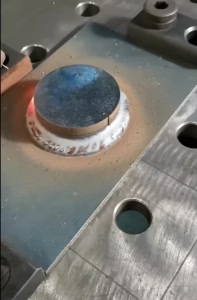
A 2kW fiber laser represents a critical balance between capital investment and processing capability. Unlike older CO2 technology, fiber lasers utilize a solid-state gain medium, delivering a beam with a wavelength of approximately 1.06 microns. This shorter wavelength is more readily absorbed by carbon steel, allowing for higher energy density and faster cutting speeds on thin to medium gauges. In the context of laser cutting, a 2kW source provides enough “punch” to handle the most common thicknesses used in Guadalajara’s industrial parks—ranging from 20-gauge sheet metal up to 16mm carbon steel plate.
 laser cutting machine for Sheet Metal” style=”width: 100%; max-width: 800px; height: auto; margin: 20px 0;”>
Processing Carbon Steel: Material Grades and Properties
In the Mexican market, carbon steel is the backbone of structural and mechanical engineering. Operators in Guadalajara typically work with ASTM A36 (hot-rolled) and SAE 1018 (cold-rolled) steels. Each grade reacts differently to the laser cutting process. Cold-rolled steel, with its cleaner surface finish and tighter dimensional tolerances, allows for extremely high-speed processing with minimal dross. Hot-rolled steel, however, often carries a layer of mill scale (iron oxide). This scale can interfere with the laser beam’s consistency, necessitating specific parameter adjustments such as lower speeds or specialized “clean-cut” settings to prevent “self-burning” during the exothermic reaction.
Optimizing Parameters for Carbon Steel Thicknesses
For a 2kW system, the “sweet spot” for production efficiency lies between 1.5mm and 10mm. While the machine can pierce and cut 16mm carbon steel, the feed rate significantly drops, and the margin for error narrows. When processing 3mm carbon steel, a 2kW laser can achieve speeds exceeding 4.5 meters per minute using oxygen as an assist gas. As the thickness increases to 12mm, the speed drops to approximately 0.8 to 1.0 meters per minute. Engineering teams must calibrate the focal position—usually slightly above the material surface for oxygen cutting of thick plates—to ensure a wide enough kerf for efficient slag removal.
Assist Gas Selection: Oxygen vs. Nitrogen
The choice of assist gas is the most significant factor in the quality of laser cutting for carbon steel. In Guadalajara’s competitive manufacturing environment, cost-per-part is vital.
- Oxygen (O2): This is the standard for carbon steel. The oxygen reacts exothermically with the iron, adding thermal energy to the process. This allows the 2kW laser to cut much thicker materials than it could with light alone. However, it leaves an oxide layer on the edge, which must be removed if the part is to be powder-coated or painted.
- Nitrogen (N2): Often used for thinner gauges (under 3mm) when a “bright finish” is required. Nitrogen acts as a cooling agent and mechanical force to blow away molten metal without oxidation. While it produces a weld-ready edge, it requires significantly higher pressures (14-18 bar), increasing operational costs.
The Guadalajara Context: Environmental and Infrastructure Factors
Operating a 2kW fiber laser in Guadalajara requires consideration of local environmental factors. The city’s altitude (approx. 1,566 meters) and seasonal humidity fluctuations can impact the performance of the machine’s chiller system and the purity of the compressed air used in the pneumatic lines. High-quality air filtration is non-negotiable; moisture or oil in the air lines can contaminate the protective windows of the laser cutting head, leading to catastrophic lens failure. Furthermore, given the region’s occasional power grid instability, the use of a high-capacity voltage stabilizer is an essential engineering requirement to protect the sensitive fiber laser source and CNC controllers.
Piercing Strategies and Heat Management
One of the most common challenges in 2kW laser cutting of thick carbon steel is the piercing phase. For materials over 8mm, a multi-stage piercing strategy is recommended. This involves starting with a high focal position and low duty cycle to “nibble” through the plate, preventing a “blowout” that can damage the nozzle or contaminate the optics. In Guadalajara’s high-volume shops, “cool-down” periods or “bridge cutting” techniques are often employed to manage the Heat Affected Zone (HAZ). If the material absorbs too much heat, the carbon steel becomes overly reactive to the oxygen assist gas, leading to “thermal runaway” where the cut quality degrades rapidly.
Maintenance Protocols for High-Uptime Operations
To maintain the precision required for automotive-grade components, a strict maintenance schedule must be followed. The 2kW fiber laser is a precision instrument. Daily checks should include the inspection of the protective window (cover slide) for dust or pits. Weekly tasks involve cleaning the motion system (linear guides and racks) to prevent the abrasive carbon steel dust from causing mechanical backlash. In Guadalajara, where industrial dust can be prevalent, ensuring the cabinet cooling filters are clean is vital for the longevity of the laser diodes. A 2kW source is robust, but its efficiency is entirely dependent on the cleanliness of the optical path and the accuracy of the beam-nozzle alignment.
Economic Impact and ROI for Local Fabricators
From a financial perspective, the 2kW sheet metal laser is the most viable entry point for Guadalajara-based workshops looking to transition from traditional plasma or mechanical shearing. The ROI (Return on Investment) is driven by the reduction in secondary processes. Because the fiber laser produces a highly accurate edge with a small kerf, parts often require no deburring or grinding before assembly. For a shop focused on carbon steel enclosures, brackets, or structural plates, a 2kW system can typically replace three to four traditional machines, significantly reducing the floor space requirement and labor costs.
Future-Proofing Your Laser Cutting Operations
As the “Industria 4.0” movement gains traction in Jalisco, 2kW laser cutting systems are increasingly being integrated with nesting software and automated loading/unloading systems. For engineers in Guadalajara, the focus is shifting toward “Smart Manufacturing.” This involves using sensors to monitor nozzle condition and real-time gas consumption. By optimizing the nesting patterns for carbon steel sheets, fabricators can reduce scrap rates to below 10%, a critical metric in an era of fluctuating raw material prices. Understanding the interplay between the 2000-watt power output and the specific metallurgical properties of the steel being processed remains the foundation of a successful fabrication business.
Conclusion
The 2kW sheet metal laser cutting machine is a powerhouse of versatility for the Guadalajara industrial sector. By mastering the nuances of carbon steel processing—from gas dynamics and piercing strategies to environmental adaptations—local manufacturers can achieve world-class precision. As the region continues to grow as a global manufacturing player, the ability to deliver high-quality, laser-cut carbon steel components with speed and efficiency will remain a primary competitive advantage. Investing in the right technology is only the first step; the true value lies in the engineering expertise applied to every pulse of the laser.