1.0 Introduction: The Industrial Context of Haiphong’s Power Infrastructure
In the industrial corridors of Haiphong, Vietnam, the demand for high-voltage transmission infrastructure has catalyzed a shift from traditional mechanical fabrication to advanced laser-based thermal processing. As a senior expert in steel structure fabrication, I have overseen the commissioning and operational integration of a 20kW Universal Profile Steel Laser System. This report evaluates the performance of this high-power density system, focusing on its application in “Power Tower Fabrication”—a sector characterized by stringent tolerances, high-tensile material requirements, and the necessity for high-volume throughput.
The power towers produced in this region utilize a variety of structural profiles, primarily large-scale angle steels (L-beams), channels (C-beams), and heavy-duty H-beams. Historically, these components were processed via mechanical punching, sawing, and drilling. However, the introduction of 20kW fiber laser technology, coupled with sophisticated automatic unloading mechanics, has redefined the baseline for precision and operational efficiency in the Haiphong fabrication cluster.
2.0 Technical Specifications of the 20kW Fiber Source
2.1 Power Density and Kerf Dynamics
The core of the system is a 20kW ytterbium fiber laser source. At this power level, the energy density at the focal point exceeds previous 6kW or 10kW benchmarks by a significant margin. For the S355 and S420 grade steels common in power tower construction, the 20kW source allows for high-speed nitrogen-assisted cutting. This results in a minimal Heat Affected Zone (HAZ), which is critical for maintaining the metallurgical integrity of the structural steel.
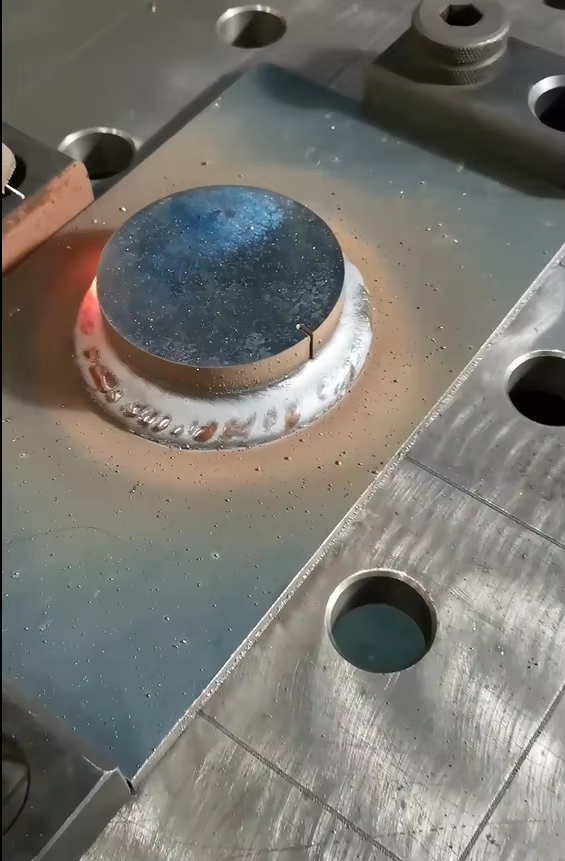
In our field tests in Haiphong, we observed that the 20kW source maintains a stable plasma shield during thick-section cutting. The high power allows for “high-speed piercing” (HSP) protocols, reducing piercing time from seconds to milliseconds. This cumulative time saving is vital when a single lattice structure for a transmission tower may require thousands of bolt-hole piercings and complex edge bevels.
2.2 Beam Quality and Thermal Management
A secondary technical advantage of the 20kW system is the beam’s M2 factor, optimized for profile steel which often possesses uneven surface oxidation or slight dimensional variances. The system’s autofocusing cutting head compensates for these variations in real-time. Given Haiphong’s humid maritime climate, the laser’s optical path is pressurized with dry, ionized air to prevent particulate contamination, ensuring the 20kW output remains consistent over 24-hour production cycles.
3.0 Universal Profile Processing: Multi-Axis Kinematics
3.1 3D Cutting Heads and Beveling Requirements
Power tower fabrication requires complex geometry, specifically for the gusset plate connections and the interlocking lattice members. The “Universal Profile” designation refers to the system’s ability to manipulate the cutting head across a 5-axis or 6-axis range. This allows for 45-degree beveling on thick-walled profiles, which is essential for high-quality weld preparation (V-groove and K-groove joints).
In the Haiphong facility, the system demonstrates an ability to process L-shaped profiles up to 250mm x 250mm with a wall thickness of 25mm. Traditional mechanical methods would require multiple setups on different machines; the universal laser system completes the profile truncation, hole pattern piercing, and beveling in a single continuous CNC program.
3.2 CNC Interpolation and Dimensional Accuracy
The synergy between the CNC controller and the mechanical drive system (linear motors on the X/Y axes and high-torque AC servos on the rotational chucks) ensures that the dimensional deviation across a 12-meter profile remains under ±0.5mm. This level of precision is non-negotiable for power towers, where cumulative errors in bolt-hole alignment can lead to structural failure during field assembly in remote mountainous terrains.
4.0 Automatic Unloading: Solving the Logistics Bottleneck
4.1 The Heavy Steel Challenge
While the 20kW laser provides unprecedented cutting speeds, the bottleneck in heavy steel processing has historically been the “material handling phase.” Manually unloading 12-meter, 500kg steel profiles is not only a safety risk but a significant drain on the machine’s “Duty Cycle.” The “Automatic Unloading” technology integrated into this system utilizes a series of hydraulic lift-and-transfer arms synchronized with the machine’s discharge cycle.
The unloader recognizes the end of a nesting sequence. As the chuck releases the finished part, a series of support rollers and lateral chain conveyors move the profile to a sorting rack. This happens while the next raw profile is being loaded or indexed, effectively achieving a “zero-gap” production flow.
4.2 Precision Preservation and Surface Integrity
In the power tower industry, the galvanization process is sensitive to surface defects. Mechanical unloading via crane or forklift often results in “scoring” or “notching” of the steel, which can lead to uneven zinc coating and eventual corrosion. The automatic unloading system uses non-marring polyurethane rollers and controlled descent mechanisms, ensuring that the profile’s surface remains pristine. This is particularly relevant in Haiphong, where the coastal atmosphere necessitates high-quality galvanization for long-term tower durability.
5.0 Field Performance Analysis in Haiphong
5.1 Throughput Metrics
Data gathered over a 90-day operational window indicates a 40% increase in total throughput compared to 10kW systems without automatic unloading. The 20kW laser reduced the “cut-time” for 20mm angle steel by approximately 55%. However, the most significant gain was in “machine uptime.” Because the automatic unloading system eliminates the need for the operator to pause the machine to clear the bed, the “beam-on” time increased from 60% to 85% of the shift duration.
5.2 Efficiency in Power Tower Component Nesting
Using specialized nesting software, the system processes various lengths of angle steel with minimal scrap. The precision of the 20kW beam allows for tighter nesting of components. In the Haiphong plant, we successfully implemented “common line cutting” on heavy profiles—a technique where two parts share a single cut path. This is only possible due to the high-power laser’s ability to maintain a consistent kerf width over long distances, reducing gas consumption and material waste by an additional 8%.
6.0 Structural Integrity and Quality Assurance
6.1 HAZ and Microstructure Analysis
One of the primary concerns for structural engineers in the power sector is the thermal impact on the steel’s grain structure. Using the 20kW source at high feed rates reduces the residence time of the heat, thereby narrowing the HAZ. Hardness testing conducted on the cut edges of S355JR profiles showed that the martensitic transformation layer was less than 0.2mm thick. This is well within the acceptable limits for structures subject to dynamic loading (wind, ice, and tension).
6.2 Hole Quality and Galvanization Adhesion
The holes pierced by the 20kW laser exhibit superior cylindricity compared to plasma-cut or punched holes. This is critical for the “interference fit” of bolts in power tower joints. Furthermore, the oxygen-free nitrogen cutting process prevents the formation of an oxide layer on the cut edge, allowing for direct galvanization without the need for secondary grinding or pickling. This synergy between the laser source and the finishing process significantly reduces the “Total Cost of Quality” for the Haiphong fabricators.
7.0 Conclusion: The New Standard for Steel Fabrication
The deployment of the 20kW Universal Profile Steel Laser System in Haiphong represents a paradigm shift in structural engineering. By integrating high-wattage fiber laser sources with advanced kinematics and automatic unloading technology, the industry has solved the historical conflict between “precision” and “speed.”
For power tower fabrication, the benefits are clear:
- Enhanced Safety: Automatic unloading removes personnel from the high-risk heavy-lifting zone.
- Unrivaled Precision: CNC-controlled 3D cutting ensures perfect alignment in lattice assemblies.
- Economic Scalability: The increased throughput and reduced secondary processing allow fabricators to meet the aggressive timelines of national grid expansions.
As we continue to monitor the performance of these systems in the Vietnamese market, it is evident that the transition to 20kW+ laser technology is not merely an upgrade but a necessity for any Tier-1 steel structure manufacturer targeting the global energy infrastructure sector.













