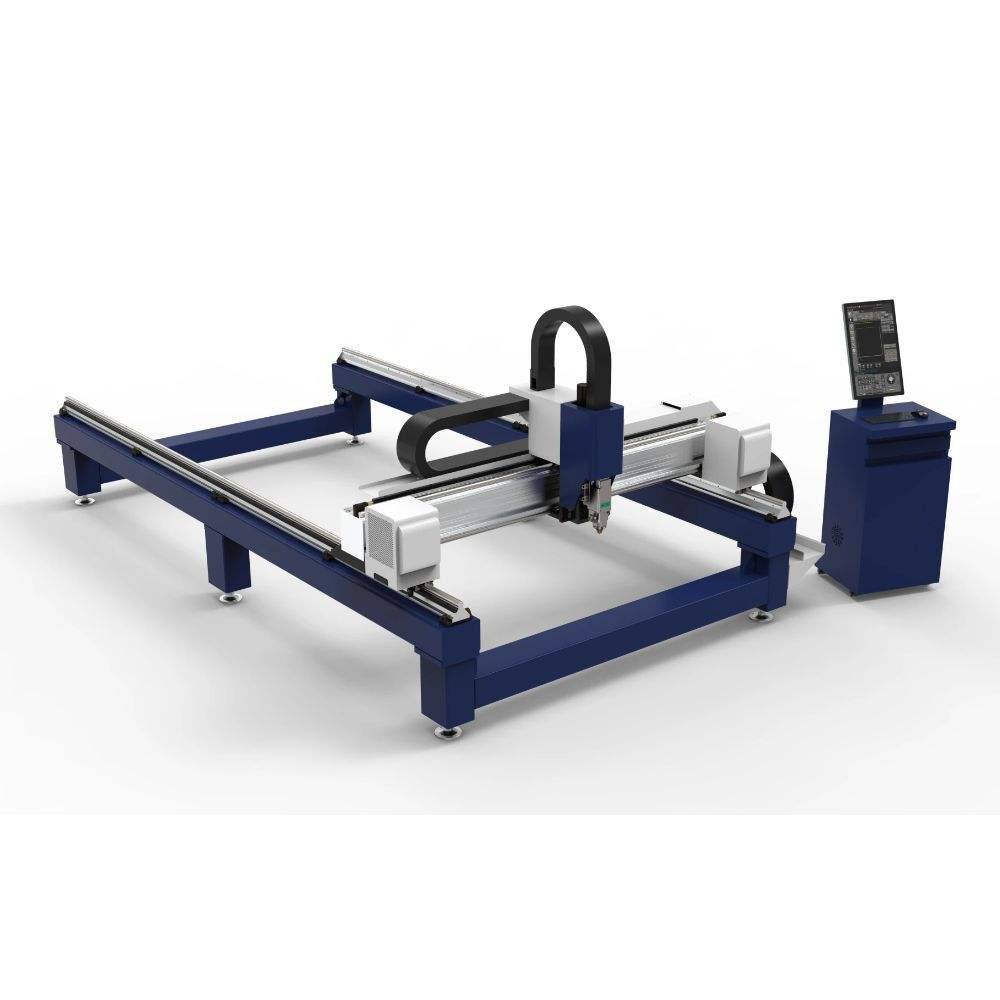
The Dawn of High-Power Fiber Lasers in Rosario’s Industrial Hub
Rosario has long been the heartbeat of Argentina’s metalworking and agricultural machinery industries. However, the global shift toward modular construction—where buildings are manufactured in factories and assembled on-site—has demanded a new level of precision and speed that traditional methods cannot sustain. The introduction of the 20kW Universal Profile Steel Laser System represents a paradigm shift.
In the past, 4kW or 6kW systems were the standard, sufficient for thin sheets but struggling with the thick structural steel required for multi-story modular frames. A 20kW fiber laser source changes the physics of the cut. At this power level, the laser creates a high-pressure plasma zone that evaporates steel almost instantly, allowing for “fly-cutting” speeds on medium thicknesses and clean, dross-free cuts on plates up to 50mm thick. For a modular construction firm in Rosario, this means the ability to process an entire floor’s worth of structural connectors and beams in a single shift.
Understanding the “Universal Profile” Capability
The term “Universal Profile” is critical in the context of modular construction. Unlike standard flatbed lasers, a universal profile system is designed with a multi-axis head and a rotary or specialized chuck system capable of handling structural shapes: I-beams, H-beams, square tubing, and C-channels.
Modular buildings rely on these shapes for their primary skeletons. Traditional fabrication involves several discrete steps: measuring, sawing to length, manual layout, and mechanical drilling for bolt holes. Each step introduces a margin of error. The 20kW Universal Profile system integrates all these processes into one. It can cut the profile to length, notch the joints for “clamshell” fitment, and interpolate bolt holes with perfect circularity—all in one continuous program. This “one-and-done” approach ensures that when the modules are sent to a site in the Santa Fe province or exported to neighboring regions, they fit together with the precision of a Swiss watch.
The 20kW Advantage: Speed, Piercing, and Edge Quality
The jump to 20kW is not just about cutting thicker material; it is about the “pierce.” In thick steel fabrication, the time taken to pierce the metal often accounts for a significant portion of the total cycle time. A 20kW source utilizes high-frequency pulsing and massive power density to “blast” through 20mm structural steel in a fraction of a second, compared to several seconds for lower-wattage machines.
Furthermore, the edge quality at 20kW, when using nitrogen as a semi-inert assist gas, results in a bright, weld-ready finish. In modular construction, welding is a primary joining method. If a laser cut leaves behind heavy oxidation or dross (as is common with oxygen cutting on lower-power machines), the fabricator must spend hours grinding the edges before a weld can be certified. The 20kW system eliminates this secondary process, allowing parts to move directly from the laser bed to the welding robot or assembly station.
The Critical Role of Automatic Unloading in Throughput
A 20kW laser is so fast that it often creates a “productivity paradox”: the machine cuts parts faster than a human operator can manually remove them from the bed. Without automation, the laser sits idle while workers scramble to clear the table. This is why the Automatic Unloading system is the “unsung hero” of the Rosario installation.
The unloading system utilizes a combination of vacuum lifters and magnetic grippers synchronized with the machine’s CNC. As the laser finishes a profile or a nest of plates, the unloading arm intelligently identifies the parts, picks them up, and stacks them onto designated pallets. Simultaneously, the system can sort scrap into a separate bin. This allows for “lights-out” manufacturing. In a city like Rosario, where energy costs and labor shifts must be optimized, the ability to run the machine unattended through the night provides a massive competitive advantage, ensuring that the assembly line for modular units never starves for components.
Modular Construction: Precision as a Prerequisite
Modular construction is essentially an exercise in logistics and tolerances. When you are stacking six stories of pre-built rooms, a 3mm error at the base can lead to a 20cm misalignment at the roof. The 20kW laser system provides a level of repeatability that is impossible with manual fabrication.
The software driving these systems—often integrated with BIM (Building Information Modeling)—allows architects to send CAD files directly to the laser. The system then compensates for the “kerf” (the width of the laser cut) and material thermal expansion. In Rosario, this means that a structural column for a modular hospital or school is cut with a tolerance of +/- 0.1mm. This precision facilitates the use of “interlocking” designs, where parts snap together like LEGO bricks, reducing the need for complex jigs and fixtures during the assembly phase.
Economic and Industrial Impact on the Rosario Region
Rosario’s strategic position on the Paraná River makes it a natural hub for shipping and industrial export. By adopting 20kW laser technology, local manufacturers can move up the value chain. Instead of exporting raw steel or basic components, they can export high-value, precision-engineered modular kits.
The integration of such a system also fosters a new ecosystem of high-tech jobs. Operating a 20kW laser with automatic unloading requires skills in CNC programming, nesting optimization, and optoelectronics maintenance. This drives a partnership between the industrial sector and local technical universities, elevating the overall technological literacy of the workforce. Furthermore, the efficiency of fiber lasers—which are significantly more energy-efficient than older CO2 technology—aligns with the growing global demand for “Green Construction” and reduced carbon footprints in the building industry.
Technical Considerations: Maintenance and Gas Management
As an expert in the field, it is important to note that a 20kW system requires a robust infrastructure. The “business end” of the machine—the cutting head—contains sensitive optics that must be kept in a pristine environment. At 20kW, even a microscopic speck of dust on a protective window can absorb enough energy to shatter the lens.
In Rosario’s humid climate, high-quality air filtration and chillers are essential. The system must be equipped with a dual-circuit cooling system to manage the heat generated by the fiber laser source and the cutting head. Additionally, gas management is paramount. To truly harness the 20kW potential, a high-flow nitrogen system (often involving bulk liquid nitrogen tanks) is required to ensure that the molten metal is evacuated from the cut zone fast enough to maintain the “high-speed” promise of the technology.
Conclusion: The Future of Prefabricated Infrastructure
The installation of a 20kW Universal Profile Steel Laser System with Automatic Unloading in Rosario is more than an equipment upgrade; it is a statement of intent. It signals that the Argentinian construction industry is ready to embrace the speed and efficiency of the Fourth Industrial Revolution.
By solving the challenges of structural steel processing through raw power and intelligent automation, this system enables modular construction to become a viable, mass-market solution for housing, infrastructure, and industrial facilities. As the modules roll out of the Rosario factories and onto trucks for deployment across the continent, the 20kW fiber laser stands as the silent engine of this transformation—cutting through the limitations of the past to build the structures of the future.