The Industrial Evolution of Sao Paulo’s Construction Sector
Sao Paulo stands as the industrial heartbeat of Latin America, a megalopolis where the demand for commercial and residential infrastructure often outpaces traditional construction timelines. In recent years, the shift toward modular construction—where building components are fabricated off-site in a controlled environment—has become the preferred solution for meeting these demands. However, the success of modularity depends entirely on the precision of the primary structural elements: the I-beams and H-sections that form the skeleton of the building.
Traditional methods of processing structural steel—mechanical sawing, manual oxygen-fuel cutting, or low-definition plasma—are no longer sufficient. These methods introduce high heat-affected zones (HAZ), require extensive secondary grinding, and lack the tolerances necessary for “plug-and-play” modular assembly. Enter the 20kW Heavy-Duty I-Beam Laser Profiler. This machine is not merely a tool; it is a full-scale fabrication center that redefines the speed and accuracy of structural engineering in the heart of Brazil.
The Power of 20kW: Redefining Throughput and Thickness
As a fiber laser expert, one must understand that the jump from 12kW to 20kW is not just about cutting faster; it is about the “quality-to-thickness” ratio. In the context of heavy-duty I-beams, which often feature web and flange thicknesses exceeding 20mm, a 20kW fiber source provides the “brute force” necessary to maintain a stable keyhole during the cutting process.
At 20kW, the laser achieves a high energy density that vaporizes structural steel almost instantly. This results in a remarkably narrow kerf and a negligible heat-affected zone. For modular construction, this is critical. When beams are cut with minimal thermal distortion, they maintain their structural integrity and geometric profile, ensuring that when two modules are bolted or welded together on a job site in downtown Sao Paulo, they align to within a fraction of a millimeter.
Furthermore, the 20kW power reserve allows for the use of compressed air or nitrogen as a secondary gas for thinner sections of the beam, significantly reducing the cost per part compared to oxygen-assisted cutting. In a market like Brazil, where industrial gas costs can fluctuate, this operational flexibility offers a massive competitive advantage.
Zero-Waste Nesting: The Economic Imperative
In the structural steel world, material is the highest overhead. Traditional I-beam processing often results in significant “drop” or scrap pieces, especially when dealing with various lengths and bolt-hole patterns. The “Zero-Waste Nesting” software integrated into these 20kW profilers utilizes complex algorithms to arrange parts along the length of the beam with surgical efficiency.
Zero-waste nesting goes beyond simple arrangement. It utilizes “common line cutting,” where two parts share a single cut path, effectively eliminating the scrap skeleton between them. In the case of I-beams, the software can nest brackets, connection plates, and stiffeners into the “web” areas of the beam that would otherwise be discarded. For a construction firm in Sao Paulo, increasing material utilization from 80% to 98% can represent millions of Reais in annual savings, directly impacting the feasibility of large-scale modular projects.
5-Axis 3D Cutting: Complexity Simplified
A heavy-duty I-beam is a three-dimensional challenge. To process it effectively, the laser head must be able to move in a 5-axis space, rotating around the flanges and the web to create miter cuts, copes, and complex bolt holes. The 20kW profilers deployed in Sao Paulo feature specialized 3D cutting heads capable of +/- 45-degree beveling.
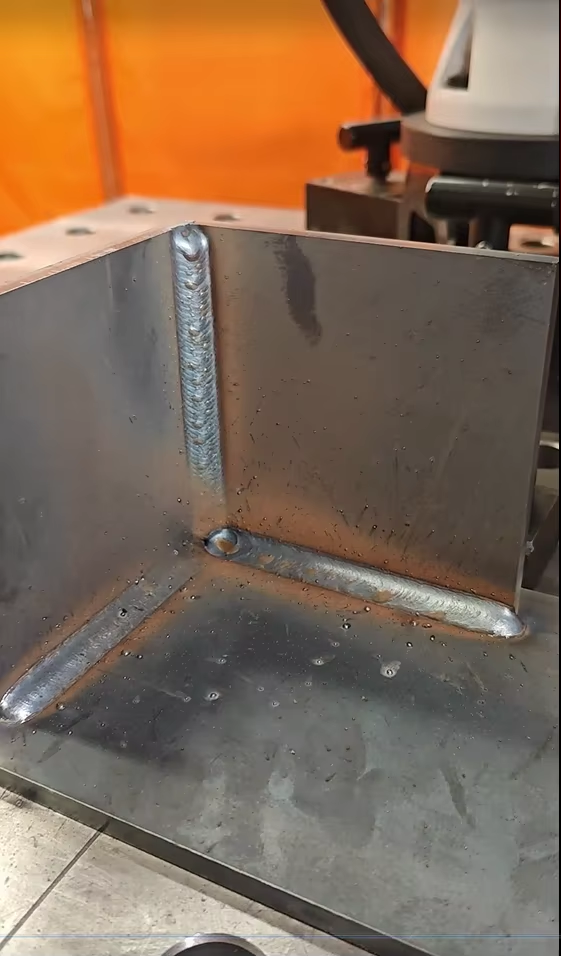
This beveling capability is a game-changer for modular construction. Instead of cutting a beam and then sending it to a secondary station for manual weld preparation, the 20kW laser cuts the beam and applies the necessary V, Y, or K-shaped bevel in a single pass. This ensures that the beam is ready for immediate robotic welding, further streamlining the modular fabrication pipeline. The precision of these cuts means that the “fit-up” for welding is perfect, reducing the amount of filler wire needed and ensuring the highest possible weld strength.
Precision Engineering for Modular “Plug-and-Play”
Modular construction relies on the concept of high-tolerance interoperability. Each module must be an exact replica of its digital twin to ensure that mechanical, electrical, and plumbing (MEP) systems align across units. The 20kW I-Beam Profiler acts as the guarantor of this precision.
With a positioning accuracy of ±0.05mm over several meters of beam, the laser ensures that every bolt hole for connection plates is exactly where it needs to be. This eliminates the need for “on-site reaming” or forced fits, which are common headaches in traditional construction. In the dense urban environment of Sao Paulo, where staging areas are small and crane time is expensive, the ability to assemble modules rapidly without structural discrepancies is the difference between a profitable project and a logistical nightmare.
Overcoming Regional Challenges: The Sao Paulo Context
Operating a 20kW fiber laser in Sao Paulo comes with its own set of technical requirements. The local power grid requires robust stabilization to handle the peak loads of a high-power laser. Modern 20kW systems are now designed with integrated power conditioning and high-efficiency chillers that are optimized for the humid, subtropical climate of the region.
Furthermore, the industrial clusters in areas like ABC Paulista or Guarulhos provide a robust ecosystem for technical support. As an expert, I emphasize the importance of local service. A 20kW profiler is a high-output machine; any downtime in a modular construction factory can halt the entire assembly line. Therefore, the integration of IoT-based remote diagnostics allows manufacturers in Sao Paulo to receive real-time updates and predictive maintenance alerts, ensuring the laser continues to fire at peak efficiency 24/7.
Sustainability and the Future of Urban Development
Finally, the environmental impact of this technology cannot be ignored. Sao Paulo is increasingly focused on “Green Building” certifications. The 20kW fiber laser is inherently more sustainable than the technologies it replaces. Fiber lasers boast a wall-plug efficiency of approximately 35-40%, compared to the 10% efficiency of older CO2 models.
By combining this energy efficiency with Zero-Waste Nesting, the carbon footprint of each structural beam is significantly reduced. Less wasted steel means less energy spent in recycling and transportation. For modular developers aiming for LEED certification or other sustainability benchmarks, the 20kW laser profiler is an essential component of their “Green” supply chain.
Conclusion
The 20kW Heavy-Duty I-Beam Laser Profiler represents the pinnacle of modern structural fabrication. For the modular construction industry in Sao Paulo, it offers a trifecta of benefits: extreme power for heavy material processing, sophisticated software for maximum yield, and the 3D precision required for modern architectural designs. As we look toward the future of urban development in Brazil, the marriage of high-power fiber lasers and modular engineering will undoubtedly be the foundation upon which the next generation of the Sao Paulo skyline is built. This is not just about cutting steel; it is about building the future with surgical precision and zero compromise.