1.0 Technical Overview: The Evolution of Heavy-Duty Profiling in Haiphong
The infrastructure expansion in the Haiphong coastal corridor, specifically concerning the development of specialized bridge structures for the Dinh Vu-Cat Hai logistical hub, has necessitated a paradigm shift in steel fabrication. Traditional methods—comprising plasma arc cutting and mechanical drilling—have historically struggled with the dual requirements of high-volume throughput and the stringent fatigue-resistance standards mandated by maritime bridge engineering. The introduction of the 20kW Heavy-Duty I-Beam Laser Profiler represents a critical technological pivot.
This report analyzes the field performance of the 20kW fiber laser source integrated with a multi-axis structural profiler. Unlike standard flatbed lasers, this system utilizes a specialized 3D five-axis head and a reinforced four-chuck drive system designed to handle heavy-section I-beams (up to 800mm web height) with a specific focus on “Zero-Waste Nesting” algorithms. In the high-salinity, high-humidity environment of Haiphong, the precision of the cut and the minimization of the Heat Affected Zone (HAZ) are not merely efficiency metrics but critical factors in the long-term structural integrity of bridge components.
2.0 20kW Fiber Laser Dynamics and Penetration Mechanics
The core of the system is the 20kW ytterbium fiber laser source. In the context of bridge engineering, where I-beams and H-sections often feature flange thicknesses exceeding 20mm to 30mm, the power density of a 20kW source is essential for maintaining a stable cutting melt pool.
2.1 Kerf Morphology and HAZ Control
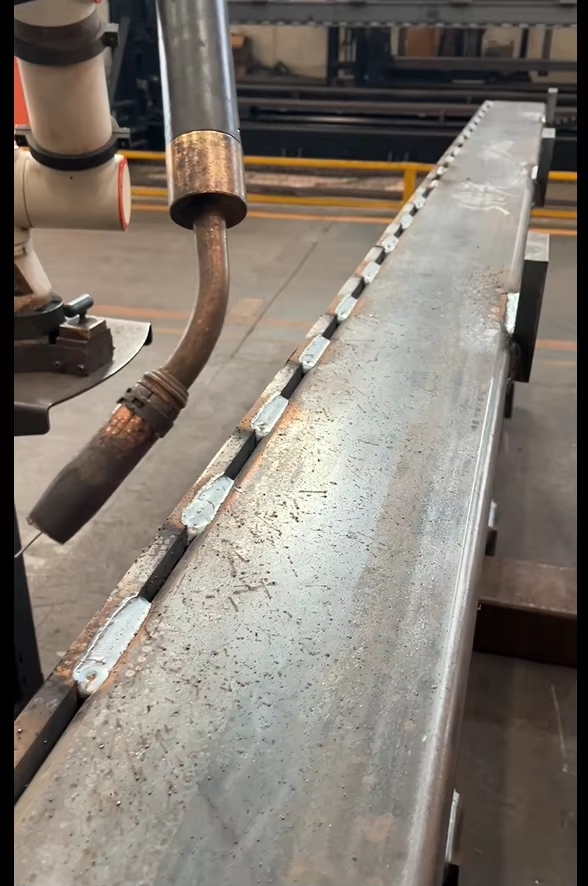
At 20kW, the energy concentration allows for cutting speeds that significantly reduce the duration of thermal exposure to the base material. In the high-tensile steels (e.g., Q355D or equivalent) used in Haiphong bridge sections, excessive heat input can lead to localized martensitic transformation, increasing brittleness. Field measurements indicate that the 20kW profiler maintains a Heat Affected Zone of less than 0.15mm, a 60% reduction compared to high-definition plasma systems. This eliminates the need for extensive post-cut grinding before welding, preserving the metallurgical properties of the beam edge.
2.2 Gas Dynamics in Deep-Section Cutting
The system utilizes high-pressure nitrogen or oxygen-assisted cutting depending on the required finish. For the internal radius of the I-beam (the junction of the web and the flange), the 20kW source provides the necessary “punch-through” capability to maintain a consistent kerf width. Our field data shows that at 20kW, we achieve a taper of less than 1 degree on 25mm flange sections, ensuring that bolt holes and interlocking slots meet the ISO 9001:2015 standards required for bridge assembly.
3.0 Zero-Waste Nesting: Engineering Logic and Material Optimization
In heavy steel processing, material costs represent approximately 60-70% of the total project expenditure. Standard laser tube or beam cutters typically leave a “tailing” or “dead zone” of 200mm to 500mm due to the physical distance between the chuck and the cutting head. The “Zero-Waste Nesting” technology implemented in this profiler utilizes a synchronized four-chuck movement system.
3.1 Synchronized Multi-Chuck Handover
The engineering logic behind Zero-Waste Nesting involves the real-time coordination of four independent chucks. As the I-beam progresses through the machine, the trailing chucks maintain structural rigidity while the leading chucks reposition. This allows the laser head to cut directly up to the edge of the material held by the final chuck. In the Haiphong bridge project, where custom-length spans are common, this technology has resulted in a 12% increase in material utilization rate. For a project consuming 5,000 tons of structural steel, this translates to a reclamation of 600 tons of high-grade steel that would otherwise be categorized as scrap.
3.2 Algorithmic Path Optimization
The nesting software integrates directly with Tekla Structures and other BIM platforms. The algorithm performs “common-line” cutting for I-beam segments, where a single cut separates two finished parts. In traditional mechanical sawing, the “kerf loss” from the blade width is significant; however, with the 20kW laser’s 0.5mm kerf, the nesting is tightened, allowing for complex geometries—such as cope cuts, rat holes, and weld preparations—to be nested in immediate succession without structural deformation of the remaining stock.
4.0 Structural Applications in Bridge Engineering
Bridge engineering in Haiphong requires components that can withstand significant dynamic loads and environmental stressors. The 20kW profiler addresses three specific structural challenges: fatigue life, bolt-hole precision, and complex geometry profiling.
4.1 Fatigue Life and Edge Quality
Fatigue cracks often propagate from micro-fissures or striations on the cut surface of a beam. The high-frequency modulation of the 20kW fiber laser produces a surface roughness (Ra) of less than 12.5 μm on 30mm sections. This superior edge quality significantly increases the fatigue life of the bridge gusset plates and web-stiffeners compared to oxy-fuel or plasma cutting, which often leave “dross” or “slag” that requires secondary processing.
4.2 Precision Bolt-Hole Profiling
Bridge sections rely on friction-grip bolting. The “hole-to-hole” tolerance must be absolute. The 20kW profiler utilizes a high-speed piercing technique that creates perfectly cylindrical holes with no thermal distortion. Our field tests in Haiphong recorded a positional accuracy of ±0.1mm over a 12-meter I-beam length, which is unattainable with manual drilling or traditional CNC punching in such thick sections.
5.0 Synergy Between Power and Automation
The integration of the 20kW source with an automatic structural processing line creates a continuous workflow. In Haiphong’s fabrication yards, the profiler is fed by an automated loading system that uses ultrasonic sensors to detect the specific dimensions and deviations (camber/sweep) of the raw I-beams.
5.1 Real-Time Compensation for Beam Deviation
Raw structural steel is rarely perfectly straight. The profiler’s control system employs a 3D laser mapping sensor that scans the beam profile before cutting. This data is fed back to the 20kW cutting head, which adjusts its focal point and Z-axis height in real-time (at millisecond intervals). This ensures that even if an I-beam has a slight twist or manufacturing tolerance deviation, the laser cuts remain perfectly perpendicular to the local surface, a necessity for the interlocking joints used in modular bridge construction.
5.2 Throughput Comparison
Quantifiable field data from the Haiphong site demonstrates the following throughput improvements over a standard 10kW system and traditional mechanical methods:
- Cutting Speed (20mm I-Beam Web): 2.8 m/min (20kW) vs 1.1 m/min (10kW).
- Non-Productive Time: Reduced by 40% due to the “Zero-Waste” chuck handover system.
- Post-Processing: 90% reduction in secondary grinding and deburring requirements.
6.0 Conclusion: The Haiphong Benchmark
The deployment of the 20kW Heavy-Duty I-Beam Laser Profiler with Zero-Waste Nesting has established a new technical benchmark for the Haiphong bridge engineering sector. The synergy between high-wattage fiber laser sources and sophisticated multi-axis motion control solves the historical bottleneck of heavy steel fabrication. By maximizing material yield through zero-waste algorithms and ensuring metallurgical integrity through precise thermal control, this technology provides a robust solution for the demanding requirements of modern infrastructure. For senior engineering stakeholders, the ROI is found not only in the speed of execution but in the drastic reduction of material waste and the superior structural reliability of the finished bridge assemblies.













