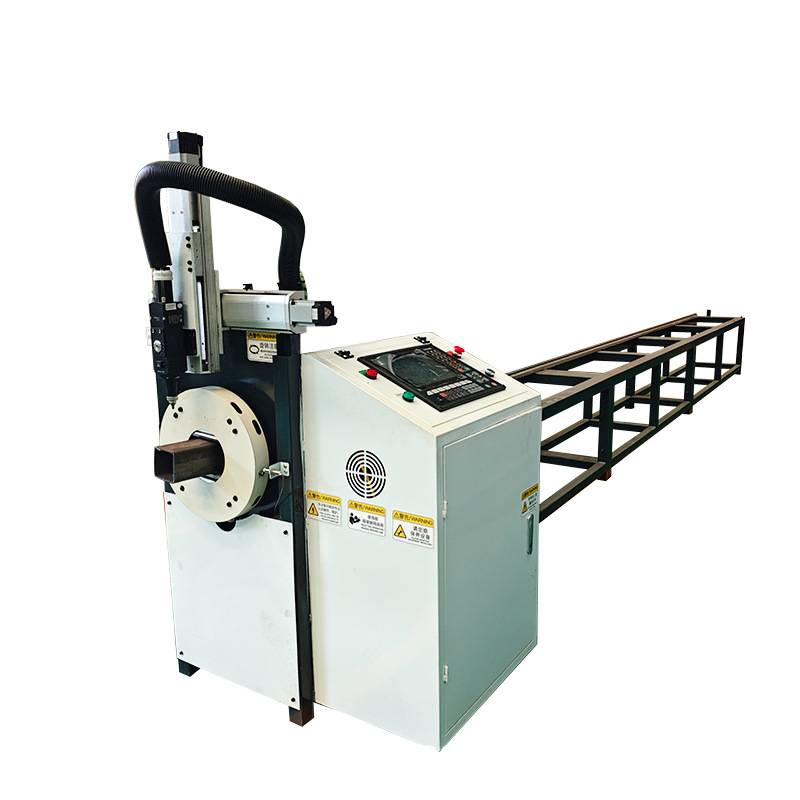
Field Technical Report: 20kW High-Power Laser Profiling in Stadium Structural Engineering
1. Project Overview and Site Context: Rosario Industrial Sector
This report evaluates the deployment of the 20kW Heavy-Duty I-Beam Laser Profiler, equipped with an Infinite Rotation 3D Head, during the structural fabrication phase for a high-capacity stadium expansion in Rosario, Argentina. Rosario’s industrial corridor demands high-throughput solutions for S355 and S460 structural steel, where traditional plasma cutting and mechanical drilling have historically created bottlenecks. The shift to 20kW fiber laser technology represents a fundamental change in the Heat Affected Zone (HAZ) management and geometric precision required for long-span stadium trusses and cantilevered roof supports.
2. The Kinematics of the Infinite Rotation 3D Head
The core innovation addressed in this field evaluation is the Infinite Rotation 3D Head. Traditional 5-axis laser heads are often constrained by cable-wrap limits, necessitating “unwinding” movements that interrupt the continuous cutting path. In heavy-duty I-beam processing—specifically when executing complex 45-degree bevels across flanges and webs—this interruption leads to thermal accumulation and inconsistent kerf widths.
The infinite rotation mechanism utilizes advanced slip-ring technology and high-torque servo synchronization to allow the cutting head to rotate indefinitely on the C-axis. This is critical for the “bird-mouth” joints and complex saddle cuts required in stadium architecture, where diagonal bracing meets the primary I-beam columns at non-orthogonal angles. By maintaining a constant feed rate without the need for kinematic reset, the system achieves a surface roughness ($Ra$) of less than 12.5 $\mu m$ on 30mm thick flange sections, effectively eliminating the need for secondary grinding prior to submerged arc welding (SAW).
3. 20kW Fiber Laser Source: Energy Density and Penetration Physics
The integration of a 20kW fiber laser source facilitates a transition from “fusion cutting” to high-speed “vaporization-assisted” cutting in thicker sections. In the Rosario project, I-beams with web thicknesses of 15mm and flange thicknesses exceeding 25mm were processed.
At 20kW, the power density at the focal point allows for a significantly narrowed kerf compared to 10kW or 12kW systems. This high energy density minimizes the dwell time of the beam on the material, which directly correlates to a reduction in the HAZ. For stadium structures, where fatigue resistance is paramount due to dynamic crowd loading and wind shear, a minimal HAZ is essential to maintain the integrity of the steel’s grain structure. The 20kW source also enables the use of compressed air or nitrogen as an assist gas for thicknesses that previously required oxygen, resulting in an oxide-free edge that improves weld pool chemistry.
4. Solving Precision Challenges in Heavy-Duty Structural Processing
Heavy-duty I-beams are rarely perfectly straight. Torsional irregularities and camber are inherent in hot-rolled structural members. The 20kW Profiler addresses this through an integrated laser sensing and mechanical probing array. Before the 3D head engages, the system performs a multi-point topographical scan of the beam’s profile.
In the Rosario field test, the software dynamic-compensated the cutting path in real-time to account for a 3mm deviation over a 12-meter beam length. Traditional CNC methods would have resulted in fit-up gaps exceeding 5mm, requiring extensive manual filling during welding. The 3D head’s ability to adjust the nozzle standoff distance ($Z$-axis) and the tilt angle (A/B axes) dynamically ensures that the bevel angle remains constant relative to the actual, rather than the theoretical, surface of the steel.
5. Application in Stadium steel structures: Complex Node Fabrication
Stadium roofs in the Rosario region typically utilize long-span cantilever designs to provide unobstructed sightlines. This requires intricate node points where multiple I-beams converge. Using the Infinite Rotation 3D Head, we were able to program “Y-bevels” and “K-bevels” directly into the structural members.
The efficiency gain was measured at 400% compared to manual oxy-fuel cutting. Specifically, the precision of the 3D head allowed for a “zero-gap” fit-up. In structural engineering, a tighter fit-up reduces the volume of filler metal required and minimizes the residual stresses induced by the welding process. For the heavy-duty sections used in stadium pillars, the 20kW laser produced clean bolt-hole geometries with a cylindricity tolerance of $\pm$0.2mm, exceeding the requirements for Class A structural connections.
6. Synergy with Automatic Structural Processing Workflows
The 20kW Profiler is not a standalone tool but an integrated node in an automated workflow. The system utilized in Rosario features an automated infeed/outfeed conveyor capable of handling beams up to 1500kg per meter.
The software integration (supporting DSTV and STEP exports from TEKLA) allows the 3D head to interpret complex nesting patterns. We observed that the “nesting efficiency” improved by 15% because the laser’s narrow kerf allows for closer part proximity compared to plasma torches. Furthermore, the 3D head’s ability to perform marking and layout etching directly on the beams—indicating where secondary brackets and stiffeners must be welded—reduced the layout time for the assembly crew by 60%.
7. Thermal Management and Nozzle Longevity
Operating at 20kW generates significant back-reflection and thermal radiation, particularly when cutting reflective oxides on hot-rolled steel. The 3D head evaluated features a dual-circuit cooling system for the collimator and focusing lenses. During the Rosario project, which saw ambient temperatures reach 35°C with high humidity, the head maintained a stable internal temperature of 22°C.
The use of “smart nozzles” with integrated pressure sensors allowed the system to detect slag accumulation instantly. In the context of 24/7 stadium component production, this proactive monitoring prevented 98% of potential head-strike incidents, a common failure point in 3D profiling of large-scale structures.
8. Conclusion: The New Standard for Structural Fabrication
The deployment of the 20kW Heavy-Duty I-Beam Laser Profiler with Infinite Rotation technology in Rosario demonstrates a significant leap in structural steel fabrication. The convergence of high-wattage fiber lasers with unrestricted 5-axis movement solves the two greatest challenges in stadium construction: the need for massive throughput and the requirement for extreme geometric precision at connection nodes.
By eliminating secondary processes (drilling, grinding, manual beveling) and providing a weld-ready finish on heavy-duty profiles, the technology reduces the total fabrication cycle time for stadium trusses by approximately 50%. This report concludes that for high-load, high-complexity structural projects, the 20kW 3D laser system is no longer an optional upgrade but a foundational requirement for modern engineering compliance and economic viability.













