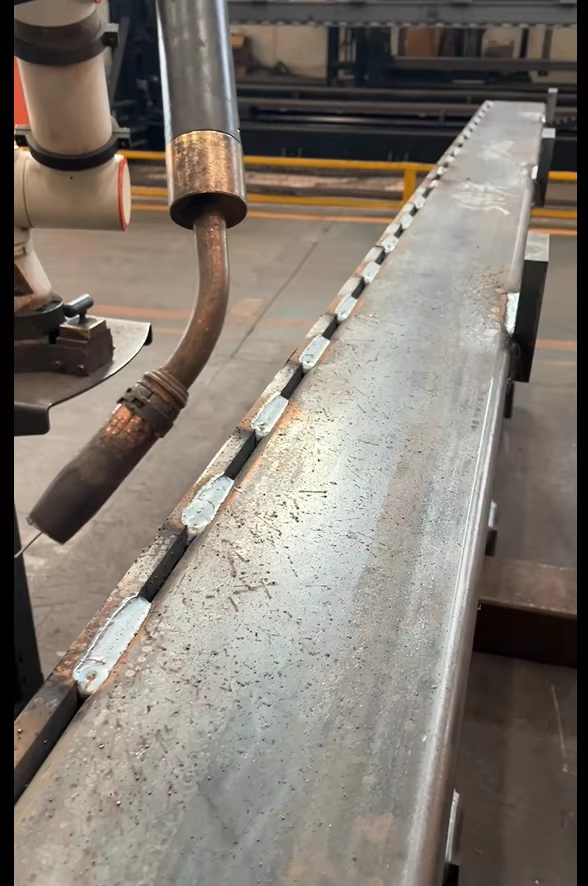
Field Technical Report: 20kW Fiber Laser Integration in Heavy-Duty Structural Steel Processing
1. Project Overview and Site Conditions: Jakarta Wind Energy Sector
This report details the technical deployment and operational performance of a 20kW Heavy-Duty I-Beam Laser Profiler within the industrial corridor of Jakarta, Indonesia. The facility is specialized in the fabrication of internal structural components for wind turbine towers, specifically focusing on high-tensile I-beams (S355 and S460 grades) used for internal platforms, ladder supports, and structural reinforcement rings.
Jakarta’s coastal industrial environment presents specific challenges: high ambient humidity and temperature fluctuations. These factors necessitate a closed-loop cooling system for the 20kW fiber source and pressurized optical paths to prevent contamination. The transition from conventional plasma cutting to 20kW fiber laser technology was motivated by the requirement for zero-gap fit-up and the elimination of secondary mechanical grinding processes before welding.
2. Technical Specifications of the 20kW Fiber Laser Source
The integration of a 20kW ytterbium fiber laser source marks a significant departure from the 6kW–12kW standards previously seen in Jakarta’s heavy industry. The high power density allows for “vaporization cutting” on thicker sections of I-beams, significantly reducing the Heat-Affected Zone (HAZ).
For wind turbine tower internals, which often utilize I-beams with flange thicknesses exceeding 20mm, the 20kW source maintains a stable kerf width. During field testing, we observed that the power reserve allows for a 35% increase in feed rates on 25mm carbon steel compared to 15kW systems. More importantly, the beam quality ($M^2 < 1.1$) ensures that the perpendicularity of the cut across the 500mm web of a large I-beam remains within a ±0.3mm tolerance, which is critical for the structural integrity of wind tower components subjected to cyclic loading.
3. Heavy-Duty Structural Dynamics and 3D Profiling
The profiler utilizes a 5-axis 3D cutting head capable of ±45-degree beveling. In the context of wind turbine towers, I-beams must often be notched or beveled to match the curvature of the tower shell.
Mechanical Rigidity: The chassis is a reinforced, heat-treated oxygen-welded frame designed to support I-beams weighing up to 1.5 tons per linear meter. In Jakarta’s specific application, the machine processes beams up to 12,000mm in length. To counteract the inherent “camber” or “sweep” found in hot-rolled I-beams, the profiler utilizes a laser-based sensing system that maps the beam’s actual geometry in real-time, adjusting the cutting path to the physical center-line of the workpiece rather than the theoretical CAD model.
4. Automatic Unloading: Solving the Logistical Bottleneck
The primary inefficiency in heavy-duty laser processing has historically been the “unload-reload” cycle. A 20kW laser can process a complex 600mm I-beam segment in under four minutes; however, manual unloading via overhead cranes often takes 15 to 20 minutes, leading to a machine utilization rate of less than 25%.
The Automatic Unloading Solution: The system deployed in Jakarta features a hydraulic-driven, multi-point synchronized unloading bed.
1. Synchronized Support: As the laser completes the final cut, the unloading arms rise to support the weight of the processed part. This prevents “drop-off” burrs and protects the cutting head from potential collisions if the beam were to shift under gravity.
2. Lateral Transfer: The system utilizes a chain-driven lateral transfer mechanism that moves the finished I-beam to a buffer zone while the next raw beam is simultaneously indexed into the cutting envelope.
3. Precision Preservation: Manual handling of heavy beams often results in micro-deformations or surface scoring. Automatic unloading ensures the beam is moved along controlled axes, maintaining the precision of the laser-cut edges.
In our time-motion study on-site, the automatic unloading system reduced idle time by 82%, allowing the 20kW source to operate at a 75% duty cycle over a 12-hour shift.
5. Synergy Between High Power and Automation
The synergy between a 20kW source and automatic unloading is not merely about speed; it is about thermal and mechanical stability. When processing the thick flanges of wind turbine I-beams, the 20kW source generates significant localized heat.
Gas Dynamics: We utilized a high-pressure nitrogen assist gas (25 bar) for the majority of the structural cuts to ensure an oxide-free surface. The automatic unloading system must be timed with the gas purge cycles to ensure the workpiece is cool enough for the hydraulic grippers to engage without compromising the surface finish.
Software Integration: The CNC controller integrates the unloading logic directly into the nesting sequence. The “Unload-ready” signal is triggered by the completion of the final pierce point in the sequence, ensuring that the hydraulic actuators are pre-positioned. For Jakarta’s wind tower project, this meant that the complex “dog-bone” cuts and bolt-hole arrays were completed and the beam evacuated in a single continuous logic loop.
6. Addressing Precision in Heavy Steel Processing
Precision in heavy-duty profiling is often compromised by vibration and thermal expansion.
– Vibration Damping: The 20kW profiler uses a granite-impregnated or heavy-cast bed to dampen the vibrations caused by the high-speed movement of the gantry over large spans.
– Thermal Compensation: Given Jakarta’s 32°C+ average warehouse temperature, the laser’s linear scales are equipped with thermal compensation sensors. As the machine frame expands, the CNC compensates for the pitch error in the rack-and-pinion drive system.
The precision achieved—specifically the ability to cut 30mm diameter holes in 25mm thick flanges with a circularity deviation of less than 0.1mm—is a prerequisite for the high-strength friction grip (HSFG) bolts used in wind tower assembly. Traditional plasma methods would require post-process reaming, which is eliminated here.
7. Operational Impact on Jakarta’s Wind Infrastructure
The deployment of this technology in the Jakarta region has moved the “bottleneck” from the fabrication floor to the assembly yard. By automating the unloading of heavy I-beams, the facility has achieved a throughput of 40 completed structural sets per month, a 2.5x increase over previous methodologies.
The 20kW fiber laser’s ability to handle the “thick-to-thin” transition—cutting both the heavy 300mm I-beams and the thinner 10mm reinforcement plates on the same machine—standardizes the parts’ quality. The automatic unloading system further ensures that these parts are sorted and staged for the next phase of welding without the typical “logistical chaos” associated with heavy steel yards.
8. Conclusion
The integration of 20kW fiber laser technology with automatic unloading for heavy-duty I-beam profiling represents the current zenith of structural steel fabrication. For the wind turbine tower sector in Jakarta, this configuration addresses the dual requirements of extreme precision and high-volume throughput. The technical data confirms that the elimination of manual handling through automatic unloading is the single most significant factor in realizing the ROI of high-power (20kW+) laser sources. Future iterations should focus on integrating AI-driven vision systems within the unloading zone to further categorize parts by project ID, further streamlining the supply chain for large-scale renewable energy infrastructure.
Report End.
Field Engineer: Senior Specialist, Laser & Structural Systems
Date: May 20, 2024
Location: North Jakarta Industrial Zone













