Field Technical Report: 20kW Fiber Laser Integration in Structural Steel Fabrication for U-Tapao Aviation Hub
1. Project Scope and Geographical Context
The following report details the technical deployment and operational performance of a 20kW Heavy-Duty I-Beam Laser Profiler at a primary fabrication site in Rayong, Thailand. This deployment is specifically tailored to meet the rigorous structural demands of the U-Tapao International Airport expansion. Within the Eastern Economic Corridor (EEC), the requirement for rapid, high-tolerance structural steel—specifically large-format I-beams and H-sections—necessitated a transition from traditional plasma or mechanical drilling/sawing to high-power fiber laser technology.
The structural framework of modern airport terminals requires massive spans with high load-bearing capacities. In Rayong’s humid, coastal environment, the integrity of the Heat Affected Zone (HAZ) and the precision of weld preparations are critical to preventing long-term structural fatigue and corrosion. The 20kW system was selected to address these specific metallurgical and mechanical requirements.
2. Technical Specifications of the 20kW Fiber Source
The heart of the profiler is a 20kW ytterbium fiber laser source. Unlike lower-wattage systems (6kW or 10kW), the 20kW threshold allows for “high-speed melt-shearing” of carbon steel flanges exceeding 25mm in thickness.
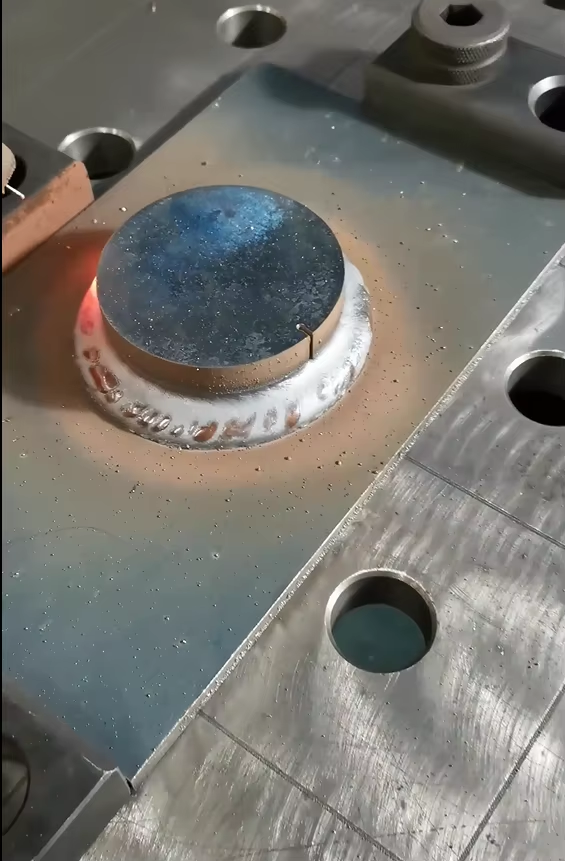
From a technical standpoint, the energy density provided by the 20kW source results in a significantly narrowed kerf width. This density allows the beam to maintain a stable keyhole during the cutting process of thick-walled I-beams. The primary advantage observed in the Rayong facility is the drastic reduction in taper. In structural engineering, a perpendicularity tolerance of less than 0.1mm on a 300mm beam depth is essential for seamless bolt-hole alignment and flange-to-web welding. The 20kW source achieves this without the secondary grinding processes typically required after plasma cutting.
3. 5-Axis 3D Cutting Head Kinematics
Processing I-beams is inherently a three-dimensional challenge. The profiler utilizes a 5-axis robotic cutting head capable of +/- 45-degree beveling. For the airport’s heavy trusses, “K-cuts,” “Copes,” and “Ratholes” must be executed with precision to allow for interlocking steel geometries.
The integration of the 5-axis head with the 20kW source allows for complex beveling on the flanges of I-beams. This facilitates “Ready-to-Weld” edges. In traditional workflows, beveling a 20mm flange requires manual oxy-fuel torching, which introduces excessive heat and deforms the beam. The laser’s high-speed oscillation (wobble technology) ensures that the bevel is uniform across the entire longitudinal axis of the beam, maintaining the structural calculation integrity required by aviation building codes.
4. The Critical Role of Automatic Unloading Technology
In heavy-duty steel processing, the “bottleneck” is rarely the cutting speed, but rather the material handling. A standard 12-meter I-beam used in the Rayong project can weigh several tons. Manual unloading using overhead cranes is high-risk and time-inefficient, often leading to 30-40 minutes of idle time between cycles.
3.1. Synchronized Hydraulic Discharge
The Automatic Unloading system deployed in this profiler utilizes a series of synchronized hydraulic lift-and-transfer arms. As the 20kW head completes the final cut, the CNC communicates with the unloading module to support the finished workpiece. This prevents the “drop-off” deformation that occurs when heavy sections are severed.
3.2. Precision Sorting and Buffer Management
The unloading system features a lateral displacement conveyor that organizes finished beams into specific zones based on their nesting ID. For the airport project, where thousands of unique structural members are required, this automated sorting ensures that the “Just-in-Time” (JIT) delivery to the Rayong construction site is maintained. The system eliminates the risk of human error in marking and sorting, which is vital when handling structurally critical components like primary roof supports.
5. Efficiency Gains in Heavy-Duty Profiling
Data gathered over a 90-day operational period in Rayong indicates a 400% increase in throughput compared to the previous plasma-sawing combination. The synergy between the 20kW source and the automated handling reduces the total “Floor-to-Floor” time per beam significantly.
- Mechanical Preparation: Previously 120 minutes (Sawing, Drilling, Manual Beveling).
- 20kW Laser Profiling: 18 minutes (Cutting, Hole Piercing, Beveling, Unloading).
Beyond speed, the “Total Cost of Ownership” (TCO) is reduced through the elimination of consumables like drill bits and specialized saw blades. The fiber laser’s ability to “pierce” thick flanges in under 0.5 seconds—versus several seconds for mechanical drilling—represents a massive reduction in energy consumption per ton of processed steel.
6. Addressing the “Rayong Factor”: Environmental and Power Stability
Operating high-power lasers in a tropical industrial zone like Rayong presents unique challenges. The 20kW system is equipped with a dual-circuit industrial chiller with a +/- 1°C stability rating. Given the high ambient humidity, the laser’s optical path is pressurized with dry nitrogen to prevent condensation on the protective windows.
Furthermore, the heavy-duty chassis of the profiler is designed with vibration damping to withstand the rhythmic oscillations of the nearby heavy machinery common in EEC industrial parks. The machine bed is a reinforced, heat-treated pentagonal structure capable of supporting a static load of 1.5 tons per meter, ensuring that the heavy I-beams do not cause “frame sag” which would negate the laser’s precision.
7. Software Integration: BIM to Laser
The Rayong project utilizes Building Information Modeling (BIM). The profiler’s control system directly imports .IFC and .TEKLA files. The software automatically calculates the optimal nesting patterns on 12-meter raw beams to minimize “remnant” waste. Because the 20kW laser can cut extremely close to the edges of the beam without compromising structural stability, material utilization has improved by 12%.
The Automatic Unloading system is also “data-aware.” It prints or etches a QR code directly onto each I-beam section during the cutting process. This code contains the beam’s position in the airport’s structural grid, the material batch number, and the inspector’s digital sign-off, facilitating a fully traceable supply chain.
8. Safety and Structural Integrity Standards
In aviation construction, the structural integrity of every joint is non-negotiable. The 20kW laser’s minimal HAZ is its greatest asset. High-heat processes (like plasma) can alter the martensitic structure of the steel, leading to brittleness. The high-speed 20kW cut “zips” through the material so fast that the bulk of the beam remains at ambient temperature. This preserves the original tensile strength of the I-beam, a crucial factor for the seismic and wind-load requirements of the U-Tapao terminal.
From an occupational safety perspective, the Automatic Unloading technology removes personnel from the “Zone of Danger” where heavy beams are moved. The entire cutting and unloading area is enclosed in a Class 4 laser safety housing with automated light curtains, complying with both Thai labor laws and international safety standards.
9. Conclusion
The deployment of the 20kW Heavy-Duty I-Beam Laser Profiler in Rayong represents a paradigm shift for Thai structural engineering. By integrating high-wattage fiber laser sources with sophisticated automatic unloading mechanics, the project has achieved a level of precision and throughput previously unattainable. For the U-Tapao airport expansion, this technology ensures that the backbone of the terminal—the heavy steel I-beams—is produced with zero defects, optimal material usage, and maximum operational safety. The transition from manual fabrication to this automated laser-centric workflow is now the established benchmark for large-scale infrastructure projects in the region.
Field Report Prepared by:
Senior Engineering Lead, Laser Systems Division
Project Site: Rayong Aviation Industrial Zone













