1.0 Technical Overview: The Shift to 20kW Fiber Laser Profiling in Maritime Construction
In the industrial landscape of Haiphong’s shipbuilding sector, the transition from conventional plasma and oxy-fuel cutting to high-power fiber laser technology represents a critical advancement in structural engineering. This report examines the deployment and operational integration of the 20kW Heavy-Duty I-Beam Laser Profiler, specifically focusing on its capacity for ±45° bevel cutting within high-tensile steel frameworks.
The requirement for structural integrity in maritime vessels demands precise fit-up and superior weld penetration. Traditional methods often suffer from excessive Heat Affected Zones (HAZ) and mechanical tolerances that necessitate extensive secondary grinding. The 20kW fiber laser source, coupled with a specialized 5-axis 3D cutting head, provides a concentrated energy density capable of processing heavy-section I-beams, H-beams, and channels with a degree of accuracy previously unattainable in heavy-duty shipyard environments.
1.1 Site Context: Haiphong Shipbuilding Hub
Haiphong serves as the nexus of Vietnam’s maritime manufacturing. The environmental conditions—high humidity and salinity—combined with the rigorous production schedules of large-scale cargo and naval vessels, require machinery that exhibits both extreme durability and thermal stability. The deployment of a 20kW profiler in this region addresses the bottleneck of manual beveling for primary structural members, shifting the production focus from labor-intensive preparation to automated, high-speed execution.
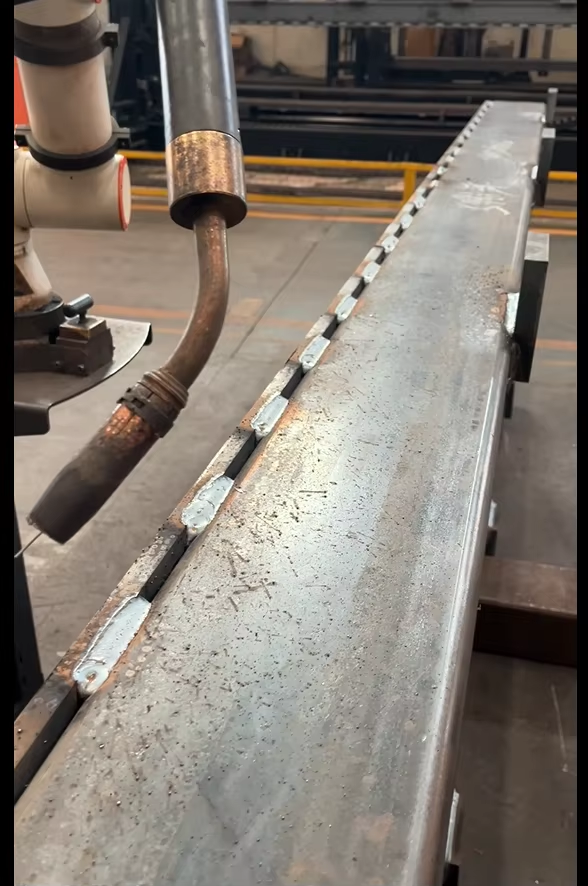
2.0 Kinematics and Structural Design of the Profiler
The heavy-duty I-beam profiler is engineered to handle structural steel sections that can exceed 12 meters in length and weigh several tons. The machine architecture utilizes a reinforced gantry system and a multi-point chuck rotation mechanism to ensure the workpiece remains centered during the 3D cutting process.
2.1 5-Axis ±45° Bevel Head Mechanics
The core of the system is the specialized 5-axis cutting head. Unlike standard 2D laser heads, the beveling unit incorporates high-torque servo motors capable of rapid interpolation across the A and B axes. This allows the laser beam to maintain a constant focal point while tilting up to ±45° relative to the material surface.
In shipyard applications, the ability to create V, X, Y, and K-shaped bevels directly on the flanges and webs of I-beams is paramount. The 20kW power source ensures that even at steep angles—where the effective thickness of the material increases—the laser maintains sufficient kerf velocity to prevent dross accumulation and ensure a clean, weld-ready surface.
2.2 Heavy-Duty Material Handling and Chuck Synchronization
Handling large-scale I-beams requires a sophisticated clamping system. The profiler utilizes a four-chuck synchronized drive system. This configuration prevents the twisting or sagging of long structural members, which is essential for maintaining the geometric tolerances of the bevels over the entire length of the beam. The synchronization software compensates for the inherent deviations in hot-rolled structural steel, such as camber and sweep, through real-time sensor feedback.
3.0 The Role of 20kW Power Density in Thick-Section Processing
The leap to 20kW of fiber laser power is not merely about speed; it is about the physics of the melt pool and the stability of the cutting gas dynamics in thick sections. In the Haiphong shipyards, structural members often range from 12mm to 30mm in thickness.
3.1 Thermal Profile and HAZ Reduction
Higher power levels allow for faster feed rates. This paradoxically results in a smaller Heat Affected Zone because the duration of thermal exposure to the surrounding metal is minimized. For the high-tensile steels used in hull construction, such as DH36 or AH36, maintaining the metallurgical properties of the steel near the cut edge is vital. The 20kW source produces a narrow kerf with minimal thermal distortion, ensuring that the I-beams retain their calculated load-bearing characteristics without the risk of embrittlement.
3.2 Gas Dynamics and Cut Quality
The 20kW system employs advanced nozzle technology designed to optimize the flow of assist gases (typically Oxygen or Nitrogen). When performing a 45° bevel cut on a 20mm I-beam flange, the “effective” thickness exceeds 28mm. The high-pressure gas delivery system must be perfectly synchronized with the laser’s focal position to clear the molten slag efficiently. This prevents “re-welding” of the slag to the underside of the bevel, a common failure in lower-power systems.
4.0 Integration of Automatic Structural Processing
The efficiency gains of the 20kW profiler are realized through the synergy between the hardware and the software ecosystem. In modern shipbuilding, the “Digital Twin” of the vessel is used to generate the NC (Numerical Control) code for every structural component.
4.1 CAD/CAM Workflow and Nesting
The profiler integrates directly with industry-standard software like Tekla Structures and SolidWorks. The software automatically identifies the required bevel angles for specific joints and optimizes the nesting of parts on a single I-beam to minimize scrap. This automation eliminates the manual marking-out process, which is traditionally a significant source of error in shipyard workflows.
4.2 Real-time Compensation and Sensing
Shipyard-grade I-beams are rarely perfectly straight. The profiler utilizes a 3D laser scanning probe to map the actual profile of the loaded beam before cutting begins. The control system then adjusts the cutting path in real-time to compensate for any structural deviations. This ensures that the ±45° bevel remains consistent relative to the beam’s actual geometry, rather than its theoretical model.
5.0 Comparative Analysis: Laser vs. Plasma in Heavy Steel
For decades, plasma cutting was the standard for I-beam processing. However, the 20kW laser profiler offers several technical advantages that justify the capital expenditure for Haiphong’s leading maritime engineers.
- Precision: Laser tolerances are within ±0.1mm, whereas plasma typically fluctuates between ±1.0mm and ±2.0mm. This precision reduces the gap-filling requirements during automated robotic welding.
- Secondary Operations: The ±45° laser bevel produces a surface finish that meets ISO 9013 standards for weld preparation without the need for milling or grinding.
- Operating Cost: While the initial investment is higher, the cost-per-meter is lower for the 20kW laser due to higher throughput and the elimination of consumable electrodes required by plasma systems.
6.0 Field Implementation Challenges and Solutions
Implementing a 20kW system in a shipyard environment presents unique engineering challenges. The high-power beam requires a strictly controlled environment to prevent optics contamination.
6.1 Dust and Fume Management
Cutting heavy I-beams generates significant particulate matter. The profiler is equipped with a high-capacity, multi-zone dust extraction system that follows the cutting head. This is essential not only for environmental compliance but also to protect the laser’s external optics from the abrasive metallic dust prevalent in shipyards.
6.2 Beam Stability over Long Focal Lengths
As the cutting head moves across the large work envelope, the beam path length changes. The system uses a sophisticated collimation system to maintain a constant BPP (Beam Parameter Product). This ensures that the energy density at the focal point remains identical whether the head is at the near or far end of the gantry, which is crucial for maintaining bevel consistency on 12-meter sections.
7.0 Conclusion: The Future of Maritime Structural Fabrication
The deployment of the 20kW Heavy-Duty I-Beam Laser Profiler with ±45° beveling technology is a transformative step for the Haiphong shipbuilding industry. By automating the most complex aspect of structural preparation—the beveling of heavy-section beams—shipyards can significantly reduce their production cycles while increasing the structural reliability of their vessels.
As maritime regulations continue to demand higher safety standards and more efficient hull designs, the precision afforded by high-power fiber lasers will become the baseline for the industry. The integration of 5-axis 3D cutting into the automated structural workflow marks the end of the manual preparation era, positioning Haiphong as a technologically advanced hub in the global maritime market.













