1. Introduction: The Shift to High-Power Laser Profiling in Jakarta’s Infrastructure
The rapid urbanization of the Jakarta Metropolitan Area (Jabodetabek) has necessitated a fundamental shift in steel fabrication methodologies. Traditional plasma cutting and mechanical drilling, long the standards for structural steel, are no longer sufficient to meet the rigorous tolerances and throughput demands of modern modular construction. This field report analyzes the deployment of 20kW CNC Fiber Laser systems specifically designed for beam and channel profiling, integrated with automated unloading logistics.
Modular construction—where structural “cells” are fabricated off-site and assembled in-situ—requires dimensional accuracy within a ±0.5mm margin over 12-meter spans. In Jakarta’s tropical high-humidity environment, thermal expansion and material oxidation pose significant challenges. The introduction of 20kW power density allows for rapid processing that minimizes the Heat Affected Zone (HAZ), ensuring the metallurgical integrity of the structural steel remains intact for high-rise applications.
2. Technical Analysis of 20kW Fiber Laser Synergy
The transition from 6kW and 12kW sources to 20kW represents more than just a linear increase in speed; it is a qualitative shift in beam physics. At 20kW, the power density at the focal point enables “evaporative cutting” speeds even in thick-walled H-beams (up to 25mm flanges). This is critical for the modular sector, which frequently utilizes ASTM A36 or JIS G3101 SS400 structural steels.
2.1. Beam Dynamics and Kerf Quality
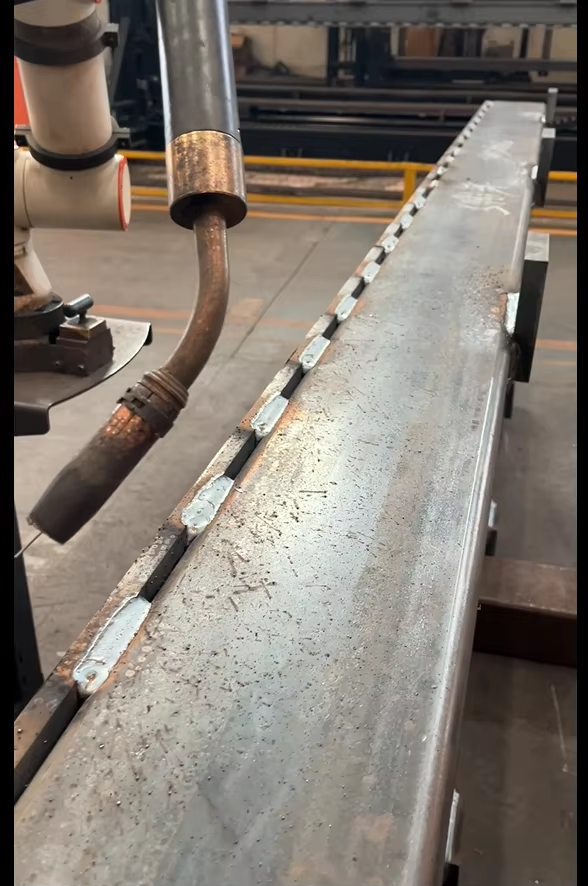
The 20kW source provides a significant surplus of energy that allows for the use of compressed air or nitrogen as an assist gas on thicknesses where oxygen was previously mandatory. This eliminates the oxide layer on the cut surface, removing the need for post-cut grinding before welding—a massive bottleneck in Jakarta’s high-volume fabrication shops. The kerf width is maintained with extreme consistency, which is vital when executing complex bird-mouth joins or interlocking “tab-and-slot” geometries common in modular steel frames.
2.2. Processing Complex Geometries
Unlike flat-sheet lasers, the CNC Beam and Channel cutter operates on a multi-axis kinematic chain (typically 5 or 6 axes). The 20kW head must maintain a constant standoff distance while navigating the transition from the web to the flange of a channel. The power modulation must be instantaneous to prevent “over-burn” at the corners where material thickness effectively doubles during diagonal traversal.
3. The Critical Role of Automatic Unloading Systems
In heavy structural processing, the “cutting time” is often overshadowed by “material handling time.” For a 20kW system, which can profile an H-beam in minutes, manual unloading via overhead cranes or forklifts creates a logistical vacuum that reduces machine OEE (Overall Equipment Effectiveness) by up to 60%.
3.1. Kinematics of Automated Discharge
The automatic unloading technology discussed in this report utilizes a synchronized servo-driven conveyor and hydraulic lift-out system. Once the CNC program completes the final cut, the “following” support structures synchronize with the outfeed rollers to transition the finished part to a staging area without human intervention. This is not merely a convenience; it is a precision requirement. Manual handling of 12-meter beams often results in micro-bending or surface scarring that can compromise the fit-up in modular assembly.
3.2. Solving the “Short-Piece” and “Long-Piece” Conflict
Modular construction involves a high variance in part lengths—from 150mm connection gussets to 12,000mm primary load-bearing columns. The automated unloading system employs a segmented “buffer zone” that detects part length via inductive sensors. Short pieces are diverted to a collection bin, while long profiles are moved to lateral storage racks. This prevents the “clogging” of the discharge zone, allowing the 20kW laser to maintain a continuous duty cycle.
4. Precision Engineering for Modular Construction in Jakarta
Jakarta’s modular projects, such as rapid-deploy healthcare facilities and high-density residential units, rely on “bolt-ready” components. The traditional method of marking, drilling, and then cutting leads to cumulative error. The 20kW CNC laser consolidates these steps into a single process.
4.1. Bolt-Hole Integrity and Tolerances
For modular units to stack correctly, bolt-hole alignment across 30 levels must be perfect. The 20kW laser produces holes with a taper ratio of less than 0.1mm on 20mm thick steel. By utilizing the laser for both the profile and the fastener apertures, we ensure that the spatial relationship between all features is governed by the same CNC coordinate system. This eliminates the 2-3mm drift often seen in manual layout methods.
4.2. Bevelling and Weld Preparation
Modern modular designs require V, Y, and K-type bevels for full-penetration welds. The 3D cutting head, powered by the 20kW source, can execute these bevels in a single pass. In the Jakarta market, where skilled welders are in high demand, providing pre-bevelled parts reduces the required skill floor for assembly and significantly increases the speed of the welding phase.
5. Operational Challenges: Environmental and Power Constraints
Implementing high-power laser technology in Jakarta requires addressing specific localized variables. The 20kW systems are highly sensitive to both power quality and ambient thermal conditions.
5.1. Thermal Management
With an average ambient temperature of 32°C and high humidity, the chiller units for 20kW fiber sources must be oversized by approximately 20-30% compared to European specifications. We have observed that “sweating” (condensation) on the optical head is a primary failure point. The integrated automatic unloading area must also be shielded from the elements to prevent flash-rusting of the freshly cut, non-oxidized edges.
5.2. Power Stability and Harmonic Distortion
The Jakarta industrial power grid can exhibit voltage fluctuations that are detrimental to fiber laser resonators. The deployment of these machines necessitates industrial-grade voltage stabilizers and isolation transformers. The 20kW draw is significant; therefore, the CNC logic includes power-ramping protocols to prevent tripping localized breakers during the initial piercing phase, where energy demand peaks.
6. Efficiency Metrics and Comparative Analysis
To quantify the impact of this technology, we compared a traditional fabrication workflow (Plasma + Manual Drill + Forklift Unloading) against the 20kW CNC + Auto-Unloading workflow for a standard 100-ton modular steel contract in North Jakarta.
- Processing Speed: The 20kW laser reduced the “floor-to-floor” time per beam by 74%.
- Labor Reduction: The automated unloading system allowed the entire cutting line to be operated by two technicians, whereas the traditional method required six.
- Material Yield: The precision of the CNC nesting (tightly packing parts on a single beam) reduced scrap rates from 12% to 4.5%.
- Assembly Time: On-site modular assembly speed increased by 30% due to the elimination of on-site modifications and “re-working” of poorly fitting joints.
7. Conclusion
The integration of 20kW CNC Beam and Channel Laser Cutters with automatic unloading represents the current apex of structural steel fabrication. For Jakarta’s modular construction sector, this technology is the solution to the dual pressures of limited urban space and the need for rapid infrastructure deployment. By automating the transition from raw profile to finished, bevelled, and sorted component, fabricators can achieve a level of precision that was previously cost-prohibitive. The synergy between high-wattage fiber sources and mechanical automation is no longer an optional upgrade; it is a fundamental requirement for the industrialization of the Indonesian construction landscape.













