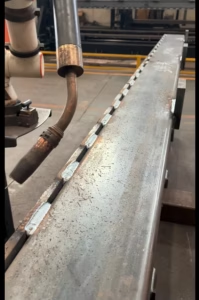
The Dawn of Ultra-High Power: The 20kW Fiber Laser Advantage
As a fiber laser expert, I have witnessed the evolution of power scaling from the early kilowatt-range oscillators to the current 20kW titans. In the context of structural steel for railway infrastructure, 20kW is not merely a number; it is a fundamental shift in material processing capability. At this power density, the laser ceases to be a simple cutting tool and becomes a high-speed thermal machining center. For railway applications, which often utilize S355 or higher-grade carbon steels with thicknesses exceeding 25mm, the 20kW source provides the necessary photon flux to maintain a stable melt pool even at high feed rates.
The primary advantage of the 20kW source lies in its ability to process thick sections with minimal Heat Affected Zones (HAZ). In railway engineering, where fatigue resistance is paramount, a narrow HAZ is critical. The high energy density allows for faster travel speeds, which paradoxically results in less total heat being absorbed by the surrounding material. This preserves the metallurgical integrity of the structural beams, ensuring that the finished components meet the stringent safety standards required for high-speed rail and heavy freight corridors.
Infinite Rotation: Redefining 3D Kinematics
The “Infinite Rotation 3D Head” is the technological centerpiece of this installation. Traditional 3D laser heads are often limited by internal cabling and gas lines, requiring a “rewind” or “unwind” cycle after a certain degree of rotation (typically +/- 360 or 720 degrees). In structural steel processing, where a laser must navigate the complex profiles of an H-beam or follow the perimeter of a large-diameter pipe, these resets are catastrophic to productivity and edge quality.
The infinite rotation capability is achieved through advanced slip-ring technology and integrated rotary joints for high-pressure assist gases (Oxygen or Nitrogen). This allows the head to rotate continuously around the C-axis without interruption. For railway infrastructure—specifically complex junctions and modular bridge components—this means the laser can perform multi-sided bevel cuts (V, Y, X, and K-shaped welds) in a single, fluid motion. The precision of the A/B axis tilt, combined with the infinite C-axis, enables the creation of complex weld preparations that were previously only possible through manual grinding or secondary CNC milling.
Queretaro: The Strategic Epicenter of Mexican Infrastructure
The choice of Queretaro for this 20kW installation is no coincidence. Queretaro has long been the “Silicon Valley” of Mexican manufacturing, boasting a sophisticated ecosystem of aerospace and automotive suppliers. By introducing a 3D Structural Steel Processing Center here, the region is diversifying into heavy civil infrastructure. This facility is strategically positioned to serve the burgeoning railway projects across North America, including Mexico’s domestic rail expansion and the cross-border logistics networks under the USMCA framework.
The industrial maturity of Queretaro provides the necessary technical support structure—skilled mechatronic engineers, reliable power grids, and advanced logistics—required to operate a 20kW system. Furthermore, the local talent pool is already accustomed to the tight tolerances of ISO and AS standards, making the transition to high-precision structural steel for railway applications seamless. This center acts as a magnet for Tier 1 and Tier 2 suppliers who require high-throughput, “done-in-one” processing of heavy structural sections.
Precision Engineering for Railway Infrastructure
Railway infrastructure demands a level of precision that traditional plasma or oxy-fuel cutting cannot match. From track vibration dampers to the skeletal structures of transit stations and bridge trusses, every component must fit with millimeter-level accuracy to ensure longevity and safety. The 20kW fiber laser, guided by the 3D head, achieves tolerances within ±0.1mm over large spans.
One of the most significant applications in this sector is the processing of “fishplates” and specialized interlocking mechanisms for tracks. With 20kW of power, the system can pierce thick steel in milliseconds, producing holes with a cylindricity and surface finish that eliminates the need for post-process reaming. Additionally, the ability to mark part numbers and layout lines directly onto the steel using the same laser head ensures that downstream assembly is error-proof—a vital feature for large-scale infrastructure projects where thousands of unique components must be synchronized.
The Integration of CAD/CAM and Real-Time Sensing
A machine of this caliber is only as good as the software that drives it. In the Queretaro facility, the 3D processing center is integrated with advanced CAD/CAM suites tailored for structural steel (such as Tekla or specialized 3D nesting software). These programs allow for the automatic conversion of 3D architectural models into laser toolpaths, accounting for the unique geometry of rolled or welded sections.
Furthermore, the 3D head is equipped with real-time capacitive sensing. This allows the laser nozzle to maintain a constant standoff distance from the material, even if the structural beam has slight deviations or “camber.” In heavy steel manufacturing, beams are rarely perfectly straight. The ability of the infinite rotation head to sense these deviations in real-time and adjust its trajectory—without losing its orientation—ensures that the bevel angle and cut quality remain consistent throughout the entire length of a 12-meter beam.
Environmental and Operational Efficiency
From an expert perspective, the transition to 20kW fiber laser technology also addresses the “Green Infrastructure” mandate. Compared to plasma cutting, fiber lasers are significantly more energy-efficient per cut-meter. They produce less waste material (narrower kerf) and eliminate the need for the hazardous chemicals often used in traditional cleaning and finishing of structural steel. In the context of Queretaro’s industrial sustainability goals, this machine represents a cleaner, quieter, and more efficient alternative to traditional heavy fabrication methods.
Operationally, the “Infinite Rotation” head reduces cycle times by 30-50% compared to standard 3D heads. By removing the need for mechanical resets and allowing for higher-speed cornering, the system maximizes the “beam-on” time. For a railway project requiring thousands of tons of processed steel, these marginal gains in cycle time aggregate into months of saved production time and significant cost reductions.
Conclusion: The Future of Heavy Fabrication
The installation of a 20kW 3D Structural Steel Processing Center with an Infinite Rotation 3D Head in Queretaro is more than a capital investment; it is a statement of intent. It signals that the future of railway infrastructure lies in the marriage of extreme power and infinite flexibility. As we look toward the next generation of high-speed rail and smart cities, the ability to process heavy structural steel with the precision of a surgeon and the speed of a titan will be the defining factor of industrial success.
In Queretaro, this technology is now a reality. It provides Mexican engineering with a competitive edge that resonates across the global stage, proving that when the right power level meets the right kinematic freedom, the possibilities for our built environment are truly infinite.